

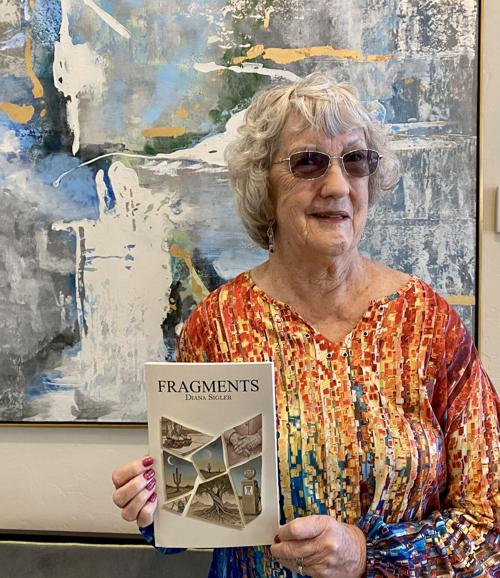
This is my second article featuring an interview with Diana Sigler, one of the most enduring and highly respected members of the SaddleBrooke Writers Group. A member for 28 years, Diana has been a steady source of encouragement and inspiration within the group. While her early work in short fiction earned recognition in literary magazines, her more recent turn to poetry has led to the publication of two collections: Snippets and, most recently, Fragments.
In Fragments, Diana continues a quiet, deliberate practice of noticing—of pausing long enough to catch what many of us overlook. The title of her second poetry collection is no accident. For her, fragments are not incomplete pieces but the very substance of living. “All of life is made of fragments,” she explains. Even when we believe we’ve grasped the “big picture,” it is still composed of dozens of small moments layered together.
The poems in Fragments emerge from moments that might initially seem insignificant: an image glimpsed in passing, a fleeting emotion, the sudden return of a scent tied to memory. These instances, Diana says, “catch my attention, seem important,” and then linger. They quietly percolate until language forms around them. The process is unhurried and intuitive, mirroring the way memory itself works—rarely linear, often associative, and deeply sensory.
One of the defining characteristics of Fragments is its use of simple, everyday language. This simplicity is a deliberate artistic choice, not a lack of craft. Diana believes that life itself is “a collection of simple words strung together into a larger meaning,” and that overly ornate language can sometimes obscure rather than illuminate truth. Her poems favor clarity over embellishment, trusting that emotional resonance does not require complexity. In doing so, they invite readers in rather than keeping them at a distance.
Knowing when a poem is finished, she admits, is less a technical decision than an instinctive one. After drafting, revising, adding, and subtracting, there comes an “aha” moment—a felt sense that the poem has finally captured what she was trying to convey. That moment signals completion. It is a process rooted in listening, both to the poem itself and to the feeling that sparked it.
Despite the emotional range of Fragments, Diana does not believe there are subjects too large or too painful to be written about—though she acknowledges, with quiet honesty, that everyone carries private experiences that remain unshared. What does make it onto the page begins as personal reflection, but when a poem succeeds, it opens outward. Her hope is that readers recognize themselves somewhere within the lines, even if the originating experience was her own.
Both Snippets and Fragments are built from small moments and brief reflections. The difference between the two, she suggests, is time. Writing Fragments, Diana is “a few years older,” shaped by more of life’s inevitable twists and turns. That added experience lends the newer collection greater emotional depth, even as the poems remain spare, accessible, and grounded in the everyday.
Ultimately, her hope for Fragments is both modest and profound: that readers enjoy the simplicity of the language yet leave with something larger than they expected—a pause, a shift in perspective, or a moment of reflection that lingers after the page is turned. In a world that often rushes toward conclusions, Fragments reminds us that meaning lives in the pieces we pass by every day.
One of the poems from Fragments, titled “Saving for Someday,” is included with this article.
SAVING FOR SOMEDAY
By Diana Sigler
I cradle the candle in my palm,
feeling its smooth, waxy exterior.
It is octagonal, four inches across
creamy white embedded with
large flakes of gold leaf.
Sixty years ago it was a wedding gift.
Since, it has been shuffled from home to home,
drawer to shelf to counter
always cherished, but never burned,
waiting for some special day, time, event.
When my babies arrived,
so did dozens of adorable clothes,
special clothes for special times.
Later I found them in a drawer, still boxed,
and much too small.
When my parents died
I discovered all the carefully chosen gifts
we had given them
still folded, wrapped, enclosed in jars,
towels never used
crystal glasses never drunk from
jam and honey never spread on bread
waiting for someday, sometime, a special time.
It is evening now.
an ordinary evening.
Again I admire the candle’s beauty.
The elderly couple who gifted us
died long ago
though the wife lived to be 105.
My husband has also died.
He never saw the candle lit.
How many days have passed since it came to us.
21,900
Were none of those days special?
Or was every day special?
Alive … seeing, hearing, feeling
the love all around me,
so much gone now.
I place the candle atop the cabinet
turn off all lights.
I strike a match and hold it to the wick.
The candle flames to life
casting golden light into the room.
I feel calm, peaceful.
Now is a special someday.
 Hotel on the rise at Tucson’s Uptown project

