
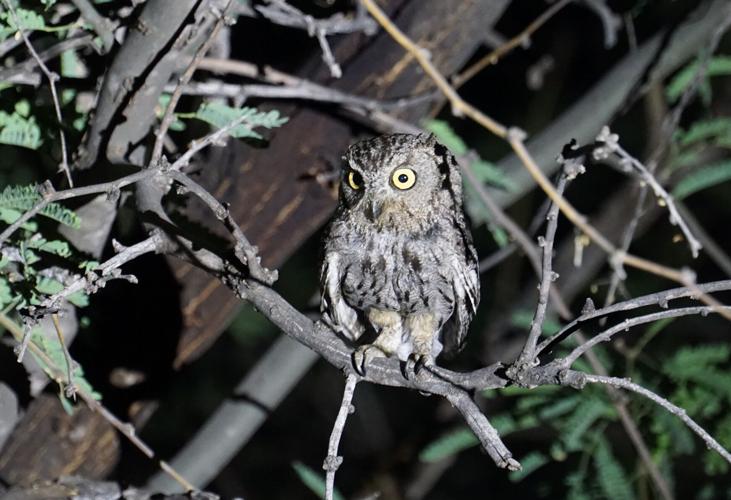

The most common owl in the United States is the Great Horned Owl, the only owl that is found year-round in every state except Hawaii. There are a total of 19 owls found somewhere in the United States, and 12 of these are documented in Arizona. Four of these are considered rare, the Ferruginous Pygmy-Owl, the Northern Saw-whet Owl, the Short-eared Owl, and the Long-eared Owl. Of these, the Long-eared Owl has been seen locally in numerous sightings in both Catalina and Oracle State Parks since October of 2021. First sighted in Catalina State Park in February 1985, 27-years would pass before the owl was again seen in the park in April 2012. Six- more years would pass before this bird was again seen there.
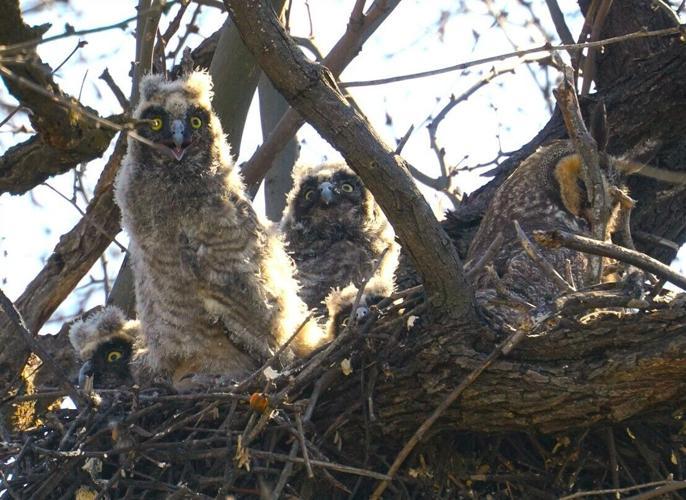
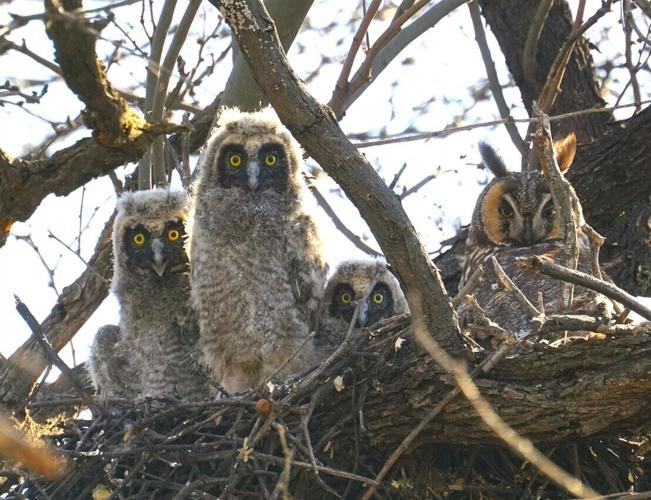
Unexpectedly, Long-eared Owls started to appear in numbers in October 2021 up to the present, with as many as five owls documented on a single sighting. Most exciting of all was the first sighting of nesting Long-eared Owls in March of this year, with four chicks successfully fledging. This might be taken as exciting news for the future, except for the fact that Long-eared Owls are nomadic and tend to move with food sources rather than establish long-term territories. In any event, it’s exciting to have documentation of nesting Long-eared Owls in Catalina State Park, especially since the Arizona Breeding Bird Atlas (published in 2005) shows no reports of nesting Long-eared Owls anywhere in Pima County.
Despite being uncommon to rare in Arizona, Long-eared Owls are widely distributed world-wide, with populations found from the United Kingdom, Spain, and Portugal east to Manchuria, Korea, and Japan and south to Morocco, Algeria, and Tunisia. In the Western Hemisphere the owl is found across Canada and the United States south into Mexico and Baja California. Other than evacuating their most northern habitat in winter, the owls are found year-round in their breeding areas which include dense forest areas up to 6,000-feet in elevation. Although bird movement due to migration is limited, nomadism is prevalent with the owls moving according to the availability of prey, which consists mostly of small mammals, rodents, and birds. The common male call is a long (more than ten) series of ‘Hoo’ calls, easily differentiated from the shorter call of the Great Horned Owl.
Adults spend very little time on the ground, but newly fledged young leave the nest before being able to fly, hopping along the ground and then climbing back into trees rather than flying to them, a process known as ‘branching’. The young leave the nest after three weeks but don’t fly for another two weeks, staying close by the nest. Long-eared Owls are often found during the non-breeding season communally roosting, sometimes in large numbers. Like all other owls, this species does not build its nests, but rather uses the nests of other large birds such as hawks and ravens. Owls are among the earliest nesters, giving them an advantage in taking over the nests of other, later breeders. Nests are often reused by the owls, giving us some hope for a repeat of this year’s nesting in Catalina State Park.
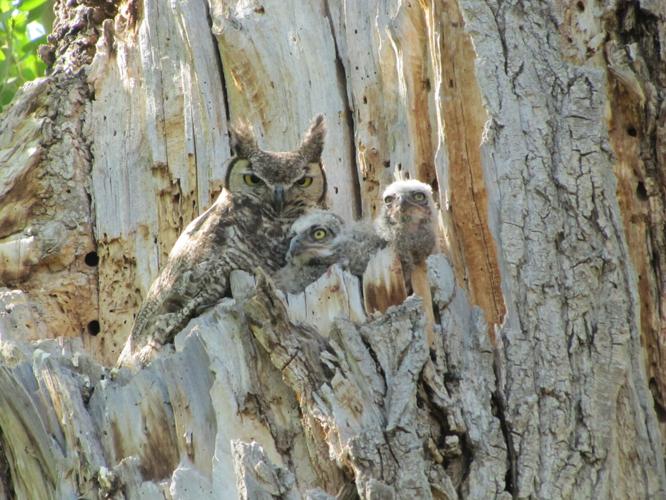
Apart from their different calls, you can easily differentiate between Long-eared and Great Horned Owls. The rarer Long-eared don’t have long ears, and for that matter the Great Horned don’t actually have horns. In both cases, what suggests ears or horns is nothing more than feather tufts on top of their heads, and those of the Long-eared Owls appear taller and closer together than those of the Great Horned Owl. In addition to being smaller than the Great Horned, Long-eared Owls appear more compact and thinner, with buffy yellow cheeks.
Owls have long been the subject of myth and folk tales, due mostly to their haunting nighttime calls and the fact that they have large scary eyes and hunt after dark on silent wings. In spite of this, it’s considered a good omen to see an owl flying near you, although this might not apply to the many prey they pursue. If you have questions or comments about SaddleBrooke’s birds, or to receive emailed information about bird walks led by Bob and Prudy, call 825-9895 or email bobandpru@gmail.com. Previously published articles can be found at www.birdingthebrookeandbeyond.com.
 Japanese company invests in mine near Mount Lemmon


