For decades, Arizona has quietly doubled as a cinematic backdrop. From classic Westerns to modern indie films, the deserts, ranchlands and dramatic red rock vistas have stood in for everything from frontier towns to alien planets.
Now, that tradition is being renewed in a different format: the sweeping, emotional world of a telenovela.
From the ranchlands around Tucson and Tubac to the red rock backdrops of Sedona and the urban contrast of Phoenix, the state is giving the new story a visual range that mirrors its emotional intensity.
Here is why this Mexican production company is filming in Arizona and what the telenovela will be about.
A story of love, rivalry and land
The Mexican production company Televisa has brought its latest project north of the border, choosing Southern Arizona as the primary setting for a new adaptation inspired by a classic 1970s melodrama. Filming was set to take place across Tubac, Tucson, Sedona, Phoenix and Bisbee, with each location lending its own texture to the story’s emotional and visual landscape.
People are also reading…
At its heart, the telenovela, “Tierra de Amor y Coraje” is a modern adaptation of a classic tale. It follows three brothers, the Corajes, who all fall in love with the same woman, Clara. Their lives are rooted in neighboring ranches, where land, loyalty and family pride collide. But tensions escalate when Clara’s father seeks to seize the Coraje family’s land, setting off a chain of emotional and moral conflicts.

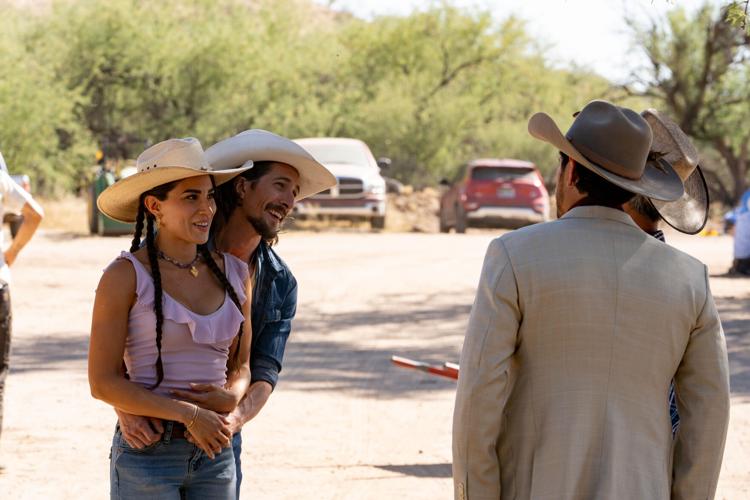
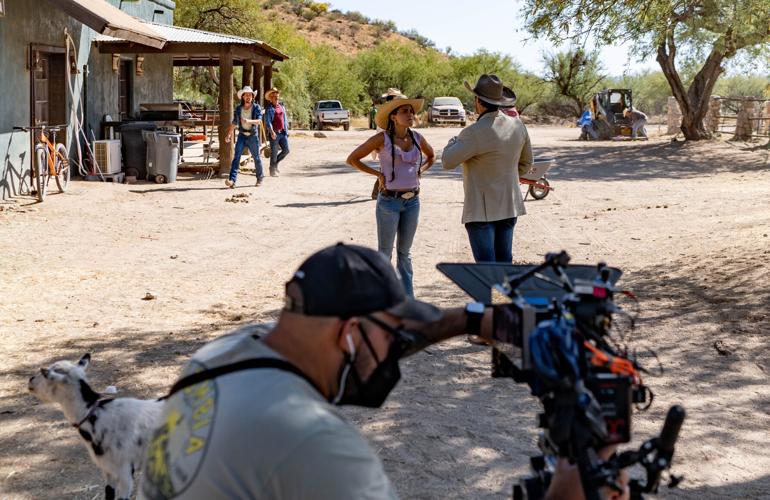
Televisa, a Mexican production company, films "Tierra de Amor y Coraje" in Tucson in April. The filming of the novela marks the first time a full-scale Televisa telenovela was filmed in Arizona.
“It worked perfectly for the story because the Coraje family raises horses, it’s a ranch with very beautiful scenery and vast land and it gave a lot of character to the story," said producer José Alberto Castro.
Claudia Zepeda, whom audiences have seen act in other telenovelas like "Corona de Lágrimas" and "Falsa Identidad," plays Lina, one of the love interests of the brothers. She said she felt blessed to work in a new place to experience a new culture.
“We are so blessed that we can work out of our own town and coming here to a new place and a new culture, I love it. I wanted to do it because ... actually filming in another place that is not Mexico city is really filling," she said.
Daniela Martínez Caballero, whom audiences have seen act in other telenovelas like "Sed de Venganza," "Golpe de Suerte" and "Mi Fortuna es Amarte," plays Rita, the ranch veterinarian who is in love with one of the brothers. She said filming in Mexico typically seems so rushed, but it's more relaxed in Arizona.
“One thing that happens in Mexico is that everything is really fast," said Caballero. "Here everything is slow. You can breath, you can think and I’m really loving this. I’ve never been on a ranch so living here and filming here has been a really wonderful experience."
A Mexican production finds inspiration in the desert
This production also marks a milestone, as it is the first time a full-scale Televisa telenovela has been filmed in Arizona.
Filming began in April and was scheduled to wrap on May 16, with roughly two months of on-location work. The logistics were no small feat. The team operated across multiple ranches and had to coordinate livestock, crew, and equipment while maintaining the rhythm of a fast-paced television shoot.
“It was very rewarding to find a local industry so willing to collaborate. People have been kind and easy to work with,” said Castro.

Claudia Zepeda and Brandon Peniche film a scene for "Tierra de Amor y Coraje" in Tucson. Filming was set to take place across Tubac, Tucson, Sedona, Phoenix and Bisbee.
Choosing Arizona wasn’t easy. The production team considered multiple locations but ultimately found what they needed in the state’s diversity and natural beauty.
“It was hard to decide. The state has incredible places but we found an impressive diversity," Castro said. "Finding places like these, with vast natural settings, the sunsets and skies are magical."
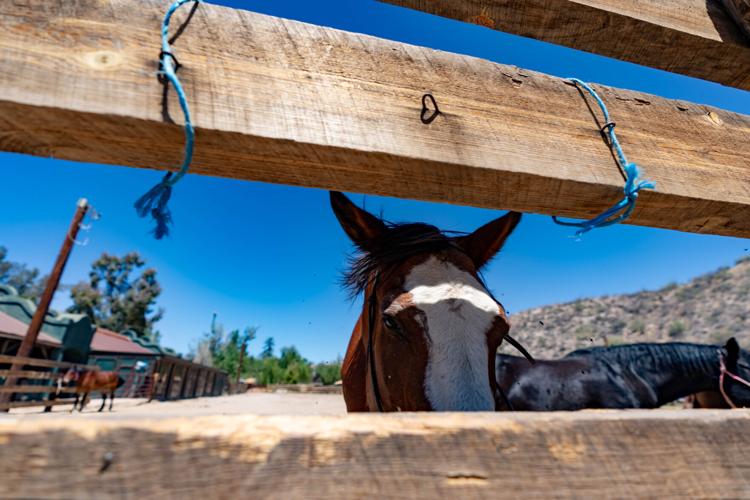
Filming centered on working ranches near Tucson and Tubac, where real livestock, hundreds of cattle and dozens of horses, added authenticity. Castro also emphasized the importance of representing Latino audiences in the U.S.
“It’s important to give them the opportunity to see places that reflect their reality,” said Castro.
Filming in Mexico versus filming in the USA
Beyond the story itself, the project highlights a broader shift in the industry. Instead of relying solely on major cities, productions are seeking out regions with distinct identities.
Arizona, with its “magical skies” as Castro said and its expansive deserts and culturally rich communities, is emerging as one of those places. Castro noted not just the scenery, but the people. “What has amazed me most is the people; it’s been very easy to work here, it’s a magical place.”
Arantza Ruiz, whom audiences have seen act in other telenovelas like "La Querida Del Centauro" and "Juana Inés," plays Jackie, one of the villains in the telenovela. Ruiz explains that in Arizona, you don’t get the chance to get distracted.

Televisa, a Mexican production company, films "Tierra de Amor y Coraje" in Tucson. Filming centered on working ranches near Tucson and Tubac, where real livestock, hundreds of cattle and dozens of horses, added authenticity.
“Here, you get involved so bad," Ruiz said. "You wake up and you have boars outside of your room, so you never get out of this story at all."
"In Mexico, you go to your house, talk to your parents, maybe your boyfriend if you have one. Here, it's just you’re living the story and I think reflect in the characters and the way we get involved with each other, like living together for a small time, you’re going to see it’s a little bit more intense,” said Ruiz.
In the end, Arizona wasn’t just a filming backdrop; it became part of the storytelling itself. For a genre traditionally filmed in studios or familiar settings in Mexico, bringing a telenovela to Arizona signals a shift that embraces new landscapes while staying deeply connected to the cultural roots of its audience.