KANSAS CITY, Mo. — Whether Arizona’s backloaded Big 12 schedule was a good thing for the Wildcats or not, coach Tommy Lloyd isn’t sure yet.
Check back in a week or two.
“Fortunately, we were able to get through it and get the result we wanted,” Lloyd said before the Big 12 Tournament started. “But let’s see how it prepares us for March. If we feel like we're sharp and battle tested going into it, then it's a good thing."

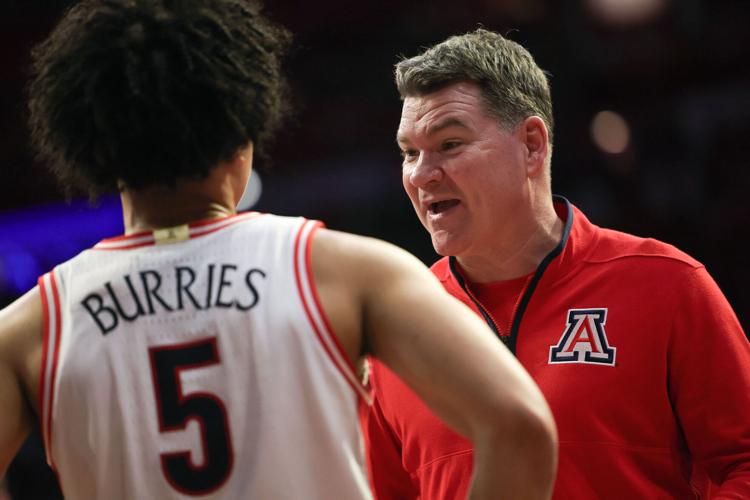
Arizona head coach Tommy Lloyd talks with Brayden Burries (5) during halftime against Oklahoma State at McKale Center, Feb. 7.
One thing’s for sure, though: It was good for the conference.
Big 12 commissioner Brett Yormark said viewership for the conference's men’s basketball games was up 20% from last season, and that the Big 12’s late-season windows in ESPN Big Monday lineups averaged 1.7 million viewers, which was double that of a year ago.
Part of the reason was that the Big 12 saved many of its marquee matchups toward the end of the season, since viewership typically rises after the Super Bowl. As part of that strategy, Arizona was asked to play six ranked teams over its final eight regular-season games.
People are also reading…
Arizona played at Kansas and hosted Iowa State in ESPN’s late-season Big Monday games — while also having to play Texas Tech, BYU, Houston and another game against Kansas — in between them.
“Any conference, whether it's football, basketball or Olympic sports, you strategically lay out your schedule because you want to maximize and optimize viewership,” Yormark said. “We weren't the only ones to do that. Everyone does that.
“We have a destinational product, and it's all about appointment viewing. When we have the kind of matchups, ranked versus ranked in big windows, people watch those games.”
Luck also probably helps. Brian Thornton, the Big 12’s VP for men’s basketball, said the league not only had some key matchups play out as expected, the league also wound up having other teams battling each other for NCAA Tournament consideration.
“It worked out really well for us this year, with some of the very competitive games that we saw late in the year ... a lot of matchups with teams competing to make it into the NCAA Tournament at the same time,” Thornton said. “There were story lines on both ends of it.”
It can be a tricky science. While the Big 12 race largely played out as it was expected to this season — with the exception of Arizona winning the league when it was picked fourth — the Big 12 doesn’t necessarily know which of its teams will make for the best matchups from year to year.
It knew that Arizona-Kansas would draw attention almost no matter what because of those programs' following, and correspondingly scheduled those teams to play twice this season, but must pick matchups and dates during the preceding summer before teams are fully assembled.
“Going into the year, you're not exactly sure who's gonna be ranked,” Thornton said. “There's some brands that certainly garner a certain amount of attention, and we work very hand in hand with our TV partners on some of the matchups they would like to see. They don't necessarily give us specific dates, but they give us matchups that they would like to see.”
The strategy to hold late marquee matchups adds complexity to a league schedule that already requires juggling 18 schools located nearly coast to coast, while preserving the conference’s few regional rivalries — and creating some two-game trips to minimize travel.
With 18 games, each team must play three opponents twice, and the other 12 just once. Thornton said regional rivals such as UA-ASU, BYU-Utah and Kansas-Kansas State are priorities for “double-plays,” along with teams in closer proximity such as Cincinnati and West Virginia.
Media partners can also weigh in. That much was obvious this season when Arizona wound up playing BYU and Kansas twice in addition to ASU.
“When we lay out the schedule … the order that that goes in is, in part, driven by TV and it's also driven by rest equity, by travel,” Thornton said. “And when you start the year, you don't necessarily know that one team is going to be great and another team is not going to be great.
“Arizona certainly did have a very challenging schedule late but when we started the season, that might not have necessarily been predicted to be the case.”
The end goal, Thornton said, is finding competitive equity as much as possible.
“TV might want Arizona to play twice against Houston, Kansas and BYU, for example, because of how that might play from a broadcast standpoint,” Thornton said. “But we obviously know that that's probably not equitable from a competitive standpoint, to just play those types of games that many times.

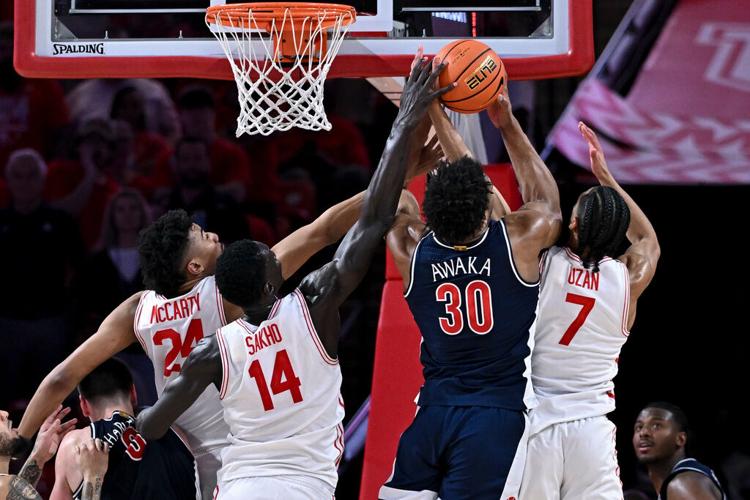
Houston guard Milos Uzan (7), forward Kalifa Sakho (14) and forward Chase McCarty (24) attempt to block a shot from Arizona forward Tobe Awaka (30) in the second half, Feb. 21, 2026, in Houston.
“So we're trying to balance it. It's a little bit of a guessing game to a certain point, but I think that we did a pretty good job this year.”
Contact sports reporter Bruce Pascoe at bpascoe@tucson.com. On X(Twitter): @brucepascoe

Bruce Pascoe
Reporter


 Seen and heard in KC: On Kharchenkov's glass experience, Chief celebs and waiting for San Diego