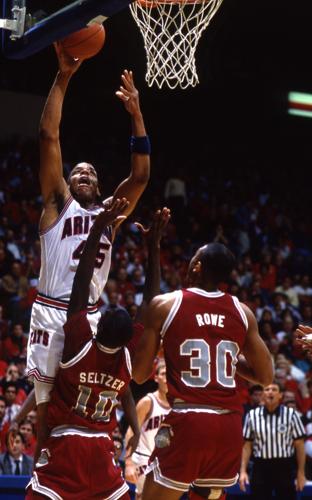
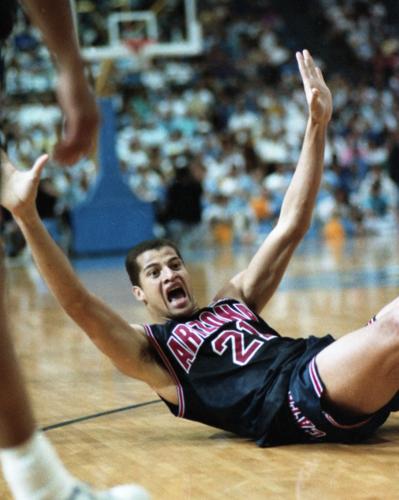
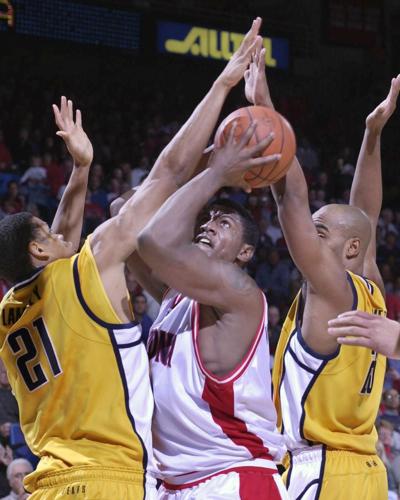
Besides the Final Fours, the 1997 title and that slew of NBA draft picks, one thing often talked about around Arizona’s basketball program is family.
That’s why Lute Olson’s heart is hurting so bad right now.
At a time when seven of his former players have reached the pinnacle of the sport, representing the Cavaliers or Warriors in the NBA finals, the former UA coach lost his second key player in the past seven months when Sean Rooks died suddenly of apparent heart issues on Tuesday.
Last November, Michael Wright was found dead outside of New York and, back in 2002, Bison Dele (known as Brian Williams during his UA career) died in French Polynesia. Both of those suspected murders remain unsolved.
That’s three key players, on top of the 1999 hate-crime murder of former UA assistant coach Ricky Byrdsong, all gone in the prime of their lives. Dele was just 33, Wright was 35 and Rooks was 46.
People are also reading…
Three players, three protégés, three family members. All gone.
“It’s been a tragic thing with all three of them,” Olson said. “There wasn’t a dad really involved with any of the three. They were raised by their moms so I was sort of a surrogate father to them when they came to school. Bobbi (Olson’s first wife), they called Mom O, and that was a big part of our developing the family atmosphere.”
They were all “sons” of Coach O and Mom O, and brothers to generations of Wildcats. Both Rooks’ ex-teammates — and several former Wildcats who arrived after him — expressed condolences via social media last week.
“Sean Rooks had the ability to connect with players he never played with at Arizona,” said Ryan Hansen, a longtime staffer under Olson who is now a radio analyst and president of Bon Voyage Travel. “The family environment, the culture that Coach O created was key. Guys who ‘Wookie’ played with have said the most, but that’s expected. But to see Miles Simon and how broken up he is, Joseph Blair, and guys that were years removed, all of them are coming out saying what an unbelievable person Sean Rooks was.”
Wright and Williams also connected with fellow Wildcats, but in different ways. Wright was a well-respected bulldog who kept his head down and never failed to give his best effort, while Williams was the free spirit, one of the program’s most talented players ever, but one whose outside interests sometimes superseded basketball.
“Brian Williams was far and away the most athletic person we have had in the program,” Olson said. “But he did not have a love for basketball. He played because that’s how he had money to go to school, but he didn’t work on his game like Sean and Michael did.”
Former UA associate coach Jim Rosborough, now an assistant women’s coach at Pima Community College, put it this way:
“Brian was a little eccentric, Rooks was on the straight and narrow, and I don’t think Coach O ever raised his voice with Michael,” Rosborough said. “He was a workhorse. He had a good career and he liked Arizona. This is just hard to understand, and hard to take.”
Rosborough said he invested so much time in Williams “trying to keep him on the straight and narrow” that he later regretted he didn’t put more into working with Rooks.
But Rooks hardly needed that kind of help: He was a late bloomer who had to get in shape and learn to deal with asthma, redshirting as a freshman in 1987-88 but gradually blooming into an all-conference player and NBA Draft pick as a senior in 1991-92.
“You could see he had great shooting touch, but he couldn’t go up and down the court twice because of the asthma,” Olson said. “But the guys really loved Sean. We had a mile run to start his freshman season and guys practically carried him the last lap or two, just so he could practice, and by his second year he had really gotten into shape.”
Wright and Williams, meanwhile, were all but ready to go once they arrived at the UA. Wright stood out quickly as a starting power forward in 1998-99, when the Wildcats welcomed a monster recruiting class that also included future NBA players Luke Walton and Richard Jefferson to play alongside veterans Jason Terry and A.J. Bramlett.
Williams, meanwhile, was a fast-rising, can’t-miss type of prospect.
He was a 1987 McDonald’s all-American despite not playing organized ball until 10th grade, then spent a year at Maryland before playing at Arizona as a 20-year-old redshirt sophomore in 1989-90.
Williams’ impact was immediate: 10.6 points and 5.7 rebounds, then 14.0 and 7.8 as a junior. He was taken No. 10 overall in the 1991 NBA Draft by Orlando, played eight seasons in the league, while changing his name to Bison Dele, and then walked away from a five-year contract worth $35 million when he retired in 1999.
He was dead less than three years later, in a still-unsolved case involving his brother, who died less than three months later after overdosing on insulin.
Thirteen years went by after Dele’s death without a tragedy in the Arizona program, but last November, Wright was found dead of apparent murder in the back seat of his car.
Now this. An initial autopsy found Rooks died of natural causes, but that hardly made it any easier on Olson and the Wildcat family. He was just 46, with a pro coaching career that appeared to be ascendant, having interviewed for an assistant coaching job with the Knicks just hours before he died.
“It just doesn’t seem real that this happened with Sean, and of course, I felt the same way with Michael,” Olson said. “Brian Williams, that’s been a long time but that was tragic, and tragic for his mom to lose both sons at basically the same time.”
Now, Olson knows Deborah Brown, Rooks’ mother, must be hurting, too. He remembers how often she used to call him, wondering if her son was OK, doing the right things at Arizona.
Last week, it was Olson’s turn to call her. It was an obligation he wasn’t about to miss.
“She was somebody who called quite often to check up on Sean,” Olson said. “We need to explain how important he was and how we loved him as an individual.”
In other words, Olson needed to tell her how Rooks’ family in Tucson is grieving now, too.