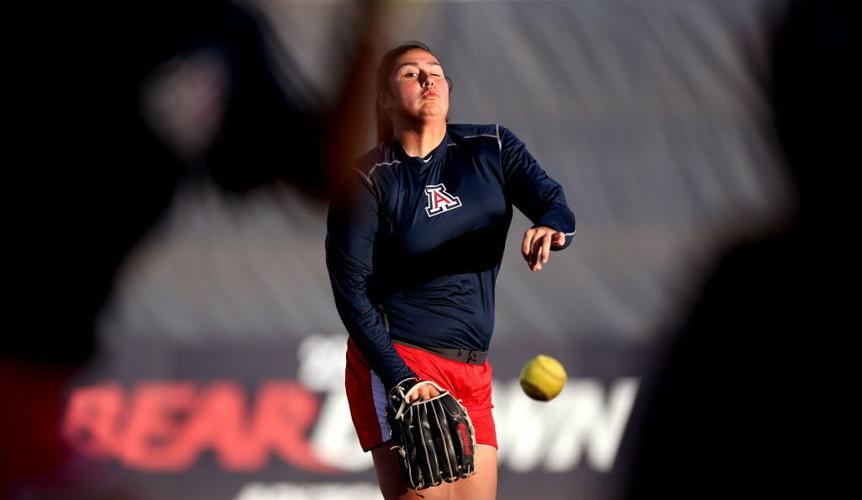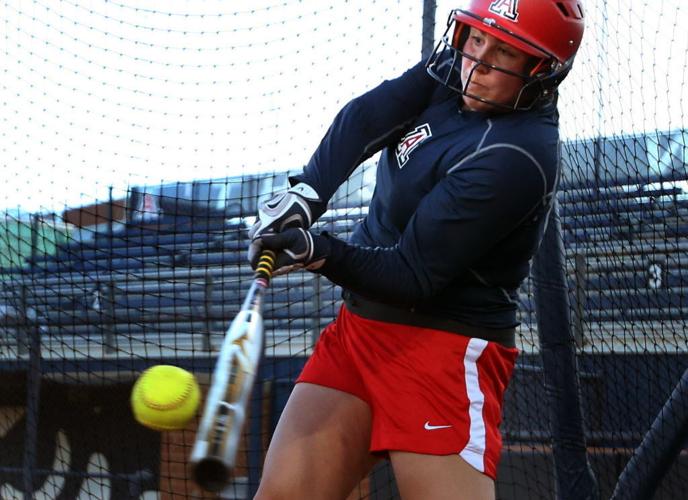
Taylor McQuillin takes the pitcher’s circle with a laser focus, a palpable competitiveness.
The Arizona Wildcats left-hander focuses on the batter in front of her. Get her out, move on.
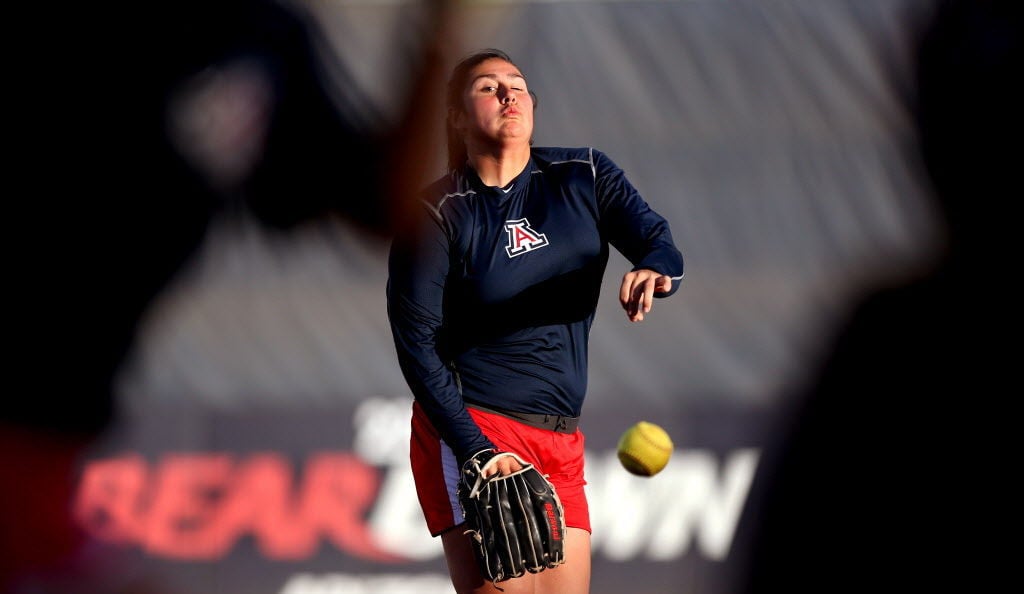
As McQuillin pitches, her left eye lid shuts — or comes close to it, the pupil sometimes facing another direction. This isn’t a part of McQuillin’s pitching routine or an intimidation tactic, although she’s certainly been an imposing presence in the circle throughout her softball life.
McQuillin is blind in her left eye.
“I think it’s normal,” McQuillin said. “I hope it’s normal.”
•••
McQuillin was just 14 when it happened.
No, not the blindness: McQuillin was born with a rare condition called Duane’s syndrome, which caused blindness in her left eye and partial hearing loss in her left ear. More on that in a bit.
People are also reading…
The hard thing was the unfathomable thought, and possibility, of losing her father.
McQuillin committed to play at Oklahoma State when she was a freshman in high school. Her plans soon changed.
Ron McQuillin has an enlarged heart; when Taylor was in the 10th grade, he suffered from serious heart failure. McQuillin re-opened her recruitment, wanting to move somewhere closer to home so she could see her father more often, and so he could see her play. That wasn’t going to happen at Oklahoma State.
Troy Ybarra, McQuillin’s coach at Mission Viejo High School, knows something about heart attacks. His father suffered one in January, and Ybarra is still recovering.
He’s not 14 years old.
“I was thinking I was going to lose my dad,” Ybarra said. “In her eyes, she’s a freshman, a 14-year-old kid. Then her dad turns for the worst. What is a 14-year-old girl thinking of at that time?”
For starters, McQuillin was worried that nobody would want her so late in the recruiting process.
That didn’t turn into much of an issue.
McQuillin looked at Oregon, Oregon State and Washington before ultimately choosing the UA. That Tucson is a seven-hour drive — or short flight — from Mission Viejo only helped.
“That was hard on her,” Ron McQuillin said. “When she makes a commitment, she stays her course. That’s her character. She’s always been like that. It was a difficult three-month period when she was looking at all these schools, but we’re happy with her choice.”
•••

McQuillin had planned to go to Oklahoma State, but reopened her search and chose the UA after her dad suffered heart failure.
Ron could understand his daughter’s concern.
Taylor was Ron and Petra McQuillin’s first child. The first-time parents didn’t know what to do when they found out their baby had Duane’s syndrome, a condition they knew nothing about.
“Your first thought is, ‘What’s going on? How can we adapt? What can be done?’” Ron said.
The McQuillins tried everything to fix Taylor’s eye, though Duane’s — an eye-movement disorder that affects 1 in every 1,000 people, and more girls than boys — is technically incurable.
McQuillin underwent four unsuccessful surgeries on her left eye before her sixth birthday.
The idea of McQuillin playing sports past childhood didn’t seem realistic. Even so, her parents signed her up for dance and taekwondo classes to help combat the depth perception issues caused by Duane’s and to help with her balance. She excelled, earning a junior black belt within a few years.
At 7, she wanted to play softball, so McQuillin’s parents signed her up for a local youth recreational league.
“We figured we wanted to at least let her have a chance, but we didn’t think it would go anywhere, honestly,” Ron said. “We thought the depth perception would be a big issue. We thought that would be the end of her career with softball, the recreational league, and we wanted her to experience that. We were surprised when she got it.”
Then McQuillin started hitting, and pitching, and fielding.
At first, her coaches put her in left field and she struggled. But when McQuillin moved to right field — initially as a warning shot to a struggling teammate — she thrived.
Ybarra started coaching her when she was 12 years old. He knew right away she was special.
And driven.
When she was in seventh grade, McQuillin wanted to play with eighth-graders. In eighth grade, she wanted to compete against high schoolers.
“When I was younger and someone told me I couldn’t do something, I just wanted to do it because they told me I couldn’t,” she said. “I was that child.”
From there, with one working eye, she took over, eventually becoming one of the most dominant pitchers in the history of California high school softball.
In her Gatorade award-winning junior campaign, she won 25 games and posted a 0.72 ERA with 299 strikeouts and 17 walks in 164º innings. Her lone loss came in the final game of the regular season, and Mission Viejo went on to win the state title. She won 30 games as a senior, posting a 0.31 ERA with 389 strikeouts in 206 innings. Her lone loss came in the state title game.
“I’d go home, not in front of people, and I’d cover my eye and walk around my house to see what it was like. And it’s…awkward,” Ybarra said. “It didn’t deter her. We never said, ‘What would it be like if she had both eyes?’
“No. She’s amazing.”
•••
McQuillin now mans a circle at Hillenbrand Stadium that’s hosted Jennie Finch and Taryne Mowatt, legends of college softball.
She follows Danielle O’Toole in Arizona’s rotation, giving the Wildcats something most teams can’t claim — two lefties, both supremely talented.
McQuillin is 8-4 with a 2.64 ERA for the Wildcats, who travel to Seattle for a weekend series against 11th-ranked Washington beginning Saturday.
It hasn’t all been perfect. McQuillin struggled against Central Michigan earlier this season, allowing 10 hits and four earned runs in a 4-1 loss.
Against Utah last week, she pitched deep into extra innings, but walked seven batters — and struck out eight — and wound up losing the game. She has lost more games this year than in her last two years at Mission Viejo.
“I think as a young pitcher, she’s had great success at the high school level and in travel ball,” UA coach Mike Candrea said. “But truly the next step is going to be here. I think, overall, she’s going to be a horse for us for a long time.”
Added Stacy Iveson, Arizona’s pitching coach: “She has a warrior mentality, and she wants to be the best.”
The struggles haven’t rattled her. Candrea kept McQuillin in the game for all but one inning against Central Michigan, even after she loaded the bases and had to get herself out of jams in almost every frame.
“That showed me that I’m going to have to keep going, I’m going to have to fight through it,” McQuillin said. “It’s not fight or flight, you’re going to be forced to fight.”
She knows how to fight.
“Within softball, I was able to prove a lot of people wrong,” she said. “Growing up, I proved a lot of people wrong. So that’s what I’m doing here, continuing to prove people wrong, and doing the thing I love.”
When she was a kid, her father, understandably, questioned if a softball playing career was in the cards for his daughter. He was happily proven wrong.
With his condition, Ron McQuillin’s heart only functions at 10 percent capacity.
There’s no “fight or flight” for him either. Just fight.
“My dad is my biggest inspiration,” she said. “Just going around and showing the world that he’s strong enough to live with what he has. If he can function at 10 percent, then I sure as hell can function at 100.”