

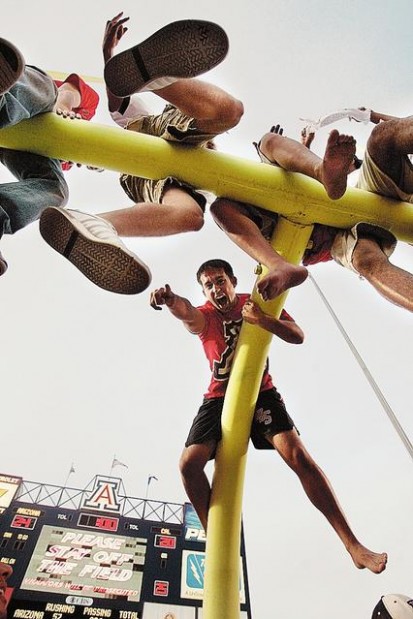
After he hugged his wife and bent over to gather his two small children into his arms, hard-bitten Mike Stoops, a tough guy among tough guys, did something we have never seen him do.
Daddy choked up.
He dabbed at his eyes, the unshakable tough guy shaken, if only briefly. He carried his kids to a makeshift press tent, bouncing more than walking. His body language broadcasting what he didn't have to say.
This is why I came here. This is why I'm a football coach.
Each of Stoops' assistant coaches walked from the joyful locker room on a program-turning, reputation-saving high.
Embattled offensive line coach Eric Wolford embraced his wife and shook his head. "Wow,'' he said, quietly. Co-offensive coordinator Dana Dimel buried his head on his wife's shoulder, his face hidden from scores of onlookers. Some of the coaches' wives were weeping.
People are also reading…
Can you imagine the pressure they have felt during this long and painful process of transforming a losing football program into one that beat No. 8 Cal 24-20 on Saturday?
Fans get frustrated and go home. Players grow up and move on. The coaches and their families absorb the uncertainty, become familiar with humility, and learn to live with it. They pay the heaviest price.
In the space of eight days, Arizona has stunned two Top 25 teams. Nobody predicted it. Nobody even imagined it.
"If you stay positive long enough, good things happen,'' UA linebacker Spencer Larsen said. "We could've gone 3-9 like we've always gone, or we could've kept at it and turned things around. We dug in and kept at it.''
Stoops laughed about "the football gods'' blessing his team with some overdue good fortune, but there are no football gods and everything the Wildcats did on Saturday can be clearly explained.
Like those two Cal interceptions that were nullified by penalties.
Like Cal receiver DeSean Jackson stepping out of bounds by, oh, two inches, on what would've been a game-winning touchdown.
Like UA defensive end Marcus Smith deflecting a pass with, oh, the tips of two fingers, detouring it just enough for Ronnie Palmer to intercept it and end the game.
Like when Cal receiver Lavelle Hawkins broke clear for an apparently easy touchdown — to tie the game at 24 — only to stumble and fall at the 1-yard line, after which the UA's goal-line stand limited the Bears to a field goal.
If any team in this country was due for a charmed day, it was Arizona, a charmless, luckless football school since the day it lost to Penn State in 1999.
"Who said building a new program was going to be easy?'' asked UA cornerback Antoine Cason, who scored the game's deciding points on an interception return.
Rather than unload on the many UA critics, Cason spoke evenly about turning on ESPN Saturday morning and watching as analyst Kirk Herbstreit repeated, several times, that Arizona had "no chance — zero'' to beat Cal.
"It fueled my fire,'' he said. "I addressed that issue with my teammates.''
Arizona did not need any extra fuel to play hard against the Bears. Losing 38-0 and 28-0 to Cal in Stoops' first two seasons was graphic evidence that Arizona couldn't begin to think it had turned a corner until it first became competitive against the Bears.
"We were down 17-3 at halftime, which is tough enough,'' said Larsen, "but being down 17-3 to Cal at halftime. That's real tough.''
Stoops had been bewildered by Cal's Jeff Tedford, who not only regularly beat the Wildcats in recruiting, but seemed to increase the competitive gap between Arizona and the Bears.
Tedford and the Bears have been viewed as the slick, new power of Western football, a small fraternity that includes only the Bears and USC. Stoops knew that to turn Arizona into a winner before his contract expired — or perhaps get fired before it expired — he would have to cut into that separation.
"This team has beaten us soundly for two or three years,'' he said. "We've closed the gap on everyone. The real measuring stick (in the Pac-10) is where you are against USC and Cal.''
The most defining play of Saturday's game had nothing to do with Cason's interception or Arizona's goal-line stand. Instead, it was when Stoops was bold enough to order a quarterback sneak on fourth-and-one at Arizona's 29 as the third quarter began.
The consequences of failure were grave: Cal, leading 17-3, would have had the ball inside Arizona's 30 and an early chance to end the game. Rather than play scared, as Arizona has played for too many years, Stoops ordered quarterback Willie Tuitama to plow straight ahead.
He got the first down by about an inch. Arizona didn't go in to score, but it had changed its attitude.
"I just felt the game was getting away from us,'' Stoops said. "Cal wanted to put a dagger in us. We were playing to win.''
Funny how football works. Thirteen years ago in Berkeley, Calif., Arizona's Desert Swarm (8-1) needed to beat the 5-4 Bears to clinch a Rose Bowl berth. The Wildcats roared to a 20-0 halftime lead.
Tucson's long-awaited Rose Bowl celebration was minutes away.
Almost predictably, Cal rallied, scoring on a deflected pass interception to win 24-20 in the final minutes.
On Saturday, 13 long years later, the Wildcats did the same to the Rose Bowl-hopeful Bears. Crazy Game II.
Asked what beating Cal meant, Stoops knew the math.
"We're 5-5 and we've got a chance every time we suit up,'' he said.
For the first time in years, an Arizona football coach can say that and truly mean it.
Inside the Cats' upset win
Page C8


