
The first sign that things are different at Air Force can be found in the first sentence of Troy Calhoun’s bio.
It doesn’t describe his accomplishments as a football coach. It doesn’t list the date he was hired. Rather, it lays out the service academy’s mission statement.
“The purpose of the United States Air Force Academy,” Line 1 of Calhoun’s bio reads, “is to develop young people of strong character who graduate and serve as outstanding leaders on active duty and beyond.”
It’s Calhoun’s job to find the young people who are capable and willing to endure the unique challenges of the Air Force Academy — while also playing competitive football at the Division I level.
It’s hard to win anywhere consistently. It’s especially challenging at Air Force, Army and Navy. The service academies have strict academic requirements. Their curriculums demand massive time commitments. Oh, and you literally might have to risk your life at some point to serve your country.
People are also reading…
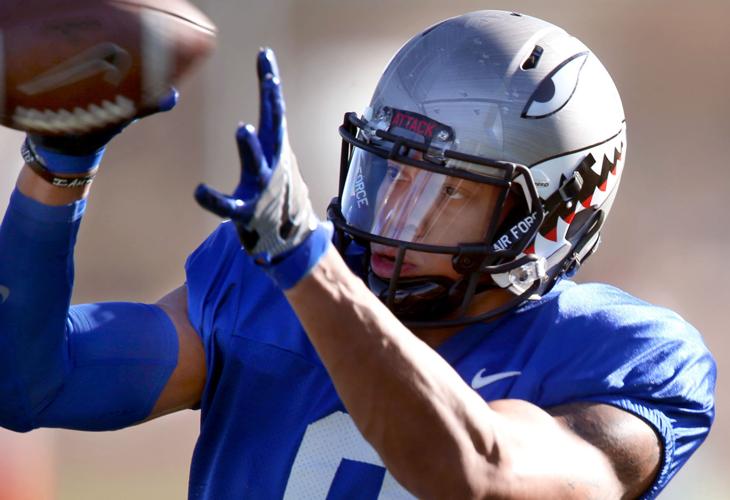
“It’s a hard place,” Calhoun said Monday after his team completed a full-pads practice at the Kino Sports Complex in advance of the Nova Home Loans Arizona Bowl. Air Force faces South Alabama at 3:30 p.m. Friday at Arizona Stadium.
“It’s a really, really challenging institution,” Calhoun continued. “And yet, at the same time, you understand why.”
Calhoun doesn’t use Air Force’s “handicaps” (our word, not his) as an excuse, nor does he need to: The Falcons are about to make their ninth bowl appearance in 10 seasons on his watch.
But he readily accepts the realities of coaching at a service academy. They affect everything, from recruiting to the team’s daily practice schedule to reassembling the squad in Tucson after a weeklong holiday break.
“You look at our roster, we’re from the whole country,” Calhoun said. “Getting all of our guys here was a major, major chore.”
Unlike, say, Arizona, which can tap into the immense talent base of neighboring California, Air Force must scour the countryside for recruits who meet its standards. The Air Force Academy is in Colorado Springs. Only five players on the Falcons’ varsity roster are from Colorado. Their nine leading rushers come from seven different states.
Calhoun and his staff must cast a wide net — yet the pool of viable candidates is relatively tiny.
“It’s either a drop or at best a puddle,” Calhoun said.
That’s because any prospective cadet must meet a stringent set of academic requirements — and be willing to commit to five years of postgraduate service.
“We take zero — I mean zero — risks when it comes to character and when it comes to academics. Zero,” Calhoun said. “We’re very, very thorough in our evaluations when it comes to visiting with every single person we come across that’s interacted with that young person.
“If it’s the security person when you walk in the door, if it’s a secretary, a principal, a coach, a teacher, a janitor, a trainer — there can’t be hesitation when we ask them about the quality of the person. They have to be adamant in terms of the character of the young person and the kind of leadership aptitude that they have. If there’s even a flinch, if they can’t tell you 10 on a scale of 1 to 10, we’re not recruiting them. Period.”
Those standards severely limit Air Force’s options. In the vast majority of cases, the players who sign with Air Force — a process that includes procuring an appointment letter from a state senator or representative — don’t view college as a brief layover en route to the NFL.
Once they get to Colorado Springs, they discover how different their lives are compared to most student-athletes they face. For example, Air Force cadets take 18-21 hours of classwork every semester, even during the football season. At most schools, players take 12-15 hours — or less — in the fall.
You won’t find ballroom dancing on any cadet’s schedule, either.
“They’re going to take two levels of chemistry, they’re going to take two levels of calculus, they’re going to take two levels of physics,” Calhoun said. “They’re going to take aeronautical engineering and astronomical engineering.”
In addition to the academic workload, all cadets must train for military service. It starts the summer before their freshman year with nine weeks of basic training, which includes obstacle courses, demanding superior officers and everything you’ve ever seen in war movies.
“There’s dust. You can’t really see anything. Everyone’s yelling at you,” senior receiver Jalen Robinette said. “You’re bear-crawling through the dirt under barbed wire. It’s not exactly fun … until you finish it.”
It doesn’t end there, though. All cadets spend their summers training for service. Air Force rarely has enough players for the offseason 7-on-7 sessions that are commonplace on other college campuses.
Senior safety Weston Steelhammer spent part of his summer last year on the cadet cadre for survival training. What does that entail exactly?
“You just have to stay out in the woods for a handful of days,” Steelhammer said, making it sound much more routine than it is. “They don’t give you too much while you’re out there, so you’ve got to make it last.”
Air Force cadets learn to make the most of what they have. Calhoun has mastered that skill.
His players don’t have as much time for football. They aren’t as big or fast as their competitors. (South Alabama has 10 300-plus-pound players on its roster; Air Force has none.) The Falcons don’t have the luxury of redshirting.
They just find a way to make it work.
“You’re looking for a rare young man or woman to come to the Air Force Academy,” Calhoun said. “You put more responsibility on their shoulders. Our guys embrace challenges and responsibility.”