

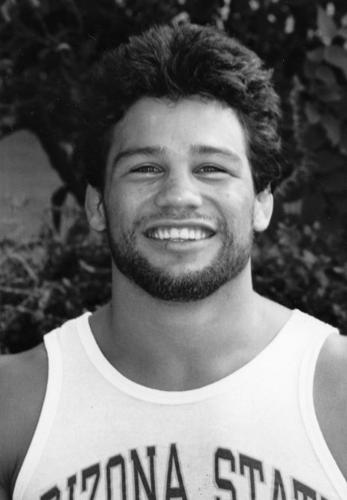
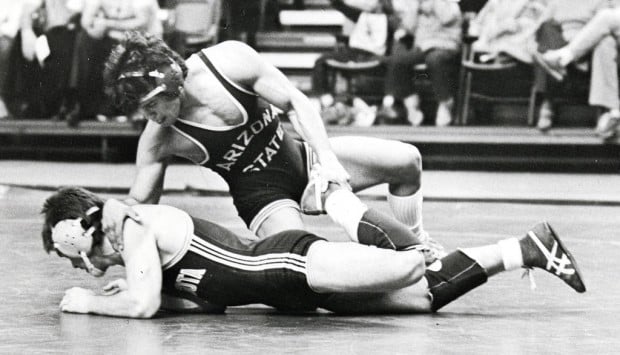
The call came early Sunday morning. Eddie Urbano is dead.
"I talked to him Thursday night and arranged to meet him for breakfast at La Casita restaurant in Mammoth," says Sam Portillo, a long-time friend. "He had some things to tell me. I never got to hear what they were."
There was silence on the phone. What can you say? Eddie Urbano was 50, father of four kids, one of the towering names of Sunnyside's long wrestling dynasty, one of the most prominent athletes in the history of Arizona.
His death was an apparent suicide.
"I don't like it, but I guess it's true," says Portillo, who was part of the Blue Devil dynasty in the 1980s and now the wrestling coach at Amphitheater High School. "Eddie wasn't a guy who had guns. I wish I would've had a chance to talk to him. Maybe I could've straightened him out.
People are also reading…
"I can still see his smile. Nobody had a better smile than Eddie."
Oh, yes, Eddie Urbano's legendary smile. In November of 1990, I vividly remember walking into the Sunnyside gymnasium to watch Team USA wrestle Team Russia. At the door, a man told me it would be $5. As I reached into my pocket, someone told the man I was from the newspaper and that there would be no charge.
I always wish I had paid that $5. It was, without question, one of the most scintillating sporting events I have attended in Tucson.
In 1990, the Russians were still our enemy and, make no mistake, all of the 3,000 people who filled the gymnasium had come with one purpose: to watch Eddie Urbano wrestle Soviet star Kustya Audeev. It was the sporting definition of Good vs. Bad.
In that setting, Eddie Urbano, was an absolute rock star.
He had won state championships while a Blue Devil in 1979 and again in 1980. Then, at Pima College, he won NJCAA titles in 1981 and 1982. How could he top that? Three years later, at ASU, he did. He won the NCAA championship at 150 pounds and left the Sun Devils, a Hall of Famer, with a 105-17-1 record.
"He was a coach's dream," says Don Klostreich, the architect of Sunnyside's wrestling legend, now a high school coach in Yuma. "Eddie always had that smile on his face. I don't know if anyone I ever had worked harder than he did. In my book, he was a great person. Forget wrestling. He was a friend."
When Urbano and Audeev finally got on the mat that night, Nov. 6, 1990, the noise in the Blue Devil gym was thunderous. How could Eddie lose?
"I felt sorry for him," Urbano said. "I just had too much adrenaline."
Urbano won 6-4. He said he hoped to meet the Russians again, at the 1992 Barcelona Olympics, but, just as at the 1988 Olympic Trials, Urbano missed making the U.S. team by a whisker.
In 1997, in downtown Phoenix, I saw him again, when a (now-defunct) sports magazine named him as one of the 50 greatest athletes in Arizona history. Urbano was there, appropriately in the group shot, with rodeo legend Ty Murray and swimming gold medalist Charlie Hickcox.
Urbano got married, had a family, was twice divorced, taught school in the Phoenix area and kept his hand in coaching, working at, among other places, Willis Middle School, Mountain Pointe High School and, last year, Florence High School.
"Whenever I'd bring my team to Tucson, Eddie would show up," Klostreich remembers. "He'd take kids off to the side and show them the proper technique. He would connect with you right away."
Portillo was four years behind Urbano at Sunnyside, but was influenced by him long before he became part of the Blue Devils' epic run of 27 state titles, including the first, in 1979.
"Sometimes my dad and I would drive to the landfill on Saturday mornings and, almost without fail, we'd see Eddie running down 12th Avenue, or over by Ajo and Mission," Portillo says. "My dad would see Eddie and say, 'That's how you become a champion; you work your tail off.' It stuck with me."
If Urbano isn't the ranking name of Blue Devil wrestling, then who? It's impossible to rank them anyway. There's Thom Ortiz; Eric Larkin; the DeBerry boys, Kory and Kyle; the Gallick boys, Nick and Nate; and a half-dozen others who separated themselves from 30 years of wrestling greatness.
Just being identified as part of that group is enough.
Urbano was a fix-it man. He could fix anything: the brakes on your car, a balky garage door, you name it. You would call him and he'd come over, listening to Travis Tritt music, smiling.
"As part of my involvement with USA Wrestling, I go to the Olympic Training Center in Colorado and it's funny: The big names in wrestling, the icons like Bobby Douglas and John Smith always ask me, 'How's Eddie doing?' "Portillo says.
"I've heard some of those guys say that if UFC had started 20 year ago, Eddie would've been a multimillionaire. That might've been his calling. He was such a tough sonofagun."
Urbano didn't make it to breakfast at La Casita last week. Never had a chance to say goodbye.
A public viewing will be held Sept. 9, 11 a.m. to 1 p.m., at Funeraria del Angel, 7 E. University Blvd. A prayer service will follow at 2 p.m.
"At least he'll be coming home," says Portillo. "Whatever was troubling him at the end of his life, I'm sure he'll know much we loved him."
In the mind of Sunnyside wrestling fans, Eddie Urbano is forever undefeated.
Contact Greg Hansen at 573-4362 or ghansen@azstarnet.com

 5 takeaways from Arizona’s season-ending loss to Michigan at the Final Four | Michael Lev


