
You thumb through the pages of Inside Gymnastics magazine until you find the piece about "The 25 Most Powerful People in USA Gymnastics." You see the recognized titans of the sport: Mary Lou Retton and Bela Karolyi and on and on.
You check the date: July-August 2009.
Retton is ranked No. 11 and Karolyi No. 10. With the exception of Tucson's little darlin', Kerri Strug, they are the two most recognizable names in American gymnastics history. You wonder who can be ranked ahead of Karolyi and Mary Lou. And so you turn the page:
No. 6, Yoichi Tomita, Gymnastics World, Tucson.
"Can you believe I'm ranked ahead of Bela and Mary Lou?" Tomita says, his voice shaking with laughter. "I talked to the editor. I said, 'Why couldn't you put me at least No. 3? It's just so funny."
People are also reading…
Tomita's modesty gets in the way. Today, he will be at USA Gymnastics headquarters in Colorado Springs, Colo., to begin another cycle as manager of the USA Men's Olympic Gymnastics program. In varying capacities, Tomita has been making the trip to Colorado Springs for 25 years, sometimes as a coach, sometimes as a manager, sometimes on a board that sets policy.
But most in USA Gymnastics suspected Yoichi would retire when his son, Yewki Tomita, retired this year after a decade on the USA national team. Yewki, a UA grad, has moved to Tokyo to become of all things, an actor. Tomita's daughters, Sakura and Naomi, have also moved to Japan: Naomi is a school teacher; Sakura hopes to get a job in fashion.
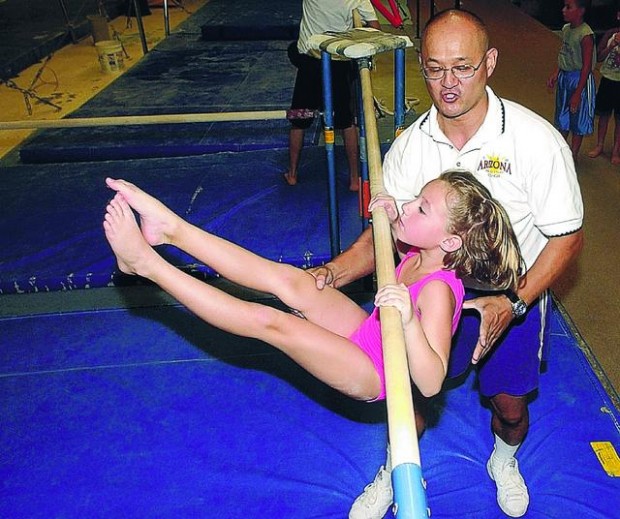
The nest is empty, but at 53, Yoichi Tomita and his wife, Setsuko, still operate three Gymnastics World facilities here. The economy has been so bad for business — "all hell has broken loose," he says — that now he does the cleaning and the landscaping as well as coaching.
"I'm on my knees," he says, figuratively. "I'm scrubbing the floors and pulling the weeds. But life is good. I will keep plugging."
This is the sixth-most powerful man in American gymnastics. He does not stay down long. He gets a chuckle at the irony of his children moving to Japan so they can learn the language. In 1974, he moved from Japan to Long Beach, Calif., so he could learn English. The cycle has been reversed.
"I started with nothing," he says, and he is not fudging much. He worked for $2.26 an hour as a custodian while on the gymnastics team at Long Beach State. "I came to Tucson 30 years ago with a suitcase and a wife, so it is not in me to give up. I'm rejuvenated by this challenge."
Part of Tomita's life story goes beyond script-writing and borders on make-believe. His grandfather Rieji, a wealthy Japanese-Taiwanese land baron, lost everything, land and wealth, at the end of World War II. His father, Shorchi, had difficulty supporting the family. He was a cook, a policeman, you name it. He was often unemployed.
Who has a better life story than Yoichi Tomita?
As a teenager growing up impoverished in Takasaki City, Japan, Yoichi wanted to be the next Sadaharu Oh, a great Japanese home run hitter. But he became a gymnast when a bully, whose position he had taken, threatened him with such tenacity that it made playing high school baseball impossible.
Next year, he will return to his high school to be a keynote speaker at the school's 75th anniversary. He will talk not about baseball or gymnastics, but about life. He can talk about becoming the 1975 NCAA champion (parallel bars) when he could barely speak English. He can talk about the devastating fire that destroyed his East Fort Lowell gymnastics center 20 years ago.
"I didn't have enough insurance," he says now. "But I overcame that. Our kids look at what we've gone through and say that anything is possible. I want to continue to make a difference."
He hopes to start making that difference Saturday, as part of National Gymnastics Day. Tomita will open all three of his Tucson facilities (information: 888-0519) at various times between 11 a.m. and 1:30 p.m. Children, their parents and teenage gymnasts are invited. There will be no admission.
Tomita has been celebrating National Gymnastics Day in similar fashion since Strug trained at his Fort Lowell Road gymnasium in the early 1990s. He is convinced that someday he'll coach another Strug, another Yewki, and that, at 53, his career isn't over.
"It's nice being wanted again," he says of his reappointment to the USA Gymnastics board. "I'm young and active. I'm in position to help a lot of people."

 Former ASU coach Bobby Hurley's name is in the Big Dance record book