

Kerri Strug employs an agent in San Francisco and another in New York. One arranges her corporate engagements, the other her gymnastics appearances.
Weekends? Last week, she was in Texas and then Tennessee.
In April, her weekends included time in Mississippi, California, Maryland, Texas and Virginia.
Strug represents the March of Dimes, the American Heart Association, the Elizabeth Glaser Pediatric AIDS Foundation and the Lupus Foundation of America.
"I'm keeping the airlines in business," she said with a chuckle. "But I have always believed when you're young, you should do some public service. It's important to be successful outside the gym. This is who I am now."
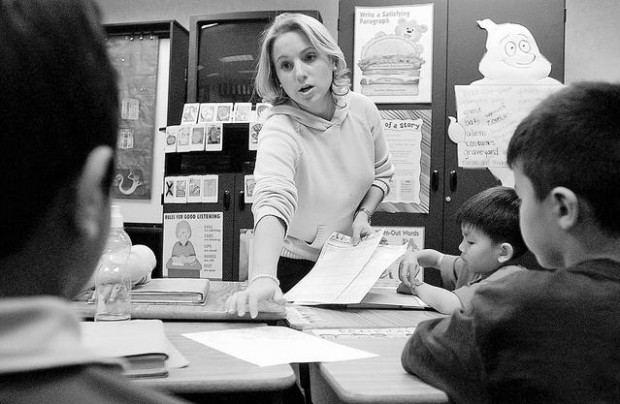
Kerri Strug is 28. Where did the time go? She earned a master's degree from Stanford. She spent a year teaching second-graders in San Jose, Calif. She wrote not one book, but two — "Landing On My Feet" and "Heart of Gold."
People are also reading…
Today, Strug works in Washington D.C. for the Department of Justice, targeting at-risk kids as part of the DOJ's Juvenile Justice and Delinquency Prevention staff.
This is heavy stuff, daily work in the trenches, about the last thing you would have expected from the 4-foot-9-inch, 89-pound bantamweight who, it turns out, has become a heavyweight.
Indeed, life has not turned out the way most expected for Our Miss Strug, 1996 graduate of Green Fields Country Day School.
Rather than vault or somersault, she runs marathons. Her hair is longer, her voice is deeper, yet her energy seemingly is boundless.
"Kerri is nobody's idea of a pixie anymore," said her father, retired Tucson heart surgeon Burt Strug. "She is a determined young woman with very serious goals. She has embarked on this stage of her life the same way she dedicated herself to gymnastics."
Almost everything has changed since that legend-making afternoon 10 years ago today.
From Time cover to motivator
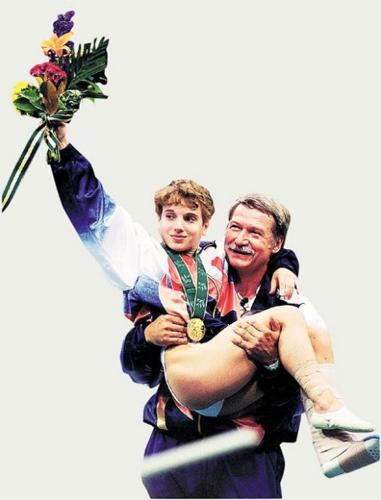
On July 23, 1996, a virtual unknown, Strug vaulted into Olympic immortality. Injured, limping on a seriously weak left ankle, Strug summoned the fearlessness to complete her final vault, scoring 9.712, providing drama, if not the final margin, for what remains the only team gold medal in U.S. women's gymnastics history.
A star was born.
A week later, simultaneously on the covers of Time and People magazines (not to mention the front of a Wheaties box), Strug stood next to superagent Leigh Steinberg at a downtown Atlanta hotel and announced she was headed to the White House to meet President Bill Clinton.
"She could earn between $10 and $15 million over the next four years," Steinberg said that day.
A few yards away, Kerri's parents, Burt and Melanie, absorbed the moment, watching as their youngest child's life forever changed.
"Kerri's life will be different than we perceived it to be," her father said then. "But it will be better. She can contribute to society in ways she didn't imagine."
Of all the things said about Kerri Strug during that almost magical fortnight at the Atlanta Olympics, her father's perception has been uncannily accurate.
She works with troubled kids. She goes coast to coast giving motivational speeches to corporate America. A decade after her intrepid vault, she is in demand, an "A" list speaker.
"All that 'sign with me and I'll build you a rainbow talk' was just a sales pitch from the agents," Burt Strug says now. "We were just fortunate she has been so grounded. So many athletes have their moments and then blow it. Kerri retained her focus. She's a wonderful person, a remarkable child."
Contributing to life in other ways
Strug is represented in New York by Peter Raskin, who works with, among others, former Olympic celebrities Dan Jansen and Bonnie Blair. In San Francisco, Jill Peterson-Burns helps to coordinate appearances on Strug's blur of a calendar. The two have worked together for 10 years.
"I am still stunned by the amount of people, particularly the men, who approach Kerri and tell her they admire her courage and perseverance," Peterson-Burns said.
"She has made incredible strides growing, personally and professionally, over the last 10 years, which I believe is typically slower and more difficult to do for professional athletes who focused on a single sport all of his or her life. It would have been natural for Kerri to stay in that realm, gymnastics, but she was hungry for new challenges. She did everything from choosing a new sport — marathons — to a new career in public service."
If there has been a clash, it has been Kerri's desire to live a normal life — "as normal as possible," she said — and the celebrity that shadows her.
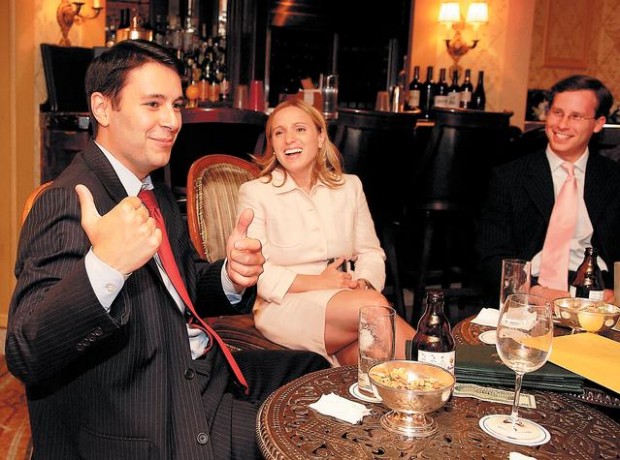
Her commute to work, Arlington, Va., to Washington D.C., is not by limo, but rather via the subway. She is routinely recognized and asked for autographs, even while at dinner with friends. She probably could spend 52 weekends a year speaking to corporate and youth groups, but has been careful about being overscheduled. She returns to Tucson, for example, to visit the dentist and for doctor's appointments.
"I have been able to achieve a great balance in life now that I'm out of the gym," she said. "All of us in life want to have some sustainability. Let's face it, the highlight of my life has been that vault in Atlanta. I had prepared for that moment from the time I was 6 years old. Now it's time to contribute to life in other ways."
'I will, I will, I will'
Strug said she rarely sees Bela Karolyi, the comic-book character of a gymnastics coach who, in 1993, accepted her as part of his Houston-based training program. Karolyi's background was unsurpassed: he coached Olympic gold medalists Nadia Comaneci and Mary Lou Retton.
"Mary Lou had been my idol, my role model," Strug said. "It was very difficult training with Bela. He was demanding to the nth degree. He pushed me farther than I thought I could go. Now I understand why he did those things. I try to express those same principles in my motivational talks."
Entering the Atlanta Olympics, Strug was known to the TV analysts but not to the viewing public. The "Magnificent Seven," which included high-profile gymnasts such as Amanda Borden, Shannon Miller and Dominique Dawes, was fronted as the most compelling story of the '96 Olympics.
What often went unsaid was that Strug might've been the team's most reliable performer, a marginal, nonscoring member of the 1992 Barcelona Olympics team who had spent four years living and training in Houston, giving up a normal childhood for the chance to compete in Atlanta.
She qualified for medal competition in three individual events and was ranked No. 1 in floor exercise, No. 4 in vault and No. 7 in all-around. But after injuring her left ankle on the penultimate vault of the team competition, those goals vanished.
Unsure if the United States had enough points to hold onto the gold medal in a tight competition against Russia, Karolyi asked Kerri if she could execute a final vault.
At a chaotic news conference 90 minutes after the meet, Karolyi said, "Kerri knew that in her hands was the gold, the silver and bronze. We needed at least a 9.6."
Strug had no more than a minute to decide if she could get enough speed and explosion off her injured ankle. She knew only that it hurt; there was no time to consult a doctor.
Said the sometimes dramatic Karolyi that evening: "I asked her, 'Can you do one more?' And she said, 'I will, I will, I will.' She could have very easily said, 'I can't,' but she is not a crying baby. What she did, I believe, in my 35 years of coaching, is the greatest act of responsibility I have seen."
Special moment relived on video
Burt Strug maintains that Kerri's Olympic performance did not launch a grab for fame or fortune but, simply, a desire to make a difference.
"Our initial concern was with her injury," he said. "Yes, she was an international hero, but as parents, we were more concerned about her well-being. She wanted to go to UCLA and be on the college gymnastics team, complete her education and have a normal life.
"It took us a few weeks to realize that it was a special moment and not just another gold medal."
Kerri didn't spin her gold medal into an untold fortune. Her father says that much of her original income has been put into a trust fund.
"I don't have financial freedom," she said. "But when I have children, I will be able to pay for their education. Athletes from baseball or football make tens of thousands of dollars to make appearances. I make much, much less. That's fine. I never planned to make a dime off gymnastics."
Her idea of a fun getaway is to fly to Atlanta and spend a day with older sister, Lisa, and Lisa's two young children. Her idea of athletic competition is running Heartbreak Hill in the Boston Marathon.
But wherever Kerri Strug goes, she finds it difficult not to be reminded, in some form, of that unforgettable afternoon in Atlanta 10 years ago today.
Speaking to a corporate group last week in Tennessee, Kerri was dwarfed by her image on an overhead JumboTron screen. She has seen the video thousands of times: standing awkwardly on her injured ankle; the frightened look on her face; Karolyi shouting encouragement; her sprint down the runway.
"I show that video during my appearances quite often," she said, chuckling. "I watched it yesterday. And I'll probably watch it tomorrow, too."
Kerri is nobody's idea of a pixie anymore. She is a determined young woman with very serious goals. She has embarked on this stage of her life the same way she dedicated herself to gymnastics.
Burt Strug / Kerri Strug's father and a retired Tucson heart surgeon


 On Becky Burke’s defiance, Tommy Lloyd’s frustration, UA softball’s strategy | Michael Lev


