Jim Kubiak has been analyzing the play of Buffalo Bills quarterbacks for BNBlitz.com. Kubiak is the all-time leading passer at Navy, has played in the NFL, NFL Europe and the Arena Football League, and has been a coach and executive in the AFL. He spent eight years as the radio analyst for the University at Buffalo and runs the Western New York Quarterback Academy to help develop the next generation of quarterbacks. He recently was named head coach at Hilbert College.
Quarterbacks are evaluated each quarter using a “Doing Your Job” grading system for every play that takes into account the quarterback’s responsibilities and outcome. The accountability system rewards a quarterback with a plus for a play in which he does what he is supposed to do, a minus for not doing what he is supposed to do. A quarterback can earn a plus-plus for an extraordinary play and a minus-minus for a play that hurts the team.
People are also reading…
Overview
The Buffalo Bills did exactly what they needed to do against a struggling Carolina Panthers team – took care of business. There were three main factors that made the difference in the 31-14 win: Josh Allen’s key throws, the Bills’ swarming defense, and the pregame injury to Carolina Panthers kicker Zane Gonzalez.
Coming off a left foot sprain, Allen did enough to win with his great play action, his timely strikes into open areas and his scrambling ability. Allen completed 19 of 34 attempts (56%) and threw three touchdowns and an interception. Allen was sacked four times and missed more throws than he has in any game this year. Yet, despite the misfires, he carried the day for the offense.
The Buffalo defense held the Panthers to just 275 total yards on 71 plays. Quarterback Cam Newton completed 18 passes on 38 attempts for 156 yards, averaging just 3 yards per pass. Newton was also sacked four times and consistently harassed in the pocket.
Gonzalez injured a quad in warmups and was ruled out. That forced the Panthers into several situations in which they went for it when they might have elected to go for extra points or field goals. This changed the complexion of the game in the Bills’ favor, who, despite the advantage, found themselves too close for comfort in the fourth quarter with a 10-point lead, with the Panthers in possession of the ball.
The game started poorly for the Bills’ offense on the first series with an Allen fumble that was recovered by Spencer Brown. Josh Allen took a costly sack on their second series, which effectively resulted in a scoreless first quarter. They corrected course with a second quarter that included a rushing touchdown by Devin Singletary, a passing touchdown to Stefon Diggs, and a field goal by Tyler Bass. This commanding second quarter set the stage for an important victory as the Bills can now gear up for a winner-take-all showdown Sunday in New England against the Patriots.
Within this context, the victory over the less-talented Panthers carries weight and provided momentum heading into Foxborough.
First quarter
Play selection: Eight plays – six passes, two runs.
Allen: 3 for 6 passing for 36 yards, two sacks. Zero carries.
Performance grade: 60%.
Score: 0-0.
Allen’s first three plays of the game graded out as minuses as the offense sputtered. Allen missed Cole Beasley in the flat to start the game, then held the football too long on an RPO concept, which created an illegal man downfield penalty. On the next play, Allen missed Beasley again with a high throw. That led to a third-and-15 play in which Allen was sacked and fumbled. Brown recovered and they were able to punt, avoiding turning the ball over to the Panthers on their own 35-yard line.
A holding penalty on Brown and a sack on second-and-8 stunted the next drive and the Bills ended the quarter with no points. Penalties and hiccups in the passing game prevented the Bills from gaining any offensive traction.
Second quarter
Play selection: 21 plays – 16 passes, five runs.
Allen: 12 for 16 passing for 104 yards, one touchdown, one interception. Zero carries.
Performance grade: 95%.
Score: Bills, 17-8.
Allen and the offense started hitting on all cylinders in the second quarter as Singletary scored on this running play from the Panthers’ 16-yard line.
Here, on first-and-10, offensive coordinator Brian Daboll used speedster Isaiah McKenzie in jet motion to influence the defense to the left side of the field. This action made it appear as though the Bills were running to the left as Allen handed the ball to Singletary the other way.
Tight end Dawson Knox made the key play, which sprung Singletary to the end zone as he cut-blocked linebacker Jermaine Carter. Carter was taken to the ground and he was unable to get back to his feet in time to make the play.
On the next series, Allen and Diggs connected on this well-executed back shoulder fade for another touchdown, which increased the lead to 14-0.
On this play, Panthers cornerback Stephon Gilmore was covering Diggs to Allen’s right. Gilmore was pressing Diggs initially and bailed out to stay on top of Diggs’ release to the back pylon. Allen read Gilmore’s defensive technique and decisively threw the ball to Diggs’ back shoulder. Gilmore had no chance to react because Allen saw the opening so quickly. This was a tremendous read, as well as great anticipation by both quarterback and wide receiver.
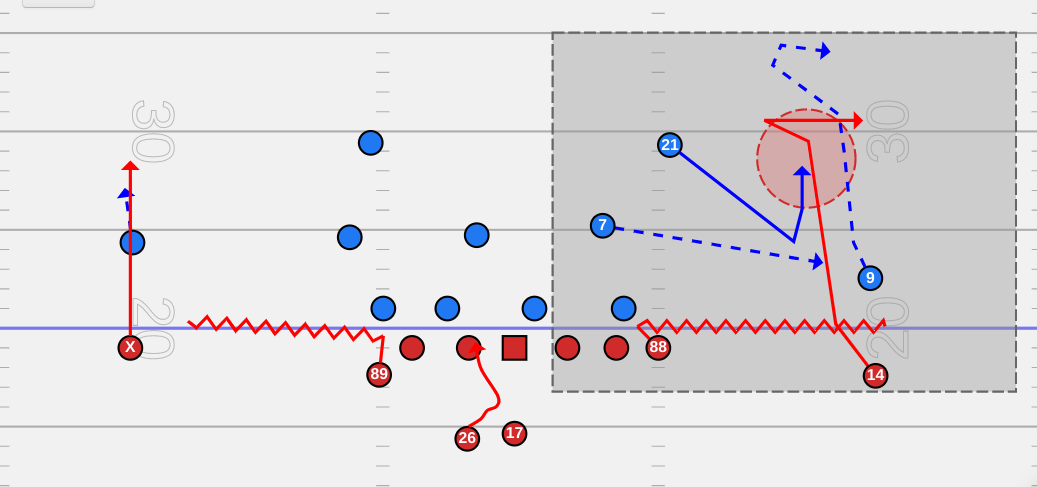
Allen was intercepted on the next series, which led to a Panthers’ touchdown and two-point conversion.
In this diagram, focus on No. 21, safety Jeremy Chinn. Chinn reacted to Knox blocking and releasing to the flat. Allen saw him fly to the flat. Diggs was trying to run a corner route, but Gilmore had outside technique. In an effort to set up Gilmore and try to get outside of him, Diggs made a move to the post and then came out of his route flat. This was a basic corner/flat combination in which Allen read short to deep. But in this case, Allen, rather than take the easy completion in the flat to Knox, waited for Diggs to come out of his break. Chinn drifted underneath Diggs and intercepted the throw. Allen never saw him.
After the Panthers scored, Allen came roaring back on a 10-play drive with 1:40 remaining and three time outs. The field goal put the Bills in the enviable position of scoring just before the half and receiving the kickoff to start the third quarter. The Bills took a 17-8 lead into halftime and jumped into command of the game with their first possession of the second half.
Third quarter
Play selection: 15 plays – nine passes, six runs
Allen: 3 for 9 passing for 56 yards, one touchdown, one sack. One carry for 26 yards.
Performance grade: 93.75%
Score: Bills, 24-8.
The third quarter did not play out exactly as the Bills had planned. A a missed throw to Beasley, a dropped pass by Tommy Sweeney, and a necessary throwaway foiled an Allen 26-yard scramble that should have set up the Bills for another score.
This was an amazing scramble, and even more incredible, considering Allen was limited in practice last week by the foot injury. He moved as though he were fully healthy, breaking tackles as he rumbled for a huge gain. Despite this play by Allen on third-and-8, mistakes and mishaps forced another Buffalo punt.
On the next drive, however, Allen orchestrated a 10-play scoring drive that was capped off with this intuitive throw to Gabriel Davis.
This was a great example of Allen throwing Davis open away from the defense. Davis had a post coming across the field from Allen’s left to the right side of the field. Allen recognized the space between the safety and cornerback and threw Davis the football into the voided space, which forced Davis to have to adjust to the football. Typically, on a post route, Davis would continue across the field, but Allen saw the coverage and threw the post behind Davis to keep him in the open spot. This was an MVP-caliber play by Allen, which ultimately helped the Bills take control, pushing their lead to 24-8.
Allen completed just 3 of 9 attempts in the quarter, but three of his incompletions were throwaways, and one was a dropped pass. Allen’s play in the third quarter and on this drive seemed to be the difference.
Fourth quarter
Play selection: 17 plays – three passes, 14 runs, including two kneeldowns.
Allen: 1 for 3 passing for 14 yards, one touchdown, one sack. Two kneeldowns for minus-2 yards.
Performance grade: 93.75%.
Score: Bills, 31-14.
Daboll went to the running game in a big way in the final quarter, perhaps to take some of the offensive load off Allen’s shoulders. Minus kneeldowns, Daboll called 12 running plays on 15 offensive plays. The significance here was that the Bills committed to the run and they were successful. On the last drive, Singletary carried 6 of 10 plays, with McKenzie running the ball on a wildcat play for a first down. Those two rushing first downs set up the final passing touchdown for Allen on fourth-and-2 off a play-action pass.
Allen completed one of three fourth-quarter passing attempts. That one completion was his third touchdown pass of the game.
Here, the Bills were in an I formation left, with fullback Reggie Gilliam in the game as a lead blocker for Singletary. Allen’s ballhandling on this play was outstanding. He extended the football out to Singletary, and then, at the last second, retracted it back to his belt buckle. Keeping the football on his belt hid it from the defense. Panthers safety Juston Burris thought Singletary had the football. That split-second mistake, due to Allen’s ballhandling and the disciplined action to carry out his fake, allowed Allen to get outside of his right tackle for an easy toss to Davis.
Davis came down in motion to slam the end man on the line of scrimmage to cut him off from the backside of the running play. This slam technique is often followed by a release to the flat. However, in this case, Daboll released Davis deeper into a corner pattern, which made it more difficult for the defenders at the line of scrimmage to recover. Essentially, Davis’ slam and release helped him to get lost on the inside. No defenders were able to pick him up after his block.
This was a superb play call, and even better execution. Allen’s ballhandling and Singletary’s discipline made it impossible for the defense to know who had the football. This action, combined with a potent running attack, can cause fits for the defense. This idea comes back to one thing, getting the running game going. If the defense is put in the position of having to commit to stopping the run, they have fewer players in the secondary available to cover. If a team cannot run the football effectively, and the defense can stop the run with five or six defenders in the box, then play action isn’t as effective. In this game, the effective run game (Singletary’s 85 yards on 22 carries) enhanced the potency of the play-action passing game.
Conclusion
Winning this football game really mattered, and the Bills accomplished this goal. It wasn’t Allen’s best performance, but the reality of a 17-game season is no player is capable of playing with elite efficiency all the time. Allen missed some throws that he almost always makes in the flat, but he also made great plays by throwing the football into open areas as he did on the back shoulder fade to Diggs and on the post to Davis. Those throws are indicators of great awareness and trust, giving his receivers a chance to adjust into the open area. His ability to understand coverage and attack those weaknesses has grown exponentially. We are seeing those results in real time.
For the foundation of a quarterback, the things that matter most are technique, footwork and ballhandling. It was fun to see Allen developing his ballhandling. This improvement and focus yielded fruit in the play-action passing game. If the Bills are going to beat the New England Patriots, I have to believe that running the football and play action will need to be a part of that equation because the Patriots have a way of taking away players’ best attributes.
As Allen continues to grow, it will be essential to see the Bills run the football successfully and play-action pass, using the lesser known part of their arsenal to achieve the big plays that drive this offense.