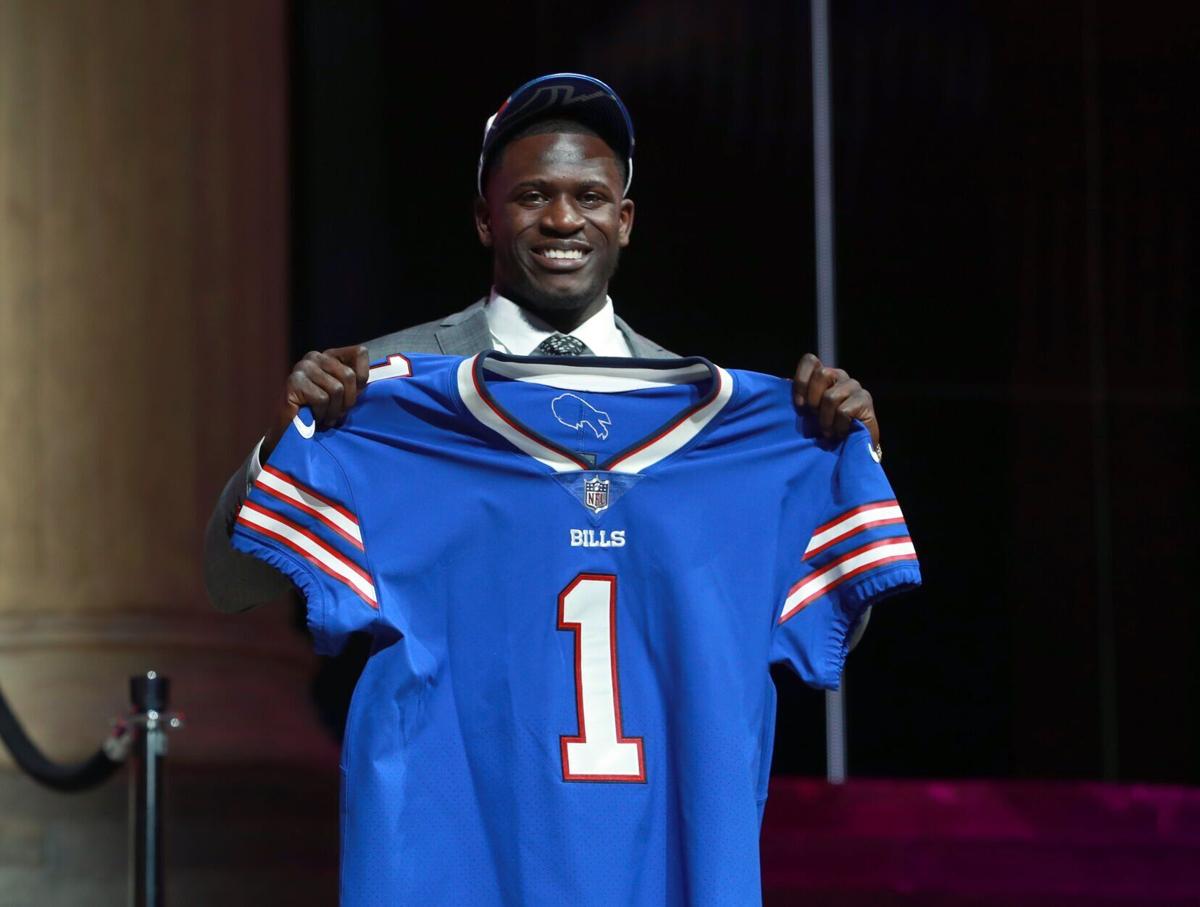
Cornerback has been a position of good fortune for the Buffalo Bills in the first round of the NFL draft.
Seven of the eight cornerbacks Buffalo has drafted in the first round since 1990 turned out to be good players.
Maybe the team will try to continue its success at mining the position this week. Cornerback is the biggest need position for the Bills, and it’s a prime option for them with the 25th overall pick – if a corner they love is available.
The success of first-round cornerbacks is a trend that holds up for the entire NFL.
In the 20-year span from 1999 to 2018, 80 cornerbacks were drafted in the first round. A total of 37 made the Pro Bowl at some point in their NFL careers, an exceptional rate of 46%. There were 25 clear-cut busts among those 80, and 50 of the 80 (62.5%) could be called hits. They had good NFL careers. Another five might be categorized as marginally OK players.
People are also reading…
It’s a good track record. Conventional wisdom holds that first-round picks have an approximate success rate of 50%.
“Yeah, I think it’s because of the way these guys can be utilized in the league now,” said ESPN draft analyst Mel Kiper Jr. “You have one, two, three, four cornerbacks playing on a team. So now if a guy’s not necessarily a lead corner, he’s still going to have a role. So your bust rate is going to drop because of that. You’re going to get contributions from these guys. They’re going to come in and they’re going to play. They’re going to be on the field.”
The 2017 draft class was an exceptional year for cornerbacks. New Orleans took Marshon Lattimore at No. 11, followed by Marlon Humphrey to Baltimore at 16, Adoree Jackson to Tennessee at 18, Gareon Conley to Oakland at 24 and Tre’Davious White to Buffalo at 27. All but Conley have been high-quality starters. Lattimore, Humphrey and White have made the Pro Bowl.
The 2018 class looks good too, with all three first-round corners – Cleveland’s Denzel Ward (selected fourth), Green Bay’s Jaire Alexander (18th) and Minnesota’s Mike Hughes (30th) – playing well. Eight of the 17 first-round corners taken from 2015 through 2018 have made the Pro Bowl.
Mark Dominik, the former Tampa Bay general manager, said pre-draft testing gives NFL teams a better handle on cornerback than some other positions.
“I think the top-end guys coming out of college have a lot of the traits you need,” said Dominik, now a Sirius XM NFL analyst. “We saw Denzel Ward get a big contract. He came in with celebrated ability as a top-end corner. You saw last year Jaycee Horn’s season ended a little early. But Patrick Surtain looks like everything you want him to be. A bunch of those last year it looks like they’ll be hard-pressed not to be top corners.
“My answer would be I think the reason why there might be a better hit rate is the one thing throughout the combine process is when you go to the Senior Bowl, when you go to the combine or individual workouts ... those drills all are set up for athleticism,” Dominik said. “I think that might be the reason why you’re seeing a little more of a hit rate. You can’t hide an unathletic corner.”
The consensus top four cornerbacks in this year’s draft are Louisiana State’s Derek Stingley Jr., Cincinnati’s Sauce Gardner, Washington’s Trent McDuffie and Clemson’s Andrew Booth Jr.
Stingley and Gardner seem sure to be taken in the first 15 picks, if not the first 10.
The average of four cornerbacks drafted per year in the first round has held up over the past 10 and 20 years. The average number of corners taken on Day 2 (rounds two and three) is 8.5 over the past 10 years. Last year, 16 were taken in the first three rounds. In 2016 and 2017, 15 were selected.
“I think you’ll see four go in the first round this year,” said former Bears college scouting chief Greg Gabriel. “You see the passing game in college, they’re throwing the ball so much, corners have become more important in the college game.”
Gabriel says that like any position, drafting cornerbacks that fit the defensive scheme is key to the player’s success in the NFL.
“The key is what are they playing,” he said. “Are they playing predominantly one coverage or are they doing multiple coverages? In this year’s draft, some are proficient in man, some in zone. You don’t always get a guy coming out of school that knows how to play all phases of the game, so you’re guessing a little bit. You work your coverages to the strength of the guy you’ve got.”
Each of the top four cornerbacks in the 2022 class has scheme versatility. McDuffie arguably is the best zone-coverage cornerback in the draft class but has the traits to play man, as well.
Obviously, Bills General Manager Brandon Beane could decide there is better value at No. 25 at another position, such as wide receiver or running back.
The next two cornerbacks on the draft board arguably are Washington’s Kyler Gordon and Florida’s Kaiir Elam. Both have scheme flexibility, too.
The Bills like their cornerbacks to be willing tacklers and have long arms. White has exceptional arm length at 32⅛ inches. Clemson’s Booth has good arm length, at 31½ inches. McDuffie's arm is a tad shorter at 29¾. Gordon is 31 inches. Elam is 30⅞ but he’s tall, at 6-foot-1½.
The one cornerback who doesn’t fit the Bills’ physical profile is Auburn’s Roger McCreary, who could be in play when the Bills select in the second round at No. 57. While he has put together an impressive body of work on the field, his arms are just 28⅞ inches. Only one cornerback has been drafted in any round in the last 10 years with shorter arms.
“Ironically, Roger McCreary, who doesn't have that length that you would like, he actually is probably the most similar player to Tre'Davious White,” said NFL Network analyst Daniel Jeremiah. “Now, he's not quite as gifted, but he's a similar type player in terms of he can play press, he can play off, he's got really good awareness and ball skills.”
Besides White, the other cornerbacks drafted by the Bills in the first round since 1990 were: Stephon Gilmore, Leodis McKelvin, Nate Clements, Antoine Winfield, Jeff Burris, Thomas Smith and J.D. Williams. Only Williams qualified as a bust.