

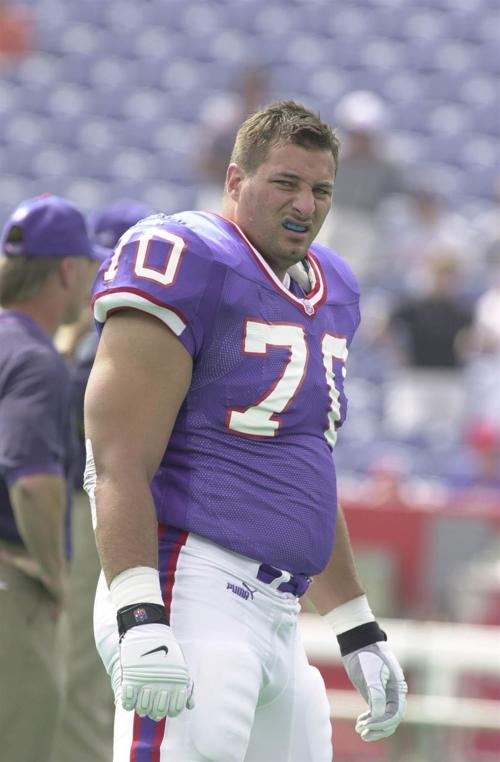
John Fina tries to keep himself occupied, almost to the point of distraction, when he watches football. Cooking usually does the trick.
“Because when I sit down and watch the game, I start to get all amped up,” the former Buffalo Bills offensive tackle said by phone from his home in Tucson, Ariz.
Fina, now an account manager for a startup pharmaceutical company called Ocular Therapeutix, describes himself as a “cursory observer of specifics.” Most of what he observes involves his former team, with which he spent 10 of his 11 NFL seasons after the Bills made him a first-round draft pick from the University of Arizona in 1992. Fina’s last year, 2002, was with the Arizona Cardinals, whom the Bills face Sunday at State Farm Stadium.
Even without being too deeply analytical, he has plenty of insights to offer on the Bills’ 7-2 start. After all, Fina spent time as an assistant offensive line coach at his high school alma mater, Tucson’s Salpointe Catholic, when his son, Bruno, was an offensive lineman there. Bruno received a football scholarship to UCLA, where he’s a freshman.
People are also reading…
Fina also has been an analyst for television coverage of college and high school football games, and he makes monthly appearances on Joe Miller’s Overreaction Bills podcast.
“What I saw from the last game against Seattle was very clearly that this coaching staff is open to weekly evolution with their game-planning,” Fina said of the Bills’ 44-34 victory against the Seahawks. “How do you score 44 points to win a game by running the ball for only 34 yards? That's incredible. I like that about the team. It's exciting, it's dynamic. They look like they're having fun.
“All of the wide receivers that we have are fantastic, so much fun to watch, so many weapons. One of the things that I took away from the game against the Patriots was, ‘Let's get some intermediate throws.’ And they did that (against Seattle). I'd like to see the play-action pick up against Arizona.”
How’s that for cursory?
Here’s more.
“I think right now, the offensive line is playing good,” Fina said. “I don't think they're playing fantastic, but they're playing good across the board. Josh Allen is kind of a ‘Kiss Me Deadly’ for the offensive line. He did this a little bit better in the last game, but he has a tendency to leave the pocket rather than just kind of moving around in the pocket. That's always bad for tackles, because in your mind there's a guy back there about seven and a half or eight yards, and that's sort of a defining point for your pass set and what you're trying to accomplish. But sometimes, when he leaves the pocket, he exposes those guys on the edge.
“Defensively, yeah, OK, so you miss the big guys in the middle. There's been some injuries, a lot of rotation, guys are picking up the slack. I think they're still trying to figure out how to defend against the run a little bit better. Some of the things that I've seen on the defense is disengaging off run blocks on the proper side of the run. And I noticed they started getting more aggressive and coming down a little better against the run. We've got to get more pressure from a four-man rush. And we've got a new kicker that needs some nurturing, but he seems like he's doing pretty good job.”
Fina, 51, said he cherishes the time he spent with the Bills. It is something his four children (two in college, one in high school and one in junior high) only know from photographs and video and their father’s stories, which he’ll happily share Sunday during a Bills Backers event in Denver.
In the latest edition of One-on-One Coverage, The Buffalo News spoke with Fina about his playing days, former teammates, former coaches, the Doug Flutie-Rob Johnson quarterback controversy, and how offensive line play has changed through the years.
Buffalo News: You joined the Bills at an interesting time. It's one thing to be on the ground floor of that Super Bowl run. It's another to come in two years after it started. What was that like?
John Fina: I was fortunate. Of course, there was a ton of stress and pressure, being the first-round pick, for me to contribute. Now, the expectation wasn't that I was going to contribute (immediately), because they had the offensive line set. To be fair, I don't think they really knew exactly where I'd play. My entire rookie year, I took every snap at center on the scout team, which was both fun and educational. I was fortunate because there was just so much learning to be had. And that offensive line group was great. I mean, they'd give you the requisite amount of crap for being the first-round pick. You took it from your teammates, too, and you had various duties that were more comical than hazing.
But it was a great place to end up, because they were loose. The pressure to succeed wasn't the same as a losing team trying to turn around an aircraft carrier at 20 knots. We just had to continue to build it. I couldn't have fallen into a better situation. Had I gone somewhere, whatever round it was, where I would have had to have played immediately, I think it would have been a disaster. I don't think that I was ready physically, I don't think I was ready mentally to be exposed to that type of football. So, for me it was, it was an optimum situation.
I got to go to a Super Bowl in my rookie year and I got to help take us to a Super Bowl my second year. I just have so much pride and fond memories of battling in each and every one of those games, some coming up short but more coming up positive. And losing the Super Bowl is not a defining characteristic of somebody or a defining event in somebody's life. The defining events are scattered throughout your entire career, not the scoreboard at the end of just one game.
BN: What were some of the biggest takeaways from your time with the Bills, the highs and lows?
JF: Honestly, I don't think about too many lows. It's a little bit like parenting. All of our kids misbehave, but they're just a joy, so if you spend your time thinking about all the disappointing episodes or painful episodes, you're just not really doing yourself right, and life is so short. So, I focus on all the highlights, like beating Kansas City at home in the (1993) AFC Championship Game and just knowing how hard it is to get to a Super Bowl. How many people have played in Buffalo since I and those players have left didn't even sniff a Super Bowl? I love the City of Buffalo, which was where I lived when I was there. If the weather wasn't so horrible, I probably would have never left. But it's just not for me.
I remember guys just getting along and trying to find an outlet for what is really a stressful job. People don't know about it, but if you only had 16 opportunities to prove that you are worth bringing back again next year, that's a lot of stress.
BN: How difficult was it to go through that divisive quarterback controversy between Doug Flutie and Rob Johnson?
JF: I mean, historically, of the number of times that staffs have tried a dual-quarterback system, how often has it worked? And how often has it not worked? I think it sort of weighs in the direction of not working. It's just like you can't please all of your kids. You can't be everything to everybody and if you're the quarterback, you want to play. Both those guys are competitors and then you see politicking going on. Without weighing in on which one it would have been, I think, the wiser move just to select one and go with it.
BN: What was the culture within the team like at that time?
JF: Let me give you a little insight into culture. People throw that word around a lot. We had the best culture in the building with the Buffalo Bills, and then it changed. It took a millisecond for it to disintegrate. The thing that turned the culture on its ear in Buffalo was when Wade Phillips left. Man, I love that guy.
Wade Phillips brought that level of humanity to the game. He was a real person. He talked to you regardless if you were playing well or you were playing poorly. And he congratulated you when you did well and when you didn't, he'd chat you up. Growing up in football like he did, he's a fan of the game. He treated you like an adult; he didn't want a kindergarten class, sort of snot-nosed little boys running around. You just did your thing with him and he was good with that.
BN: What were your impressions of Wade's successor, Gregg Williams, during that one season he was your coach?
JF: You know, looking back on it, I wasn't thrilled with Gregg and the way he did things. He's had a great career, he's a brilliant defensive mind. I don't think that he was as responsible for kind of the changes as the other guy. Hindsight's always 20-20, but the place certainly changed.
BN: The other guy? You mean Tom Donahoe, the GM?
JF: I didn't say it. You said it.
BN: What was it about Tom that impacted the culture?
JF: I just say, cultures change. I didn't like what some people used to write about me, so I try to keep it as even-handed as possible. I left there and I played my last year with the Arizona Cardinals. And it was no better. It's just so hard to succeed if you don't have everybody, from facilities management to security to your quarterback to the PR department, happy to be at work, rooting for one another. It's hard to make a go of it.
You hear around the league, among players, places that you don't want to go, and the Arizona Cardinals were one of them back then. I didn't think anything could be that true and it was. They turned it around, obviously. They added guys like Larry Fitzgerald, who's a first-ballot Hall of Famer for good reason. They have chances now because of guys like that, chances now because the owners understand much better, I think, than they probably did in the '80s what it meant to have players happy, the community happy, employees happy to achieve those goals.
BN: Being in Arizona, how often do you watch the Cardinals play?
JF: I haven’t watched them much this season. I do like to, when I get the chance, because of Kyler Murray; he’s so exciting to watch. But my 14-year-old son, Roman, is pitching great and he’s hitting great and these club baseball teams tend to have games on Sundays. So, I’ve been watching a lot of baseball.
BN: What was the relationship like between all you guys on the line?
JF: There's just such a camaraderie and kind of joy of living, joie de vivre, so to speak, between Dusty Zeigler, Jerry Ostrowski, Robert Hicks, Ruben Brown, Victor Allotey, Corbin Lacina, those were kind of on the back end. But then in the beginning, with Kent Hull and Jimmy Ritcher and Howard Ballard and Will Wolford and, of course, the incomparable Glen Parker, these guys were all personalities and everybody had something to say, everybody had a quip, good-natured stuff. When people talk about team sports, they're not really talking about winning a game. They're talking about the stuff that you get from preparing and working as a group. And those experiences are irreplaceable.
BN: What have you seen in the way offensive line play has changed from when you were in high school and college?
JF: Oh, it's night and day. The real thinkers in offensive line technical play through the NFL basically just gave a gift to every other level. I mean, there's really no excuse now to not have technique. And I think it is sort of a hand-in-hand evolution. Initially, you couldn't use your hands as an offensive lineman. Now, you can. Coaches started working on technique, but then the evolution of the game took over and now it's so exciting with all these spread offenses.
Back 40 years ago, everybody ran a power play, everybody had a counter and there wasn't a lot of real creativity in the run game. Now, the run game is just incredibly exciting. And, of course, the passing game has evolved not dissimilarly. So, you ended up with a situation where the demand for smarter players and prepared players had to match the scheming that defenses would kind of dictate at you. If you were always kind of victimized, if you’re always caught on your heels, you weren't going to be able to protect very well, you weren't going to be able to run very well.
Bills Mafia is a fan movement co-founded by Del Reid and Breyon Harris about a decade ago.
Then, of course, the evolution of play-calling at the line of scrimmage by the offensive line went hand-in-hand with that. As defenses became more relaxed and less stoic and they moved around and had more personnel changes, where every down there were different guys on the field, offensive linemen were now trained to diagnose who the players are they have to block, the likelihood of their alignments and then what they might do on the snap of the ball.


