

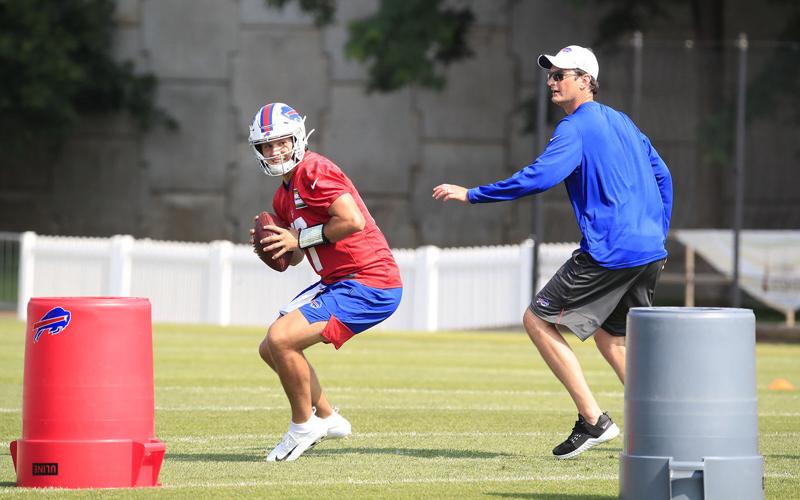
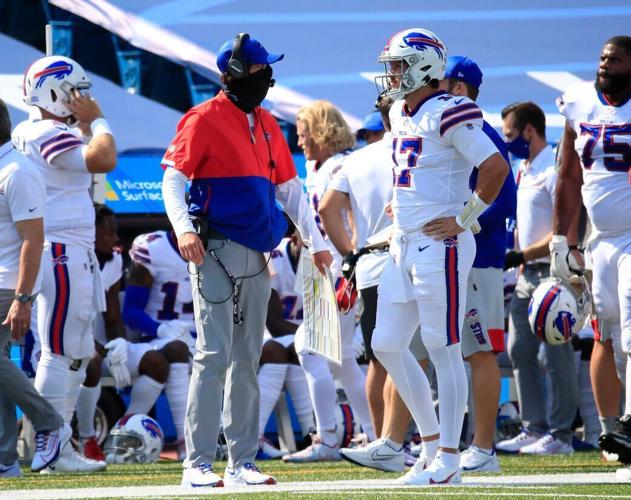
This is the eighth part of a series of questions facing the Buffalo Bills in the offseason. How big are the shoes new offensive coordinator Ken Dorsey is stepping into?
A lot of the heavy lifting on the Buffalo Bills’ offense already has been done as Ken Dorsey steps into the coordinator’s seat.
Josh Allen has been molded – with Dorsey’s help – into an established, elite NFL quarterback.
Stefon Diggs leads a quality wide receiving corps, as opposed to the cast of misfit toys Brian Daboll had at his disposal in his first season as coordinator in 2018.
Dion Dawkins and Spencer Brown are entrenched as the tackles on what is a quality pass-protecting offensive line.
In short, Dorsey is set up to succeed as he takes over the play-calling duties for the first time in his nine-year NFL coaching career.
People are also reading…
Expectations will be high. The Bills ranked in the top three in the NFL each of the past two years in scoring and yards gained. They were in the top three the past two years in third-down efficiency and the fewest three-and-out drives in the league. And the offense is coming off a postseason in which it was virtually unstoppable against two of the better defenses in the league, New England and Kansas City.
So which is it? Does Dorsey have giant shoes to fill? Or is he taking the wheel of the NFL equivalent of a Formula 1 Mercedes?
Let’s call it a little of both.
If the 40-year-old Dorsey isn’t ready for the promotion this year, he never will be ready. He is one of the winningest college football quarterbacks ever, compiling a 38-2 record for the University of Miami Hurricanes from 1999 to 2002. He spent seven seasons as a backup pro quarterback. He worked five years as quarterbacks coach for the Carolina Panthers. He has spent the past three years working under Daboll on Sean McDermott’s Buffalo staff. Dorsey was quarterbacks coach the past three years and last season added the title of passing game coordinator.
His promotion was the obvious decision by McDermott, despite rumors Dorsey might join Daboll with the New York Giants. In New York, Dorsey would have been working without an established quarterback and likely not calling the plays. In Buffalo, he gets to work with one of the NFL’s young superstar quarterbacks. If the Bills’ offense stays on its current path, Dorsey could be a head coaching candidate in two or three years.
Allen wanted continuity on offense. Everyone at One Bills Drive wanted continuity.
“I feel fortunate that Josh has only had one offensive coordinator,” general manager Brandon Beane said after the season. “You see young quarterbacks struggle that have to go through multiple coordinators. So that was one of the things that we put down. Stability in the offensive system and the coaches around him. So it’s been a great four years for him. Three of those years Ken Dorsey has been right there. . . . Look, we know what he thinks of Ken Dorsey. It’s very high. That matters to us.”
Allen has all the talent to make whoever’s calling the plays look good.
The challenge for Dorsey will be to keep the Bills’ attack near the top of the league while adjusting to changing personnel.
That’s what Daboll did during his entire tenure.
He spoon-fed Allen in 2018 on a run-oriented scheme that included LeSean McCoy, a fullback and receivers Zay Jones and Kelvin Benjamin, and tight end Charles Clay. He gave Allen a little more rein in 2019 with receivers John Brown and Cole Beasley while still relying heavily on the run game. The Bills ranked only 18th in first-down passing percentage in 2019. Then Daboll unleashed a dynamic passing attack in 2020, with Allen as the master distributor to Stefon Diggs & Co.
Even the 2021 campaign was a season of adjustments, even though the Bills “ran it back” with largely the same personnel. The Bills opened against Pittsburgh with their four-wideout set, spreading out the defense to try to reveal pre-snap coverages. But the Steelers were ready for it, sitting in shell coverages and getting pressure with just four rushers.
The emergence of tight end Dawson Knox ditched the four-wide set. Daboll continued to use more run-pass option plays, going from 9% in 2020 to 17% in 2021 (seventh most in the league). And in some matchups (like against Kansas City), Daboll successfully incorporated more tight formations, with Reggie Gilliam on the field, making it tougher for the defense to get hands on receivers and enhancing the play-action pass game.
Obviously, a big point of emphasis for Dorsey & Co. will be to get more efficient production out of the running backs and better run-game push from the offensive line. The Bills ranked fifth in pass attempts and 13th in rush attempts last season. That ratio is not likely to get tighter.
But the Bills were 31st in rushing attempts by running backs. That number needs to increase some. While Allen always is going to be a weapon in the run game, his number of rushes could stand to decrease a bit, with his own preservation in mind.
The Bills have gotten to the point where they are diverse in the way they can use varying personnel groups and formations to attack defenses. Daboll was mixing those combinations brilliantly at the end of the season. It will be Dorsey’s challenge to keep it going. It’s worth noting he has an accomplished new quarterbacks coach to aid in the process in Joe Brady, former offensive coordinator in Carolina.
“I know Dorsey is going to have his mix-ups, his own style of calling plays, his own scheme, if you will, of how he wants to do it,” Allen told The News at the Super Bowl.
“Whether he's a 21, 12, 11, 10 personnel guy. That's something we'll figure out going on along the way. It's a fun challenge now to kind of work through and develop his own playbook and to be a part of that. Figure out what we do like, what we don't like, what we're going to get rid of, what we're going to add.”


