

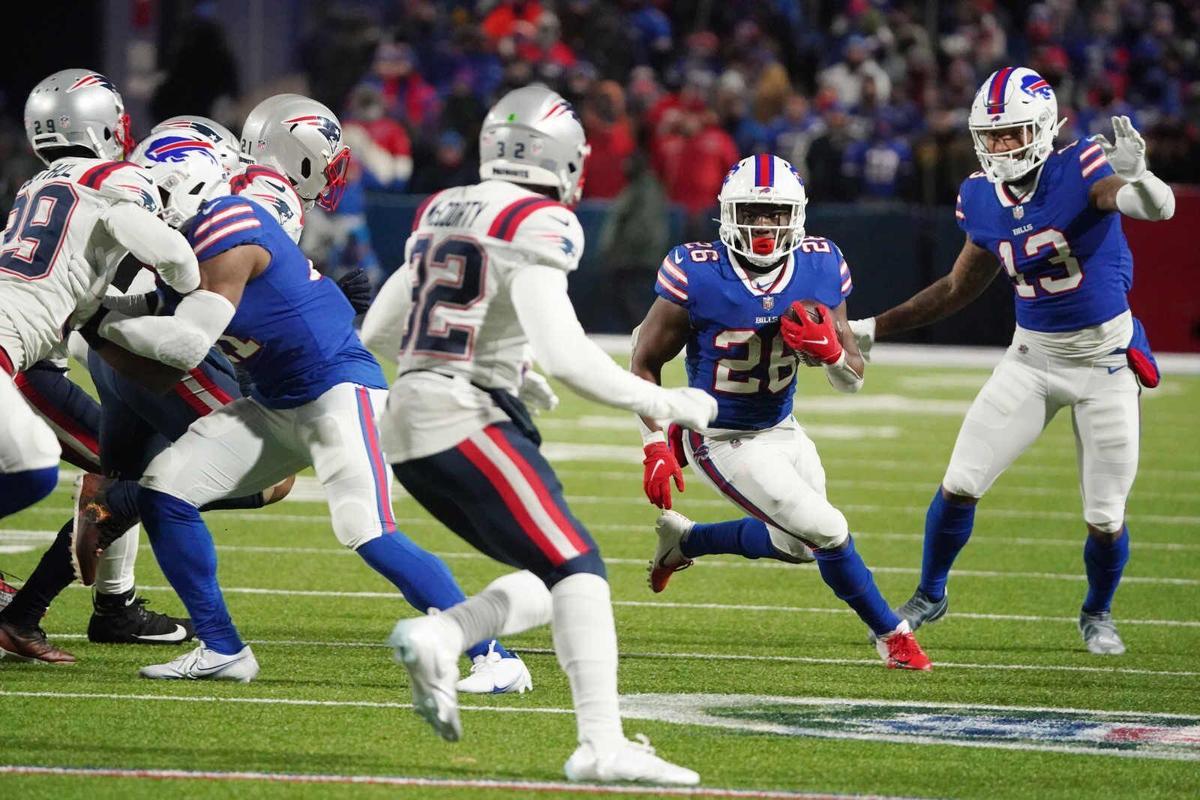
This is the fourth in a series of questions facing the Buffalo Bills in the offseason. Did Devin Singletary do enough to come back as the No. 1 RB?
Time and time again in December and January, Bills coach Sean McDermott was asked what running back Devin Singletary had done to have a breakthrough. Even as Singletary’s play and statistics kept improving, McDermott said there were no major changes behind the scenes. Singletary had rewarded the Bills with a level of play they believed in all along.
As the season came to an end, Singletary was asked directly whether he feels he’s done enough to solidify his role as the Bills’ No. 1 running back.
“I guess you could say so,” he said. “Yeah, I showed I’ve (grown). … It's something to build off of.”
While it’s not the most brash of statements, it’s true to Singletary’s usual nature. The 24-year-old running back is quieter when it comes to interviews. His end-of-year performance said plenty.
People are also reading…
He had six all-purpose touchdowns in four games to finish the regular season, with 323 rushing yards on 76 carries during that stretch. Then, in the postseason, Singletary added three touchdowns in two games. It all came as the Bills' offense found a better level of consistency.
“I think towards the end, we kind of got it to what we wanted it to be,” Singletary said in January. “But, of course, it can always be better.”
The Bills drafted running backs in the third round in back-to-back years, with Singletary in 2019 and Zack Moss in 2020. The team also brought in Matt Breida this season, rounding out the running back room. Breida is set to become an unrestricted free agent in March.
While Buffalo may look to draft a running back once again, the preference of current options is clear. Moss and Breida were both healthy scratches throughout the season, even before Singletary had his breakthrough. When general manager Brandon Beane looked back at the run game as a whole last season, Singletary’s jump was top of mind.
“Very inconsistent early, and we struggled to get that going, and … we definitely found a rhythm,” Beane said in January. “I thought Devin had his best stretch of his three-year career (in) December, January. … For a 200-pound guy, he runs with good power. I thought his vision was really good and catching the ball out of the backfield.”
Beane credited the offensive line with finding a rhythm later in the season and having better communication as part of Singletary’s success.
Singletary finished the regular season with 870 rushing yards and seven touchdowns on 188 carries. Five of the seven touchdowns came in the end-of-year stretch, where he tacked on a receiving score, as well. His and the offensive line's improvement has Beane optimistic about the general state of the run game.
“Something to build on and, hopefully, next year we won’t start out with the lull that we had this year,” Beane said.
The Bills finished sixth in the NFL in both rushing yards and in yards per attempt. Those numbers were bolstered by Singletary’s late season performance, but also by quarterback Josh Allen, whose 763 rushing yards and six touchdowns on 122 carries were second-most on the team.
The Bills are not a team that needs to overly rely on running backs, given Allen’s dynamic play. At times, forcing the run seemed to hamper drives. Still, coach Sean McDermott was consistent throughout the season voicing his desire to have the threat of the run, which would open up the offense. He also felt it helped Allen individually, particularly in giving him time and keeping him from taking hits.
“You’ve heard my message all season long about the health, the healthiness of an offense and being, the threat of being two-dimensional,” McDermott said in January. “And I firmly believe in that. You saw the results, to your point, of when we were really rolling, we had a good – I don’t want to say a good balance, I don’t like to use that word, but a good ebb and flow.
“Just the run and pass and the action game, and some of those things, as well. So I think that that helps the offensive line when you can do both.”
With former offensive coordinator Brian Daboll off to coach the New York Giants and the usual roster rotation, there will be tweaks to the Bills' offense. Singletary is less focused on those changes and more on what he can tweak in his own game the next few months. He spent last offseason in his home state of Florida, where he worked on having more explosive runs. He’s eager to find more to work on.
“Back to the drawing board,” he said. “(There’s) always something that you can improve at. It's going to get harder, like your workouts got to be harder, the way you prepare has to be harder. It's just all about being harder, that's what it's going to come down to.”


