

Jim Kubiak has been analyzing the play of Buffalo Bills quarterbacks for BNBlitz.com. Kubiak is the all-time leading passer at Navy, has played in the NFL, NFL Europe and the Arena Football League and has been a coach and executive in the AFL. He spent eight years as the radio analyst for the University at Buffalo and runs the Western New York Quarterback Academy to help develop the next generation of quarterbacks. He recently was named head coach at Hilbert College.
Overview
The final throw of Josh Allen’s season was a thunderous strike on a seam-post in Arrowhead Stadium with virtually no time remaining, seemingly to win the game. It was a spectacular read and throw in perhaps the biggest moment of Allen’s career, considering the Buffalo Bills had spent the previous offseason acquiring players for this very game.
People are also reading…
Two quick completions against the Bills defense, which was in surprisingly deep and soft, prevent-style coverage, suddenly gave the Chiefs the razor thin opening to tie the game, and the rest is history. The flip of the coin fell to the Chiefs, who took full advantage and scored the winning touchdown. The overtime rules prevented Allen from getting another opportunity. He had come to the end of his fourth, and dare I say his best, season as a pro.
Defining greatness in terms of quarterback performance comes down to more than just completions and touchdowns. It ultimately means winning championships, and beating the best, which results in a “new” best. No football coach will tell you that having the highest completion percentage or throwing the fewest interceptions makes a quarterback the “best,” though, statistically, these might be markers for how quarterbacks are guiding their teams to victory.
More often than not, statistical categories such as touchdown to interception ratio, turnover ratio, completion percentage and touchdown percentage demonstrate excellence and proficiency. However, these categories do not equate to greatness. And thus, truly amazing players such as Dan Marino, Fran Tarkenton, Warren Moon, Dan Fouts, Jim Kelly, Randall Cunningham, Philip Rivers and Michael Vick achieved these successes in every way except one, a Super Bowl ring.
The real reasons why these players didn’t reach that pinnacle has nothing to do with their quarterback abilities, but rather a combination of other factors, most notably, the team they played on, their supporting cast, salary cap room, coaching, injuries, turnovers and any number of hiccups or mishaps that resulted in poor team performance at key moments. There is an argument to be made that some blame should fall on the players themselves, but there is also a paradoxical argument that these players didn’t possess any less talent than those who won the Super Bowl.
Playoff performance
If winning the championship is the defining factor for greatness, then what is the next step for Allen? How does Allen become the last quarterback standing with the Lombardi Trophy in hand?
Allen played the best football of his professional career in this year’s playoffs. He completed 48 of 62 attempts for 637 yards and a staggering completion percentage of 77.4%, while throwing nine touchdowns and zero interceptions. He was sacked only twice in the playoffs, a dramatic improvement from the previous year when he was sacked eight times in the playoffs. Allen’s playoff magic set him apart from any other player as he was mistake free and unstoppable. He achieved a level of performance on our grade scale that is unparalleled, with consecutive 100% performance grades, avenging a regular season home loss against the rival Patriots and then doing his part to beat the Chiefs. It is seemingly impossible to play better than Allen did in the playoffs.
Patrick Mahomes threw 11 touchdowns in the playoffs to three interceptions, while playing one more game than Allen. Super Bowl-winning quarterback Matthew Stafford threw nine touchdowns in the playoffs while playing in two more games. Tom Brady, Aaron Rodgers, Joe Burrow and Jimmy Garoppolo came nowhere near the production of Allen in the playoffs. Allen protected the football better than anyone in the game and was arguably the hottest quarterback in the postseason. The point here is that Allen operated at a level beyond the quarterbacks who had the opportunity to go further. He gets checks in the boxes for his remarkable growth and for playing at the pinnacle of performance in the most important moment for the Bills in the Allen era.
Quarterback 'foundation'
Allen also gets high marks for his physical development, and honing those vital habits encompassed in what I call the quarterback foundation. There are three physical components: footwork, ball handling and throwing technique. Allen increased his accuracy consistently from 52.8% in his rookie season to 58.8% in his second year to 69.2% in his third year. This past season, Allen’s completion percentage decreased to 63.3%, which was the result of other factors: injuries to the offensive line, offensive play calls and his willingness to throw the football away.
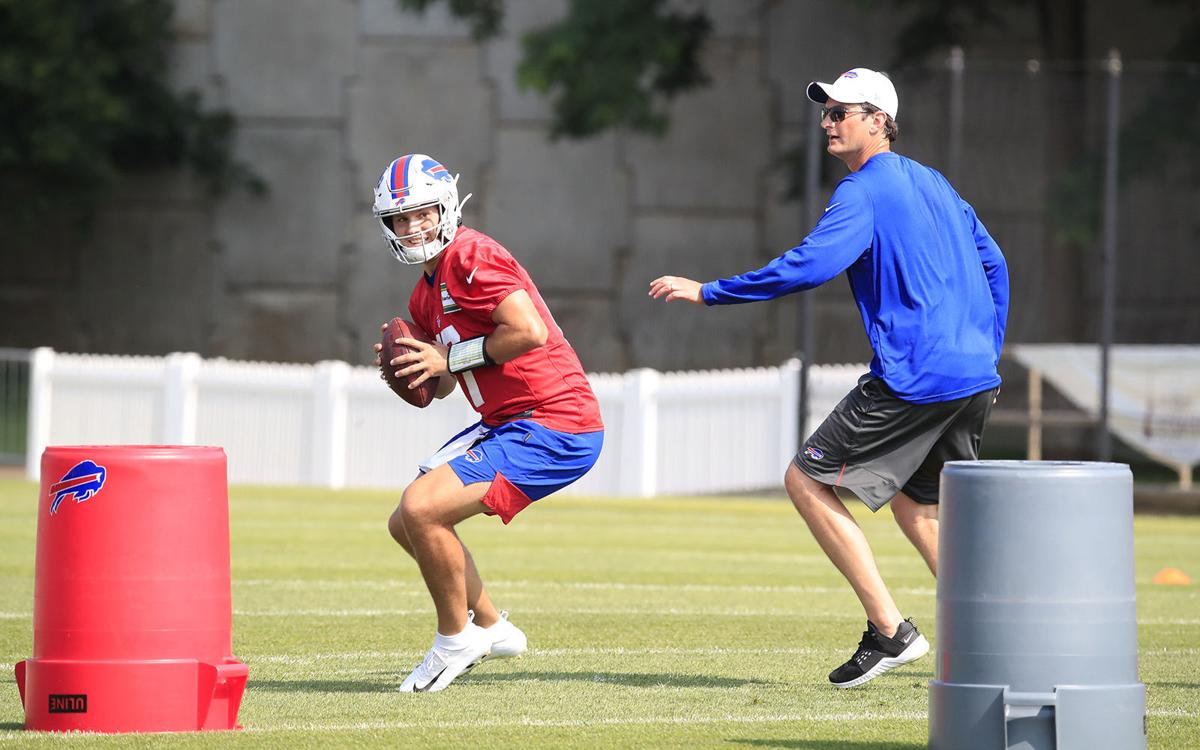
Every throwaway is an incompletion and detracts from his overall percentage. Allen also tried to take deeper shots down the field, rather than taking the underneath open routes, which he typically did in 2020. My point is that the reduced completion percentage was not due to poor technique or footwork. His footwork was precise and consistent. He did not miss throws because his feet were too wide on delivery, his elbow was too low or because he didn’t open up his hips enough. He was astonishingly accurate because of his consistent focus on perfection within his technique. His dedication in the offseason and his work with Ken Dorsey, then the Bills’ quarterback coach and now offensive coordinator, resulted in Allen being able to use his overall skills to the max.
Here is a comparison between Allen’s passing statistics in 2020 and 2021:
Completions - 2020: 396; 2021: 409
Attempts – 2020: 572; 2021: 646
Yards – 2020: 4,544; 2021: 4,407
TD passes – 2020: 37; 2021: 36
Interceptions – 2020: 10; 2021: 15
Yards/attempt – 2020: 7.9; 2021: 6.8
These numbers are comparable and demonstrate growth, despite the decrease in completion percentage. It might be difficult to see by solely looking at the numbers. The throwaways and the offensive line adjustments affected his completion percentage, but his production was every bit as good as his previous season.
Allen on the run
Allen continued to be consistently accurate, on time and virtually impossible to stop in 2021. Hiss rushing numbers suggest he was more dangerous, rushing for 16 more first downs and 342 more yards this season.
Here is a comparison between Allen’s rushing statistics in 2020 and 2021:
Carries – 2020: 102; 2021: 102
Yards – 2020: 421; 2021: 763
First downs – 2020: 38; 2021: 54
Touchdowns – 2020: 8; 2021: 6
Yards/carry – 2020: 4.1; 2021: 6.3
Yards/game – 2020: 26.3; 2021: 44.9
The numbers reflect an improvement in Allen’s situational awareness, preparing to use his legs and run while facing man-to-man coverages. This also demonstrates former offensive coordinator Brian Daboll’s confidence in and use of Allen as a primary running back in designed quarterback sweep schemes.
Play-action development
Allen’s play-action was also better than in any of his previous seasons. He has undeniably devoted considerable time to honing his play-action fakes, extending the football out into the running back’s belly and then pulling the ball back to his belt buckle. This action hides the football very well, as you can see in the videos. When an offense combines the extension-retraction movement with disciplined running backs who pretend they have the football, they create indecision in the minds of defensive players who must first respect the running game. Allen’s investment in improving this aspect of his foundation paid big dividends in offensive production and keeping the defense off-balance.
Allen’s next step
The statistics continue to point in the direction that Allen is a top quarterback in the NFL and has all the necessary talents to help the Bills win the Super Bowl. Like those great players listed above who had amazing careers but did not win the Super Bowl – and all the Super Bowl-winning quarterbacks – Allen is just as talented and has perhaps more raw ability.
Allen’s next step isn’t physical or mental, though, he must continue on the same training path that has resulted in his remarkable ascent. His next step isn’t emotional, either, as he has clearly learned to manage his highs and lows within each game and during the grind of a season.
Arguably, his next big challenge will be handling change. Each season is a new chapter, with new characters, new situations and different obstacles. The NFL salary cap limits a team's ability to retain all their young, developing talent, as those players draw higher salaries in the market, salaries the Bills cannot afford, no matter how much they might wish.
The biggest change for Allen, the first one of his young career, will be adapting to Daboll’s departure. He and Allen had developed an extraordinarily close, personal relationship.
Daboll’s history and connection to Buffalo runs deep, being raised in West Seneca, attending St. Francis and the University of Rochester and lettering in two seasons in Division III.
Daboll also had 20 years with five NFL teams to develop his professional football and coaching philosophies under the direction of some of the greatest coaches of all time. Daboll’s resume includes five Super Bowl championships with the New England Patriots and one college national championship with Alabama. He has been an offensive coordinator for the Cleveland Browns, Miami Dolphins, Kansas City Chiefs and Alabama under Nick Saban, and coached other positions along the way including tight ends, wide receivers and quarterbacks. Clearly, his vast experiences helped guide the best out of Allen.
Daboll also took assistant quarterbacks coach Shea Tierney with him to the Giants. Allen had called Tierney the “most underpaid person working for the Bills.”
Allen’s success going forward will be tied directly to how he adjusts to Dorsey and new quarterbacks coach Joe Brady and plays without Daboll’s creativity, his depth of experience and his personal friendship. The Buffalo offense is going to change with new ideas and beliefs, and Allen will change, too.
Future success will be determined by how Allen evolves and grows with Dorsey. Dorsey has imparted great habits and developed a strong working relationship with Allen as well, but Dorsey does not possess the vast breadth of experience that Daboll did. Dorsey’s coaching resume has stints as quarterbacks coach with the Carolina Panthers (2013-2017) and the Bills (2019-2021). He also was promoted to passing game coordinator in 2021. Without question, Dorsey is a talented coach and tremendous leader, but he does not yet have the resume that Daboll had.
The beauty in promoting Dorsey, from coach Sean McDermott’s perspective, is that the Bills are able to maintain the same offensive system. This was a big win for the Bills, keeping the same offensive system for Allen to continue to grow in and to replace Daboll with a knowledgeable and trusted advisor. Allen had advocated for Dorsey’s promotion and was kept apprised of the hiring process.
“I think when he got here three years ago, my career definitely changed in terms of how I viewed the game of football,” Allen said after the season. “Just the way he approaches the game, he's competitive, he's smart. You know, he works his (butt) off. I appreciate what he's done for me over the course of my career so far.”
Now, Dorsey gets to build on a great foundation, on what Allen knows and believes, and they both get to continue the work that has begun in the Bills’ march to Super Bowl consideration.
Conclusion
Allen’s production, his leadership, and his potential to be the last man standing with the Lombardi Trophy will be attached not only to his continued pursuit of physical and mental excellence, but it will be linked to his ability to grow and thrive without Daboll.
Dorsey’s performance in his new role will be the single greatest factor to Allen’s success. The pressure to succeed has never been higher.
Dorsey, who as quarterbacks coach enjoyed time to work diligently with Allen on the little things, will now be faced with managing the entire offense, and matching and exceeding the expectations of past performance on offense. The relationship will be different.
The question is, can Allen, Dorsey, and the Bills franchise dominate in the face of change and hoist the Lombardi Trophy?


