HARTFORD, Conn.— Apparently, the ACC wouldn’t present much of a problem for the UConn women’s basketball team either. Monday night in Storrs, Conn., was a rough one for those who laughably doubted the Huskies should be the No.1 overall seed in the NCAA Tournament, a rough night for the crowd that sneers, “they wouldn’t look this good in a power conference.”
Oh, yes, they would. This team has all the answers, if only opponents would pose a few questions.
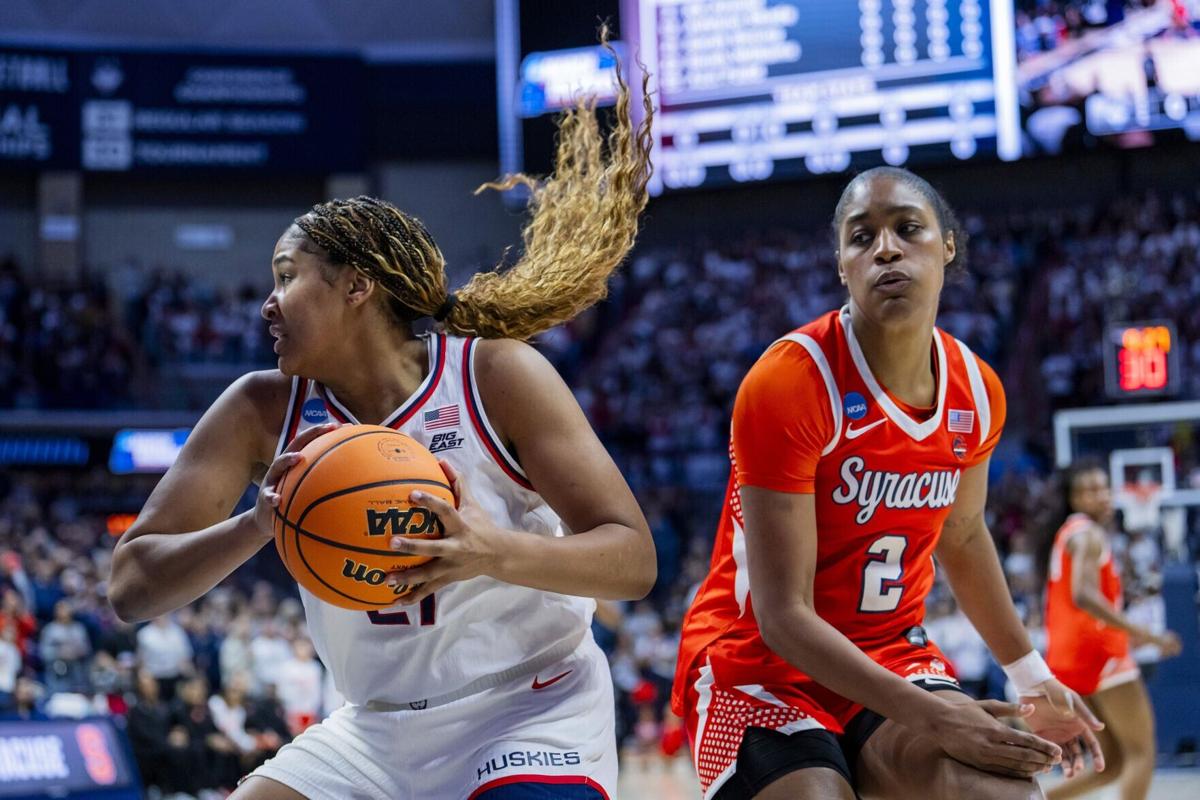
Syracuse came into the second-round matchup with a 24-8 record, 12-6 in the ACC, still a power conference, last we checked. By early in the third quarter, UConn led 67-12 and, channel surfacing during the commercial, I heard a local newscaster tell us the score “wasn’t a typo.”
If a definitive book is written about the UConn women, that might as well be a working title. “That score isn’t a typo.” Hey, I’m not one to overreact to one game, but three decades is a pretty good sample size. This state of affairs, it seems, never changes. After the game, Syracuse coach Felisha Leggette-Jack let her exasperation flow.
People are also reading…
“I asked God to touch my heart and help me speak kindly about this opportunity, but I also have a responsibility,” she began. “And when I tell my players they’re warming up, I think I have to do the same thing. For us to do what we’ve done, to continuously have to come to UConn, and every single school that I go to, from Buffalo to — it’s unfair to the young people. I don’t know what it is. Somebody said, is there something that they might have against me? If that’s the case, then we need to communicate about that.”
Leggette-Jack’s complaint is that she has been sent multiple times to UConn to play in the subregional the Huskies’ annually host. Whether they go strictly by metrics to assemble the brackets, or try to go by geography or other considerations, her teams at Buffalo and Syracuse have driven down this cul de sac too many times, with nowhere to go but back home.
She is not wrong, but it was a rather melancholy commentary. The problem is not the bracketology. UConn’s dominance is not bad for the sport, that’s absurd. All sports need a team at the summit taking on all comers, the Yankees, the Dodgers, the Lakers or Celtics, Tiger Woods or Scottie Scheffler, and Geno Auriemma’s job is to get all the best players he can and maintain that type of organization. What’s needed is more teams on the climb ready to challenge the gold standard, and after all these years women’s college basketball just does not have nearly enough of them. That is bad for the sport, and curmudgeonly commentators are apt to point it out.
The Huskies played a nearly flawless first half, then traded baskets in the second half to win 98-45. (That looks like it could be a real score.) Next, they go to Fort Worth, Texas, for the Round of 16 to play North Carolina, 28-7, 14-4 in the ACC, a team that went to overtime to beat Syracuse during the season. If Syracuse was that overmatched, it looks like more of the same coming on Friday. UConn is now 36-0, their only close game was against Michigan, which came from far behind to challenge late.
Recently, the debate has centered on whether the Huskies are better than last year, when they won championship No. 12. It’s a interesting debate, though it still limits the discourse to comparing one UConn championship team to, presumptively, another. With Paige Bueckers on the floor, and Sarah Strong and others a year younger, champs XII played like a classic rock band. This year, the Huskies are just classical, like a symphony with sounds, silences, melodies and counter-melodies. They lead the country in assists, taking their trademark ball-movement to a still more exquisite level. Auriemma turned 72 on game day, and the Huskies passed that mark in points with 3:44 left in the third quarter.
With two All-Americans, Strong, player of the year, and Fudd on the same team, and arguably several more of the top 20 players on the court together, Geno Auriemma can play virtually any style he wants. He chooses to coach a style that is beautiful basketball to watch, and in Connecticut, fans have loved watching it for many years. The rest of the country? … Well, maybe at the Final Four, South Carolina, Texas or UCLA, the same teams who were there last April, might be a challenge.
So Leggette-Jack believes her teams have been treated unfairly having to play UConn in the second round.
“What we’ve done and our body of work, to have to come and play the best team in the country,” she said, “I mean, Geno has this thing going, and I love what he’s done. But I thought, deserved a little more respect. To have to come and be in this particular bracket every freaking year is unacceptable. It’s wrong. Everybody that comes through Geno and UConn is going to get the wrath of what they can bring. I just know that this (Syracuse) team right here had a strong chance of getting beyond this particular level, and I am hoping that I’m not disrespecting anyone. I’m hoping that I’m not bringing shame to Syracuse by crying (over) spilled milk, but after a while … I just want the young people in my locker room to have a fighting chance.”
This has been the mindset for too many teams, for too many years, and it’s not a good place. “Oh, we’re not going to win, so just put us in a bracket where we can play a couple of more games before getting knocked out.” When Auriemma was annoyed to have Vanderbilt in his bracket, it was because he thought it was costing his former player and assistant, Shea Ralph, the chance to coach her team in the Final Four. Ralph is building something special at Vanderbilt, and could one day join the too-exclusive group of championship contenders. Right now, more than 60 of 68 teams start the tournament with a glass ceiling called the Elite Eight.
More schools need to take on the challenge and responsibility of flinging rocks at this sport’s time-resistent monolith. Develop coaches, look for them in different places, pay them more, invest more of that bountiful football TV money in women’s basketball so that all the best players don’t end up at the same handful of schools. This won’t, and can’t happen overnight, but UConn has dominated this game for so long — this could be Auriemma’s seventh undefeated team — one surely thought there would be at least some semblance of parity by 2026. There must be a way to get there.
Women’s basketball at all levels is growing, the TV ratings bear it out, the new WNBA collective bargaining agreement bears it out, too. The stars are charismatic, and come from high school with the skills to build and leverage massive social media followings into name-image-likeness riches. The women have “had next” for a while now, but to do something with it, they need more college teams to gather the resources and personnel to say, “Bring on UConn. We’ll let ’em know we’re here.” But there is no such challenge in sight and that, not UConn, is still hurting the game.
____