


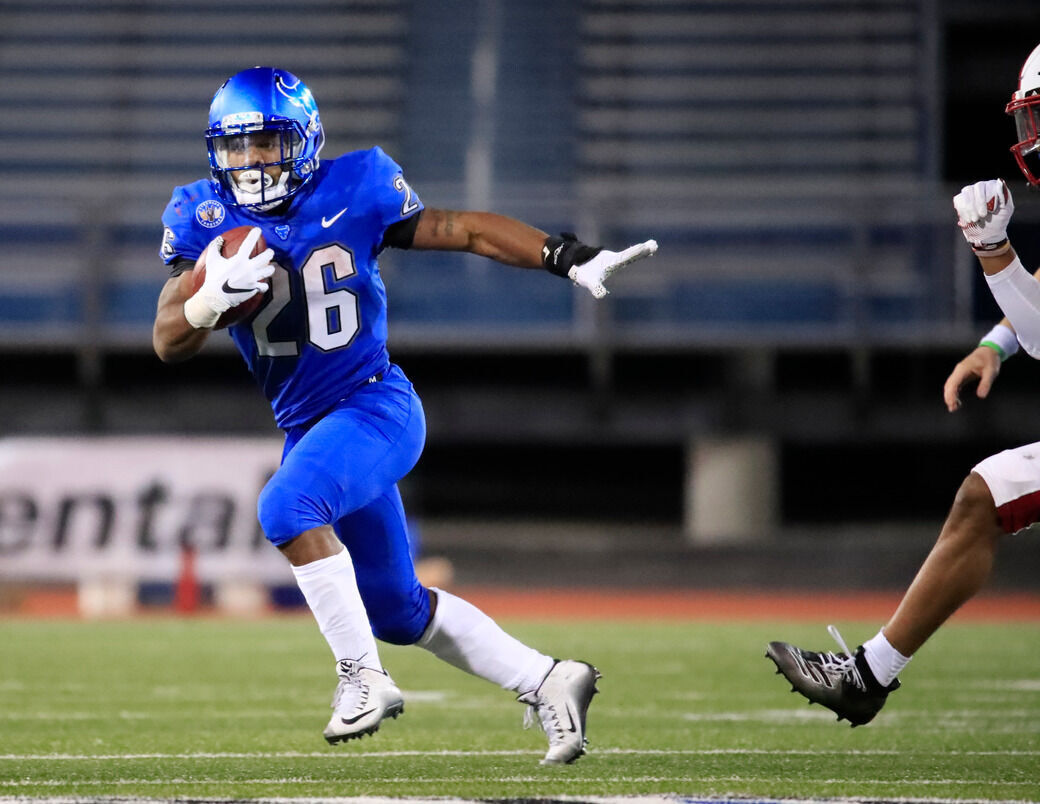
Jaret Patterson said the first person who wanted him to pursue his dreams of playing professional football was his fraternal twin brother and University at Buffalo teammate, James.
“My brother, just being the person he is, he told me that I need to leave,” Jaret told The News. “I gave it some thought, gave it some prayer, and I thought that this was the best move for me. I felt like I’d done everything I could do for UB.”
After three seasons with the Bulls, Patterson announced Dec. 29 that he would forgo his remaining college eligibility to declare for the NFL draft. A little more than a month later, he is living in South Florida and preparing for a future in professional football. His goal is to be known as more than just a running back who can pile up yardage. He wants prospective teams to see him as a versatile player who can produce on special teams or as a niche running back.
People are also reading…
“I’m the type of guy who needs to improve on every aspect of the game,” said Patterson, who is training at Bommarito Performance Systems in Aventura, Fla. “The teams I’ve talked to, they want to know what I can run, but if I can run routes and catch, but I need to improve on everything. Not even from the physical side of the game, but the mental side. Becoming a student, keep working and keep learning how to be a pro.”
Expanding his role
Patterson left UB as its second all-time leading rusher (3,884 yards) and as the leader in rushing touchdowns, with 52. He led the nation in rushing yards per game (178.67 over six games) in 2020, and tied an FBS record with eight touchdowns and set a single-game MAC rushing record of 409 yards Nov. 28 in a 70-41 win against Kent State.
It was right after the game against Kent State that UB coach Lance Leipold realized that Patterson's next step in football was quickly approaching.
"The Bowling Green, Kent numbers, the consecutive games, within his family, within the program, outside people, I think all those things started to say, 'This is heading in a direction that this will be his last year here,' and rightfully so," Leipold said. "We weren't holding him back from any records so that he could stay, or anything like that.
"Those two games, and where it was pointing, and the time frame of things, he made that decision (to turn pro), and we support it."
Patterson's gaudy numbers are eye-opening, but those won't be enough to get his name called by an NFL team.
In some ways, he said, he felt limited in his role at UB, knowing that he has aspirations to play professionally. Patterson practiced with UB's special teams units and hoped for a bigger role in the passing game, but UB's coaches chose to maximize his primary role as a productive running back, a decision that Patterson said he understood.
“You’re such a big part of the offense that sometimes coaches are scared you might get hurt," Patterson said. "That’s another reason why I decided to come out, to show teams that I am an all-around back. I just don’t run the ball. I can run routes, I can catch, I can block, and I can play on kick returns and punt returns.”
Patterson did not catch a pass this past season after posting 13 receptions for 209 yards and a touchdown in 2019 and seven catches for 62 yards in 2018. While he practiced with UB’s special teams personnel, he only returned one kick in his career, for 16 yards, in 2019.
Leipold said UB had to consider the physical impact of not stretching Patterson too thin, as Patterson played in 14 games as a freshman in 2018 and in 13 as a sophomore in 2019.
"You can't always be 100% cautious, but if your star running back is returning kicks and he gets injured on it, what's the first thing everybody's going to ask you, 'Why is your running back back there, returning kicks?' " Leipold said. "Some programs are really good at it. We've encouraged our players that one way to keep developing is to get engaged in special teams. Jaret was doing kickoff cover drills right after he'd rushed for all those yards (against Kent State). He wanted to do that, because he knows it's for his total skill set, especially with special teams being a part of it."
Draft analysts have noted that Patterson has quickness and strong vision, and that while he’s listed at 5 feet, 9 inches and 195 pounds, he can sneak behind bigger blockers in order to create more yardage. Patterson has the ability to make opposing defenders miss in space, he can break for long runs and he can create yards after contact. His 4.7 yards after contact per carry was tied for the nation's best with Virginia Tech's Khalil Herbert, according to Pro Football Focus.
"They know I can run the ball," Patterson said of NFL scouts, "but they’re going to be very surprised by what else I can do."
The NFL draft is scheduled for April 29-May 1 in Cleveland, and Patterson has been projected by several draft analysts as a Day 3 pick. NFLDraftScout.com ranks Patterson as the No. 8 running back in this year’s class, which includes Alabama’s Najee Harris, Clemson’s Travis Etienne and Oklahoma State’s Chuba Hubbard.
CBSSports.com ranks Patterson as the No. 6 running back, behind Etienne, Harris, North Carolina's Michael Carter and Javonte Williams and Memphis’ Kenneth Gainwell.
The Draft Network ranks Patterson as the No. 10 running back. Jordan Reid, a senior NFL draft analyst with the Draft Network, projects Patterson as a fourth- or a fifth-round pick. But it’s not just about where Patterson could be drafted – it’s about how he is projected to carve out an NFL career.
“Because he was the focal point of the offense from a rushing perspective, they didn't really enable him to show off his talents as a pass catcher,” Reid said. “He's really an unknown in that area. Proving that he can be a three-down running back is crucial to his success on the next level."
Recovering from injury
Patterson’s final games at UB weren’t what anybody expected. He sustained an injury to his right knee in the MAC championship game Dec. 18 in Detroit, when he was tackled by Ball State defensive lineman Jack Sape.
Patterson knew he wasn’t going to be at 100% for the Camellia Bowl game Dec. 25 in Montgomery, Ala.
“I was on the edge,” Patterson said. “I tried to practice, but I wasn’t going to help the team like I usually do.”
Instead, Patterson was on the sideline. James Patterson said after the bowl game that his twin brother and their family decided that Jaret should not play in the game.
“We thought it would be the best for his future, and that’s all that went into it,” James Patterson said. “It was kind of emotional, going into it, but he had to be the leader that he is. He wasn’t going to pout about it. But he was going to be the best hype man he can be.”
Four days after the Camellia Bowl, Jaret Patterson announced he would forgo his remaining college eligibility to turn pro.
Patterson said the knee injury he sustained did not require surgery, and that he is fully recovered and training with other NFL draft hopefuls.
“Running backs don’t have long careers, that’s just the name of the game,” Patterson said. “You have to strike while the iron is hot. That’s why I really felt comfortable with this decision.”
Preparing for pro day, combine
Patterson posted last week on his social media accounts that he had received an invite to the NFL scouting combine. He’s one of three UB products who announced that they have received combine invitations, including offensive tackle Kayode Awosika and defensive end Malcolm Koonce.
This year’s combine will be much different than in previous years due to the Covid-19 pandemic. The combine is traditionally held in late February and early March in Indianapolis, but the combine will be decentralized this year. Much of the combine will be in a virtual format for interviews and psychological testing, and there will be no in-person workouts.
The NFL said in a letter to combine invitees that they may be invited to Indianapolis in April for the final step in the evaluation process, following interviews and a player’s potential to be selected early in the draft.
Had there been a traditional combine in Indianapolis, Patterson would have been able to test against players from Power Five programs in strength, speed and agility drills.
Patterson, however, sees an advantage to the reformatted combine. Teams and player personnel who are scouting him will have to dig a little deeper to learn more about him as a professional prospect.
“I’ve told scouts and my parents this, that I’m kind of in the middle of the pack,” Patterson said. “I’m going to show my abilities but scouts now have to do their homework. They’re really going to watch the film instead of getting hyped over a 40 time, or a guy that benches 225 a certain number of times. That’s a good thing for me. I’m a football player, not a combine warrior.”
Patterson plans to participate in drills at UB’s pro day, which is scheduled for March 18 at the Murchie Family Fieldhouse. That’s where Patterson will have to test well in order to help his stock, show what kind of future role he can play and how he compares in relation to other draft-hopeful and current NFL running backs.
"There's a comfort in their own setting, and there's a lot of things under combine settings that an athlete doesn't get a chance to fully control," Leipold said. "Sometimes, in their pro day, they have a little more say in how it works, even though someone will put them through drills, or some of it is scripted. When Jaret comes back here, he'll have a chance to show all his skills.
"But I know his hunger, his desire, his work ethic, Jaret won't be a guy who says, 'No, I'm not doing that drill.' He's hungry enough, unselfish enough, that if someone wants to see him do it, he will do it and do it to the best of his ability."
As he prepares for the NFL, Patterson will face one difference next fall: He won’t play on the same team with his twin brother, James, for the first time in his life.
“It’s going to be fine, and he understands, and he knows we’re a phone call away from each other,” Patterson said. “You don’t know how it might work, because I might end up in Orchard Park (with the Bills), but he’s supporting me with this decision, 1,000%.”


