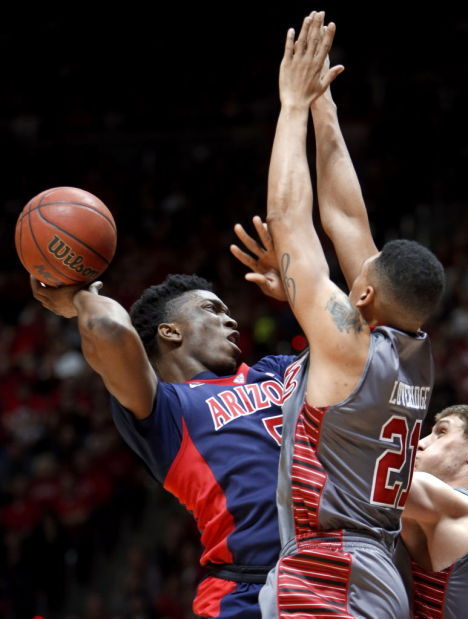
The truth, the whole truth, half-truths, shades of the truth and other items admissible as into-the-madness-we-go news:
Item I: It was disconcerting to watch referees Bob Staffen and Larry Spaulding walk into the Huntsman Center on Saturday. In what was essentially the Pac-12 championship game, the league sent two refs who have never worked in the Pac-12 tournament, which is symbolic of the league’s top referees.
Staffen’s two previous assignments were Grand Canyon vs. Texas-Pan American and UNLV vs. Utah State. Spaulding’s two most recent games were Rice-Florida International and Fresno State-Wyoming.
They were part of a 46-foul fiasco that required 2½ hours and was marred by lengthy reviews at TV monitors. It made the league look bad.
The third official was Dave Hall, a veteran of the Final Four and among the handful of the lead officials in the West. He couldn’t save the flow of the game.
People are also reading…
How bad is a 46-foul game? At the 2005 Elite Eight, in which Illinois beat Arizona 90-89 in overtime, there were 28 fouls. At the 2011 Elite Eight, in which UConn beat Arizona 65-63, there were 27 fouls.
Those games were called by elite-level officials.
The league’s top refs, all Final Four vets, were scattered over the map on Saturday. Dick Cartmell worked the Boise State-San Diego State game. Randy McCall was at the Air Force-Utah State game. Verne Harris called the Wyoming-UNLV game.
The Pac-12 makes its game assignments long before the season begins. Most referees know where they’ll be working, week to week, before October. That happens because many of the officials have day jobs; they make their travel plans and work schedules months in advance.
But it is on the Pac-12 to better anticipate showcase games; Arizona and Utah were generally picked to finish 1-2 in the league last summer. To staff such a meaningful game with a substandard officiating crew reflects poorly on the entire Pac-12 basketball operation.
Item II: The Pac-12 Player of the Year derby has surely been whittled to three players: Arizona guard T.J. McConnell, Utah guard Delon Wright and Oregon shooter Joseph Young.
There are three things to consider:
1. Young has attempted 482 shots this season. That’s nuts. McConnell has taken fewer than half that, 233. You couldn’t find two more different players.
2. Yet in the Oregon-Arizona games, McConnell outscored Young, 31-24. McConnell shot better from the field, 73.7 percent to Young’s 34.7 percent. And even though Young is not Oregon’s primary ball-handler, he committed five turnovers in those two Arizona games. Playing 62 minutes against the Ducks, McConnell committed one turnover. No contest. McConnell is the easy choice over Young.
3. Wright plays so seamlessly in Utah’s disciplined offense that he often doesn’t do enough. He has the size, quickness and skills to drive to the basket against anybody, and be a game-changer.
When Utah took a 47-41 lead over Arizona, Wright had been on the attack, already shooting 12 free throws. He’s an 84 percent foul-shooter. He is money when he attacks the rim. But in the final eight minutes, he stopped attacking. He became a jump shooter in those minutes (he was 0 for 4) and didn’t draw a foul.
I thought the game was Utah’s to lose as long Wright initiated action. Instead, the Utes unaccountably turned to 5-foot, 9-inch Plan B Brandon Taylor, who attempted seven shots in the final eight minutes. He made two.
Wright did not play well against Arizona. He was 7 for 19 from the field this season against Arizona (37 percent). By comparison, McConnell averaged 11.5 against the Utes, shooting 62 percent with 11 assists — and only five turnovers in 70 minutes.
If head-to-head competition counts, and it should, McConnell is the clear winner.
Item III: The most simple play in basketball is the block out. You put your body on the man next to you, eliminating him from the play. Like every team in college basketball, with more than 300 hours of practice since October, Utah has gone over the foul-line block-out play, what, 500 times?
Yet with 1:39 remaining Saturday in Salt Lake City, the Utes failed to block out Arizona foul-shooter Gabe York. It likely cost Utah a share of the Pac-12 championship.
If you study the video of that play, you’ll be surprised at how lackadaisical the Utes were at such a critical moment. They led 57-56.
And then they blew it.
York immediately knew his foul shot was off — “to the right,” he said. He defied Sean Miller’s fundamental order for a guard not to pursue a rebound on a free throw. Why? It’s more important to get back on defense.
But this time York’s follow-the-ball instincts were rewarded.
To the right of York, Utah’s Jordan Loveridge put his body on Brandon Ashley, but only with minimal effort. Ashley neutralized Loveridge, who remained static, about six feet from the basket.
On the left, Utah’s Dallin Bachynski stood his ground against Kaleb Tarczewski. But Bachynski was mostly a spectator; he didn’t react to York’s miss.
Immediately to York’s left, Utah guard Isaiah Wright extended his right arm in a lazy attempt to block York. The how-to-play-basketball manual says that Wright should’ve hustled to get his body in front of York, fully eliminating him from the play.
But by the time Wright moved into the lane, York had bolted past everyone — past Loveridge, Bachynski and Wright — for an easy rebound basket. It was Basketball 101 and the Utes were doomed, never leading again.
Item last: Arizona freshman Stanley Johnson attempted 19 shots at Utah. He made three. In retrospect, it’s amazing the Wildcats could win with those numbers.
Derrick Williams never attempted more than 17 shots in his Arizona days. Mark Lyons, a go-to scorer, didn’t have a game with more than 16 shots.
Nick Johnson twice took 20 shots in his junior season. Arizona lost both games, at Arizona State and in the Pac-12 final against UCLA.
In the Sean Miller system, less has led to more.