
The longest conference road trip in Power 5 college football is 1,536 miles. It’s Arizona-Washington.
It’s longer than the ACC’s lengthy Syracuse-Miami (1,417 miles) trip, and stretches beyond the Big 12’s longest junket, West Virginia-Texas (1,401 miles).
Arizona’s charter plane to and from Seattle is not a spacy, spread-out-and-let-your 300-pound-body-roam-the- aisles jumbo jet. The middle seats are full with football players.
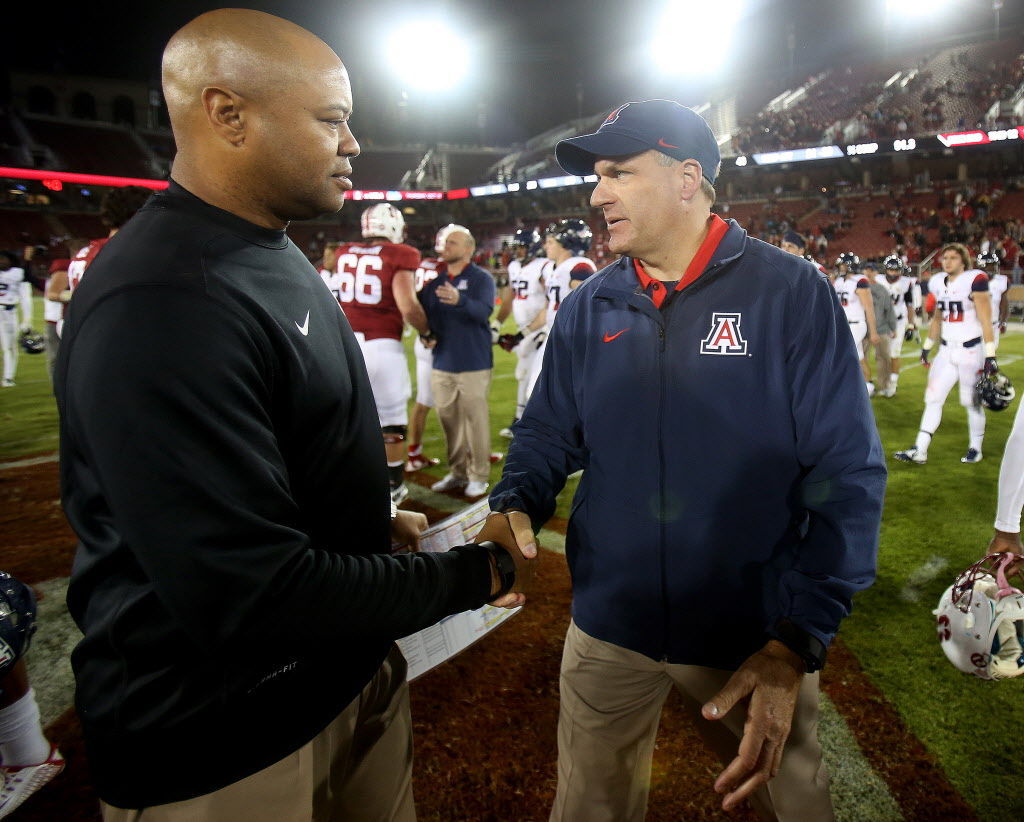
“We put the bigger guys in the aisle seats,” UA coach Rich Rodriguez said Monday. “It’s hard for them to sleep on a plane.”
The UA estimates its Sunday arrival at Tucson International Airport at 5 a.m. Is that any way to run a business?
Travel itineraries and start times have become the game within the game of college football. It’s the purists vs. the profiteers, and the profiteers always win.
People are also reading…
RichRod blew a socket last week when told Saturday’s game at Washington would not begin until 8 p.m. (or, in strict TV terms, more like 8:12 p.m.). He was seconded by Stanford’s David Shaw, whose team is to play Saturday night at 7:30 in Pullman, Washington.
It will be Stanford’s fifth consecutive 7 or later kickoff, which “wins” the Cardinal the Oregon State Traveling Trophy. A year ago, the Beavers played six games at 7 or later, including a Nov. 15 home game when it was 34 degrees at kickoff against Arizona State.
Thousands of normally occupied seats were empty.
It is believed the ’14 Beavers played the most taxing logistical schedule in league history, although to be fully accurate, OSU was blessed with a bye on Oct. 9. Arizona does not have a bye this season.
Shaw, whose team had a bye Oct. 10, told reporters the Pac-12 and its TV partners should create a more sensible schedule, “even if it’s some kind of a rotation.
“Let the TV networks be involved in the discussion,” Shaw said. “I’d love to say you could only play three 7:30 games in a year and the TV people can pick which ones. Every week when you play at 7:30, it’s tough.”
The profiteers don’t play fair. They play for money.
Unthinkably, bowing to ESPN, the Pac-12 permitted Washington State and Washington to play the 2014 Apple Cup on Nov. 29 in Pullman. Start time: 7:37 p.m. It was 19 degrees at kickoff.
This year, Pac-12 Commissioner Larry Scott looked the other way when Fox Sports 1 scheduled the Arizona-Washington on Halloween night in Seattle.
Scott last week told CBS that, “Our athletic directors and presidents and conference office agreed to give a certain amount of flexibility to broadcast partners to pick games and have nighttime broadcast windows. In exchange, we have blockbuster TV deals that have been incredibly beneficial to our schools and student-athletes from a resource and exposure perspective, and the trade-off is worth it.”
It’s worth it to Scott, the league’s No. 1 profiteer, who is paid about $3.5 million per year.
What do the UA football players get for the Seattle trip? For the second year, each player is guaranteed a free breakfast six days a week at the Lowell-Stevens Football Facility, a meal essentially paid for by the league’s media rights deal.
On Monday, UA safety Will Parks said another benefit of killing time in a Bellevue, Washington, hotel on Saturday is that the players get an extra peanut butter-and-jelly sandwich between meals.
For those who play the game, the league’s $3.1 billion TV deal comes down to brunch and a PBJ sandwich.
The real losers are the people who occupy (or once occupied) the seats at Husky Stadium and the league’s other Late Night With Larry Scott venues.
The losers are the purists who drive to Husky Stadium from the many distant suburbs in western Washington, and those Oregon fans who drive from Portland, and the Stanford fans who are spread all over the Bay Area.
Increasingly, many of them don’t drive to the late-night games anymore at all. The TV rights fees pay for their absence.
On Monday, RichRod laughed when he suggested the Pac-12 delayed the announcement of next week’s Arizona-at-USC start time until his weekly press conference was complete.
Bingo. An hour later, the league announced Arizona would play at USC at 7:30 p.m., (or 8:30 Tucson time), meaning the Wildcats will return to Tucson about 2:30 a.m. on Nov. 8.
Brutal.
Credit RichRod for standing up to the league’s front office. A year ago, Mr. Nice, former Oregon State coach Mike Riley, did not go public with his displeasure about the Beavers’ Pac-12 After Dark schedule.
If a visible man like RichRod makes enough noise, the Pac-12 office might be forced to be more sensible.
After Arizona joined the Pac-10 in 1978, it played 34 consecutive day games at Oregon State, Oregon, WSU and Washington. Its first Northwest night game did not come until a 1997 season opener at Eugene.
That’s when the league was run by old-school purists; the idea of playing mid- and late-season night games in cold-weather venues was considered absurd. Who would want to buy a ticket to sit in the rain in Seattle or Eugene?
But when TV money became the league’s most powerful force, the guy who would drive 115 miles to/from a WSU home game was the first casualty.
Saturday’s game in Seattle will be Arizona’s sixth night game in seven Oregon/Washington road dates since Scott assumed leadership.
It would be comforting to know that he stays up until midnight, munching on a PBJ, checking the late scores, before calling it a night.