
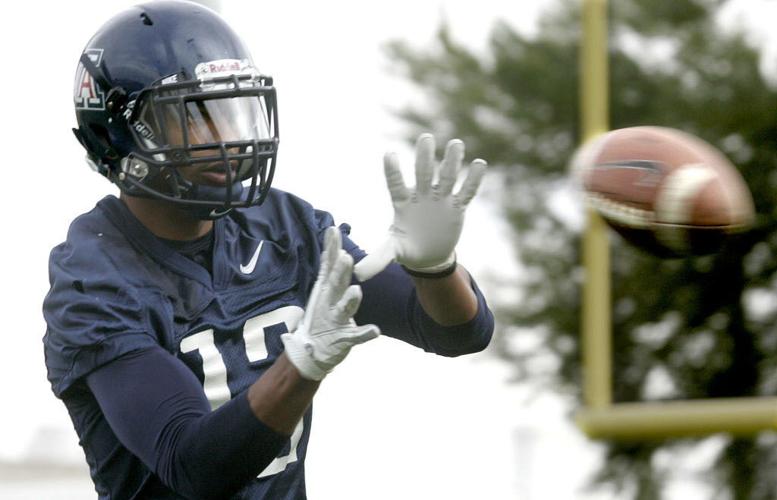
Can you imagine what Scooby Wright must’ve been thinking when an anesthesiologist stuck a vein over the weekend and surgeons prepared to put his knee back in working order?
Will I lose any mobility? Will the damage in my left knee keep me from playing in the NFL? Will I play like Scooby again or will I just be Philip Wright III?
Of all the people on the field last Thursday at Arizona Stadium, about 150 players, what were the odds that the most seriously injured player would be America’s most dominating linebacker?
It is a violent game with an indiscriminate pattern of destruction. The brightest stars are not spared.
The big event at Arizona Stadium in September 1993 was the showdown between the Desert Swarm defense and big ol’ USC tackle Tony Boselli, the most feared offensive lineman in college football.
People are also reading…
Arizona won 38-7 and Boselli spent the night in a Tucson hospital with a dislocated kneecap. He worried, and the Trojans feared, that his football career would never be the same.
Boselli missed five weeks. A year later he was a consensus All-American, the No. 2 overall pick in the NFL draft and, in 2014, elected to the College Football Hall of Fame. At 31, when Boselli was forced to retire after nine NFL seasons, it was a shoulder injury, not the knee he busted up in Tucson, that ended his career.
“I’m fine with it,” he told reporters then. “I had my hip replaced 12 weeks ago, and I have a bad shoulder from playing. It hurts to walk around, but if I could do it all over again I would.”
Scooby knows the risks, too.
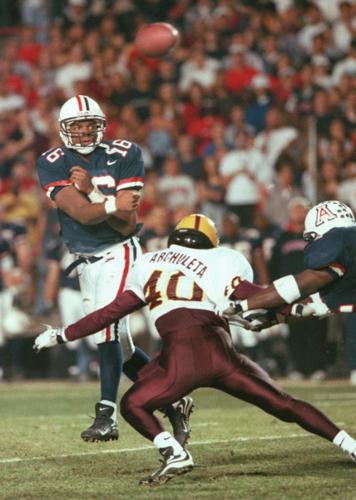
In retrospect, it’s remarkable that Arizona’s Hall of Fame foursome — Ricky Hunley, Rob Waldrop, Tedy Bruschi and Chuck Cecil — all played their final three seasons without missing a start.
But many of the UA’s leading players have been in the wrong place at the wrong time and required knee surgery. The majority were able to return to their pre-surgery production levels. Here’s a group of 10 ex-Wildcats who know what Scooby is feeling:
1. John Conner, quarterback. After putting in two seasons on the depth chart, Conner finally earned a start in the 1984 opener against Fresno State. His knee buckled and he missed seven weeks. By the time he returned, Alfred Jenkins was firmly the starting QB.
2. Randy Robbins, cornerback. Robbins and teammate Julius Holt, a defensive lineman, collided while co-hitting a running back in 1980. Robbins’ knee was wrecked. He returned a year later and by 1983 was a first-team All-Pac-10 cornerback who went on to play in 131 NFL games.
3. Jeff Hammerschmidt, safety. The Hammer played so well in the first seven games of 1989 that he became a first-team All-Pac-10 safety. But in garbage time in a 38-14 victory over Pacific, Hammer tore up a knee with five minutes remaining. He was back in 1990, his senior year, but had lost a half-step, scuttling his NFL hopes.
4. George Malauulu, quarterback. Moving into the starting lineup as a 1989 freshman, Malauulu shredded his knee while running an option play at Cal. Much like Scooby against UTSA, it was essentially a non-contact play. After ACL surgery, Malauulu returned for three seasons, throwing for more than 2,600 yards and running the ball 227 times.
5. Mike Ciasca, tackle. The nation’s No. 1-ranked prep tackle at Sahuaro High School, Ciasca redshirted as a freshman, 1990. At training camp 1991, he tore up his right knee and required surgery. Ciasca returned to start three games in 1992 before hurting his shoulder, also requiring surgery. In 1993, after six starts, he required back surgery. He retired from football in training camp, 1994, with a back injury.
6. Richard Griffith, tight end. The Catalina High grad went on to play seven years and 90 games in the NFL, but he required ACL surgery as an Arizona junior in 1991. The surgery was so successful that after starting in ’92, he was a fifth-round draft choice.
7. Ortege Jenkins, quarterback. He ripped up his knee while practicing with the UA basketball team in November 1996. After surgery, Jenkins returned to start at QB (and throw 19 TD passes) in the 1997 season, share the job in 1998 and 1999, and become the full-time starter in 2000.
8. Jake Fischer, safety. After tearing his knee up in the 2011 spring game, the Ironwood Ridge High grad missed all of the ’11 season but became a starter in 2012-13, leading the UA in tackles both seasons.
9. Adam Hall, safety. The Palo Verde High All-American tore up a knee in spring camp, returned at the middle of the 2011 season, and then re-injured his knee in the 2012 spring game, effectively ending his football career.
10. Art Luppino, tailback. The NCAA’s leading rusher in 1954 and 1955 injured his knee in training camp, 1956. Given the medical technology of that period, he did not undergo surgery. Although limping notably, he was moved to the third team and rushed for 327 yards, about 1,000 below his two previous seasons. He then failed a physical when the Washington Redskins examined him before the 1957 NFL season. He never played again.
Across a period of 55 years, Luppino and Hall became the most notable UA football players whose careers were ended by knee injuries. Most have been more fortunate.
In recent years, UA starters Adam Grant, Dan Pettinato, Jonathan McKnight and Austin Hill, all returned from knee surgery to become productive starters.
Now Scooby wears a scar. He won’t be the last.