
Arizona defensive coordinator Jake Rowden, his wife, Patti, and their five kids climbed into the family station wagon in the summer of 1964 and drove through the desert toward Disneyland.
Outside of Yuma, as Patti attempted to pass another car, she lost control. The car flipped and she was killed. It was a tragedy of unimaginable depths; she was only 35. Her children ranged in age from 4 to 13.
The Rowdens were driven back to Tucson; they went to the home of Arizona football coach Jim LaRue, where they spent the night.
“I stayed with Aunt Betty and Uncle Jim for eight or nine months,” remembers Duff Rowden, now a minister in San Juan Capistrano, California. “I was unconditionally welcomed and treated as a part of the family.”
Aunt Betty? Uncle Jim?
When Jim LaRue was Arizona’s football coach from 1959-66, he was widely known as “Gentleman Jim.” But the children of Jake and Patti Rowden always called him “Uncle Jim.”
People are also reading…
“He was a powerful influence,” says Rowden, who will officiate at LaRue’s funeral service Monday afternoon. “It didn’t seem right to call him Coach, because he was so much more.”
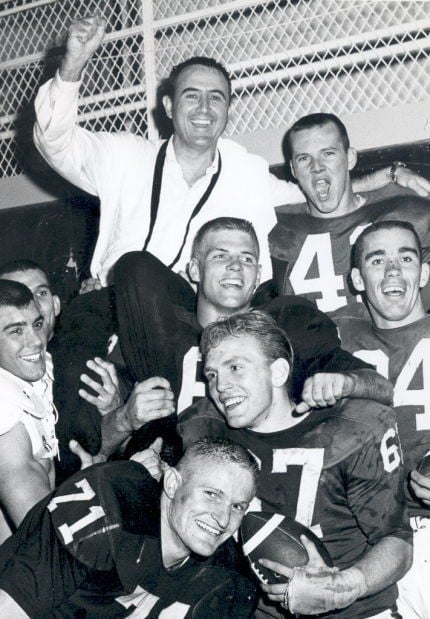
Tucsonans usually called him “Gentleman Jim,” but in 1961 they called him a genius. That’s when the Wildcats went 8-1-1, an Earth-shaking season that changed the way Arizona approached college football and began to schedule Oregon and Ohio State instead of Idaho and Hardin-Simmons.
LaRue, 89, died in a Tucson hospice Sunday. He didn’t coach a game in Tucson the last 49 years of his life, and, there is no visible reminder of him or his teams at Arizona Stadium. But he never let go of Tucson the way it let go of him in 1966.
In the summer of 1998, I wrote a long piece on former Arizona athletic director Dick Clausen, the man who hired LaRue from the staff at SMU; the man who took Arizona out of the Border Conference and helped to form the Western Athletic Conference; the man who in December 1966 fired LaRue.
“I might be the only man on Earth who Jim LaRue does not like,” Clausen told me. “I’ve wrestled with that for years.”
The day my story was published, LaRue phoned the sports desk. He asked if I could help him reach Dick Clausen.
“He’s a good man,” said LaRue. “I’ve always admired what he did for Arizona. I want to tell him that before we both get too old.”
LaRue’s career job was as secondary coach of the Chicago Bears, 1978-89. He was a Mike Ditka man. That “46” defense that enabled the Bears to win the 1986 Super Bowl? It was named after Bears safety Doug Plank, No. 46, a man LaRue coached for five seasons.
Plank later became, among other things, an analyst for Fox Sports Arizona, working several UA games at Arizona Stadium. One night in the press box, I asked Plank if he knew LaRue was living in Tucson.
“Sure I do,” he said. “He calls me every year to find out how I’m doing.”
That was more than 20 years after Plank had left the Bears.
LaRue was a Papa Bear like few others.
He didn’t have just one school or one set of “guys.” He played at Duke and Maryland. He coached at Kansas State, Wake Forest, Utah, Houston, the Coast Guard Academy and even spent a season coaching the high school team in his hometown, Clinton, Oklahoma.
More than anyone in a 40-year coaching career, LaRue was most closely identified with star Arizona quarterback Eddie Wilson, a once-unknown recruit from small-town Chandler who went on to play for the Kansas City Chiefs and, much like LaRue, spend a lifetime coaching football.
When Wilson would attend Arizona Homecoming celebrations, he would always drive out to the far east side and pick up his old coach. They hadn’t just kept in touch; they had been close. When Wilson was recruiting for Army or at Cornell, making a plane change at a Chicago airport, LaRue would drive to the airport so they could talk for a few minutes.
“At the 50th anniversary of our 1961 team, I was sitting at coach LaRue’s table when the emcee introduced him,” Wilson remembers. “I was worried that many of the more recent Arizona players wouldn’t acknowledge him. But the entire room stood and applauded, a standing ovation. It brought tears to my eyes and to all the fellas sitting at the table. I could tell he was touched.”
When Wilson coached at Duke in the early ’90s, someone at the school discovered that he had played for LaRue. Typical of LaRue’s modesty, he told few people of his days as a Blue Devils running back.
The Duke man gave Wilson a tape of the 1945 Sugar Bowl and suggested he listen to it.
With two minutes to go, in front of a crowd of 72,000 in New Orleans, Duke trailed Alabama 26-22. On fourth down from the 40, LaRue ran a reverse 21 yards for a first down. The Blue Devils scored on the next play to win, 29-26.
“I still listen to that tape religiously,” Wilson says. “Coach kept breaking tackles. I don’t now that I’ve ever listened to it that I didn’t get all choked up and wipe away tears.”
On Monday, Wilson will give the eulogy for his old coach. Bring a handkerchief.