

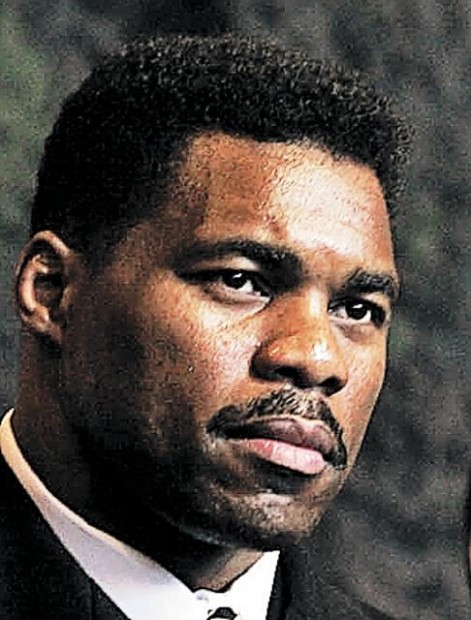
ATLANTA — Herschel Walker's first step was a bold one.
The former Georgia football star admitted he had a problem.
In his new book "Breaking Free," Walker describes his struggle with Dissociative Identity Disorder, a condition in which alternate personalities aid a person who is dealing with or has dealt with traumatic events.
Now Walker wants to help others come to grips and understand their problems by explaining his story and by helping finance the development of several mental health hospitals.
"If they are feeling these feelings I want them to realize, 'You are not crazy,'" Walker said in an exclusive interview with the The Atlanta Journal-Constitution. "'You are not a loser. You are going through a tough time.'"
For Walker that lasted a long time. For years, particularly after his football career ended in 1998, he said he was confused about whom he truly was. He said as many as 12 different alternate personalities controlled him.
People are also reading…
"I could have hid all this bad stuff … but that wouldn't have been fair," Walker said. "I have an opportunity to help people that are hurting. There are a lot more people with DID than want to admit it."
Walker said he is working with medical professionals to set up a network of hospitals. University Behavioral Health in Denton, Texas, is the first of those hospitals. Another is scheduled to open in El Paso in May.
Walker's largest step in his mission to help others was the release of his book last week. The cathartic biography chronicles Walker's years of not understanding who he was and how the different "alters" manifested themselves in his life.
"I used to think, 'Am I crazy?'" Walker said.
When Walker learned he was not and how to cope and deal with his DID he said he immediately wanted to help others.
"A lot of people have said, 'Oh jeez, this is something that is going to be devastating because you are Herschel Walker,'" he said. "I am not sure what they expect. I am a man that admitted that I had a problem."
The foremost expert on the disease, Dr. David Spiegel, the associate chair of psychiatry and behavioral sciences at Stanford, has opined that about 1percent of Americans have DID.
Others in the psychiatric profession have dismissed the diagnosis. And it remains a controversial subject within the psychiatric field.
But for Walker it is real. The disease, which Walker said affects him because of verbal abuse he received outside the home as a child, manifested itself in different forms over his lifetime. Walker said he had episodes where he very nearly took his own life and at other times that of his former wife, Cindy Grossman. He would play Russian roulette. He threatened Grossman with guns, knives and a straight razor.
He said he does not remember most of those episodes but does believe they happened.
"Think about a person that lives at home and wears a white hat," Walker said. "When he goes to play football he wears a red hat. When he goes to a business meeting he wears a blue hat. And when he is with his friends he wears a pink hat.
"The person with DID starts mixing the hats up and gets confused. They need somebody to help get the hats straight again."


