

The most ambitious sports endeavor in Tucson history wasn't packaging the Diamondbacks, Rockies and White Sox at spring training, or staging 12 years of NCAA tournament basketball at McKale Center.
It was saving our pro golf tournament.
Unless you've checked the calendar, or have been among those who have raised $26 million for the Tucson Conquistadores, you can't possibly guess that this month is the 30th anniversary of the save-the-PGA-Tour-in-Tucson campaign.
That it worked at all still defies sports logic.
Thirty years ago this month, the Conquistadores and the PGA Tour wrestled with the sobering financial reality of 1983 golf: The $300,000 Joe Garagiola Tucson Open no longer had enough money to attract the leading pro golfers. And none of the TV networks, not even the relatively new ESPN, was interested in televising pro golf from a municipal golf course in Tucson.
People are also reading…
After almost four decades on the PGA Tour, Tucson was about to be jettisoned.
If someone had predicted that by 2013 Tucson would play host to an $8.75 million golf tournament, drawing the world's top 64 players - televised for 20 hours - you would have advised them to get a designated driver for the trip home.
None of this would have been possible had not the Conquistadores and former PGA Tour commissioner Deane Beman agreed to become partners, dust off an idea from the long-ago days of pro golf.
They would stage the first PGA Tour's regular match-play event since 1958, at Randolph North, and they would find a sponsor that would increase the purse to $1 million and invite not only the 136 leading golfers in America, but also the 24 leading Seniors Tour players.
That's not just thinking big, that's thinking on steroids.
It worked anyway.
Beman signed a four-year contract with the Seiko Time Corp., and by New Year's Day 1984, a large and prominent Seiko clock was erected at the Tucson International Airport to mark the occasion. Tucson was going global.
The Seiko Tucson Match Play Championships would either be the most daring or the most ridiculous idea in pro golf, 1980s version.
In retrospect, it was a bit of both.
Beman's first edict was that America's top golfers would begin play on Monday morning, Jan. 1, 1984. It snowed.
The format was outrageous. The PGA Tour players ranked Nos. 17-136 would tee up in a sudden-death shootout. After Monday's first round, players ranked Nos. 9-16 would be folded into the bracket.
First-day losers would receive a mere $750. (Now first-day losers get $46,000.)
The tournament would stop on Thursday for a Pro-Am. That was the Conquistadores' sticking point; their money-raising gala. And the PGA Tour bought it. Today's chances of that happening? Zero percent or less.
And then, after four days of golf, America's golfers ranked Nos. 1-8 would be seeded into the Round of 16. Do you realize the clout of those eight players in 1983? The game's giants - Tom Watson, Hal Sutton, Fuzzy Zoeller, Lanny Wadkins, Calvin Peete, Tom Kite, Ben Crenshaw and Gil Morgan - showed up to meet golfers worn by a week of stress.
J.C. Snead and Bob Gilder were so miffed at the idea, unhappy that anyone received a bye and was guaranteed $15,000, that they publicly complained. Beman fined both.
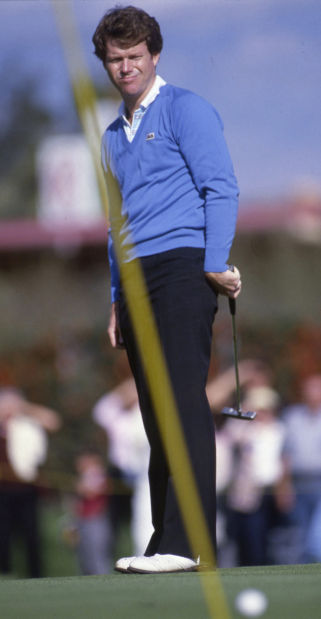
Watson loved it. He earned the $100,000 winner's check (the second-largest of his career) by dispatching Scott Hoch and Morgan in Sunday's 36-hole, morning-afternoon finish. Randolph overflowed. A crowd estimated at 10,000 squeezed onto the small plot of turf.
For eight days, Tucson was the center of America's golf universe.
Alas, in a piece of bad luck, the 1985 and 1986 championships were won by Jim Thorpe, who had neither the charisma nor the drawing power of the Big 8 of 1984, those whose byes were eliminated in 1985. Almost all the big names were bumped off and sent home before the quarterfinals.
On the weekend rounds of '85 and '86 at Randolph North, it was difficult to count as many as 5,000 spectators. Maybe half that. Fans didn't enjoy the format, or the thought that they could sit in the grandstands at the 18th hole and not see half of the field, or more.
After four years, Seiko jerked its sponsorship, and Beman wrote off the entire exercise as a good try that failed.
But the first Match Play endeavor in Tucson was a success because if for no other reason than it whetted our appetite for big-time golf.
Thinking big, the Conquistadores gained approval to move the event to November, the first fall tournament in Tucson history, and took advantage of the Tournament Players' Club concept, which expanded to the splashy and new TPC Starr Pass.
The decade to come was among the best in more than 60 years of Tucson golf: Phil Mickelson won three times, UA grad Robert Gamez launched his career with a victory in the 1990 Northern Telecom Open, and subsequently David Duval and two-time U.S. Open champ Lee Jansen won in Tucson.
Now Tiger Woods is here, as are the most imposing golfers in the world, from Rory McIlroy to Bubba Watson.
The Golf Club at Dove Mountain was built 26 years after Tom Watson won the original Match Play tournament at Randolph North, but the '84 Match Play event surely led to its successor 30 years later on Dove Mountain.
You might have to drive a bit farther to watch it, but the Conquistadores' bold idea of 1983 was more visionary than anyone could have imagined.


