Oct. 23, 1926: Pop McKale tells the UA football team about “Button” Salmon’s “Bear Down” wish
John Byrd “Button” Salmon lie motionless at St. Mary’s Hospital in the early evening of October 17, 1926. He was paralyzed below his second rib, his spine shattered from an automobile rollover 14 days earlier.
Two Tucson doctors, Victor Gove and E.J. Gotthelf knew that even though Salmon regained some function in his arms, further surgery was useless.
UA football coach James F. “Pop” McKale visited his senior quarterback that evening, as he had every night since Salmon’s automobile rolled on top of him near Florence as he was returning from a visit with a fraternity brother in Phoenix.
Gove and Gotthelf probably told McKale that his 5-foot-7-inch, 145-pound quarterback/baseball catcher would die soon, although Salmon’s sister, Clyde “Babe” Lockie, told me in 1986 that the family had been encouraged when Button started moving his arms.
People are also reading…
“We were afraid he might be permanently paralyzed,” Lockie said when she returned to Tucson for the unveiling of her brother’s statue outside McKale Center. “But we didn’t think he would die.”
Before leaving St. Mary’s that night, McKale asked Salmon if he had anything he wanted to tell his teammates.
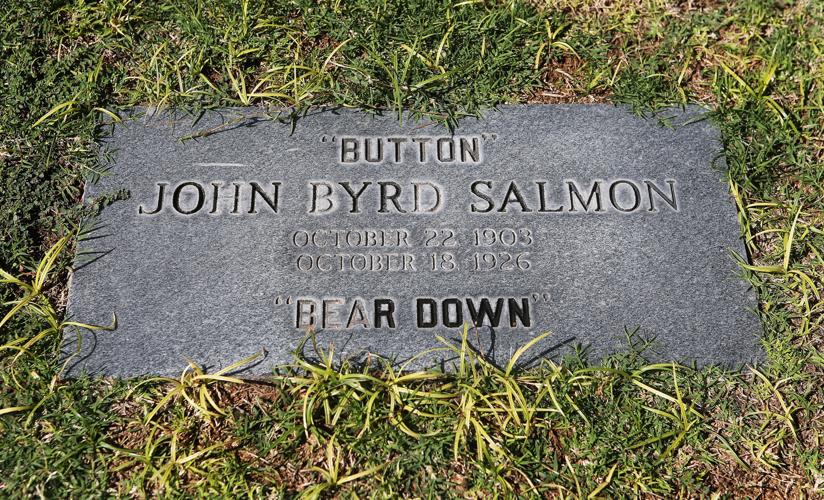
“Tell them … tell the team to bear down,” he said.
Salmon died at 6:15 the next morning.
• • •
Frank and Kathryn Salmon moved from Texas to Bisbee in 1905, shortly after their second son, John, was born. Frank had been a teacher and Kathryn had studied at the Boston Conservatory of Music.
In Bisbee, Frank rose through the ranks in the copper industry, becoming the chief of security at the Copper Queen Mine. Although they lived in what today would be described as a ramshackle hut, they were people of means. They had enough money to send Button and his older brother, future Phoenix attorney Riney Salmon, to the UA.
At Bisbee High School, Button became the vice president of the student body in his senior year, 1920-21. Next to his yearbook picture he wrote:
“He trudged along unknowing what he sought, and whistled as he went for want of thought.”
In the school play, “Quality Street,” he starred as a recruiting sergeant. At the senior class Christmas party, Salmon was Santa Claus, handing out gifts at the conclusion of the party. His photographs in the school yearbook show that he was the shortest player on the football team, with a shock of red hair, shaved close on both sides, as was the style of the day.
Button didn’t immediately become an athlete of significance at Arizona. As a junior, after a breakout-type football game against Nevada in 1925, the Star described him as “only a scrub at the beginning of the season” who had emerged as “the tow-headed wizard from Bisbee.”
Later that season, against USC, the Star had even more praise.
“Greatest of all was little Button Salmon,” it reported. “His punting was a revelation to the fans. The “Leaping Tuna” was everywhere at once and he was just about the main cog of the machine.”
In the summer, he played semipro baseball for the Bisbee Bees with former New York Yankee first baseman Hal Chase and two infielders from the 1919 Black Sox World Series scandal, Buck Weaver and Chick Gandil.
Little Button Salmon, a catcher with some bite, seemed to have a future in pro baseball, but first he would complete his senior year at Arizona, 1926-27. He had some important business ahead; he had been elected student body president.
• • •
The magnitude of the death of the school’s star quarterback and student-body president was such that Salmon’s body lie in state at the school’s assembly hall from 3 p.m. Tuesday afternoon until the 1 p.m. funeral a day later.
Members of Sigma Nu fraternity, the Bobcats, the A Club and the Chain Gang took turns as an honor guard, on vigil for 22 hours. Wednesday’s classes were canceled.
At the funeral, McKale was one of four speakers. According to the UA Library Special Collections, the coach said:
“John overcame the handicap of a diminutive frame and labored as an uncomplaining sub, finally achieving the places of star quarterback and first-string baseball catcher. He advanced his ambitions over all obstacles.”
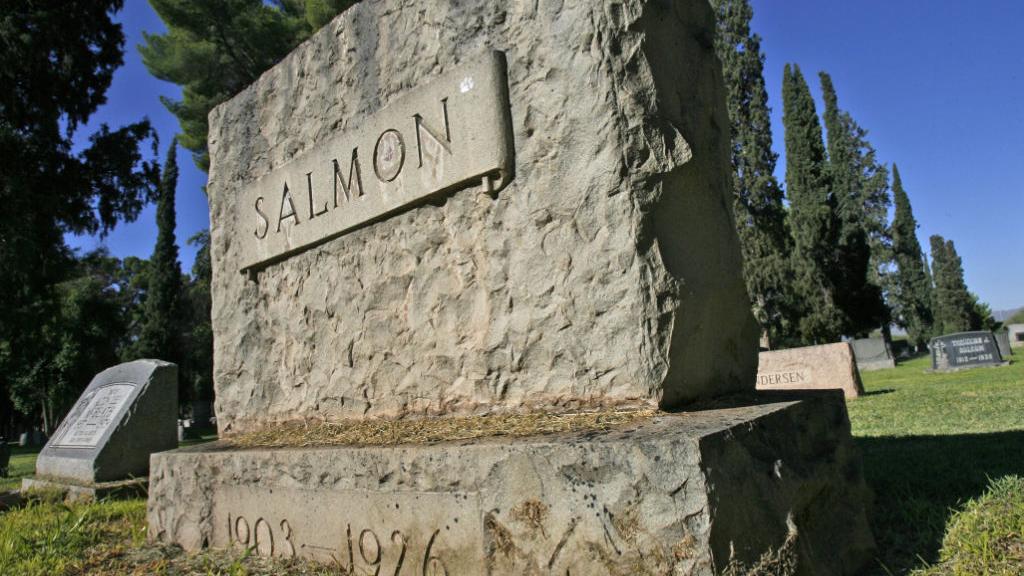
The Star reported that more than 1,000 people drove from campus to Evergreen Cemetery on Oracle Road for a graveside service and burial. Button’s headstone says, simply:
SALMON
1903 – 1926.
• • •
The UA chose not to cancel a game at New Mexico State three days later. In mourning and beset by grief, McKale did not attend the team’s workouts Thursday or Friday.
His squad of 24 players, assistant coach Fred Enke and a trainer departed on a Southern Pacific train a few minutes before midnight Friday.
Just before the afternoon kickoff — not at halftime, as the legend has it — McKale gathered his players for final instructions.
On the day Salmon’s statue was dedicated in 1986, former UA lineman Martin Gentry, a Bisbee attorney, described the scene for me.
“It was a very emotional moment,” he said. “Mac said that he had asked Button if he had a message for the team. And Button had told him ‘Tell them … tell the team to bear down.’”
Arizona scored in the fourth period to win 7-0.
“We almost lost, and we should’ve won easily,” Gentry, then 83, said. “We were all uptight. We were all thinking about Button.”
Former UA assistant coach Frank “Limey” Gibbings, a backup QB on the 1926 team, told me in 1986 that none on the team doubted McKale’s words.
“Mac was a good talker,” said Gibbings. “He could always get a team stirred up. I had never heard him use the term ‘Bear Down’ so I think he told us exactly what Button said.”
A year later, after the construction of the UA’s first large-scale gymnasium, Gentry made a motion at a student hearing that “Bear Down” be used as the school’s official slogan.
In 1991, Ralph Deal, a classmate of Gentry and Salmon who would become one of the leading basketball and football referees in college sports, invited me to his Tucson home to talk about the Bear Down legend.
He showed me an old black and white photograph of the roof of the UA gymnasium in 1927. Deal was on the roof, helping to paint a huge B. And for 89 years BEAR DOWN has been visible on the roof of what then became Bear Down Gym.
“It wasn’t just some emotional friends getting carried away,” Deal said. “Button was a take-charge guy. Cocky, self-assured, a natural leader. When he said something, he meant it. He didn’t allow anybody to dog it.
“It didn’t take hold immediately, but once the newspapers started writing ‘Bear Down’ it picked up.”
For most of the next 60 years, Arizona’s athletic department didn’t fully understand the scope of the Bear Down legend.
In 1961, after he retired, McKale told the Star: “I didn’t think there was great significance to (Bear Down) then. But I enjoy the sense of tradition it gives the school.”
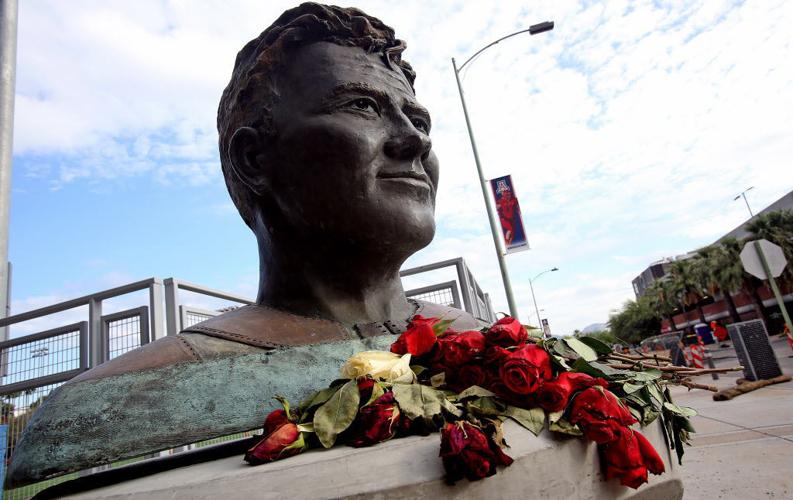
By 1985, spurred by athletic director Cedric Dempsey and marketing whiz Dave Sitton, the UA began to emphasize the legend of Button Salmon. A year later, $20,000 was spent to build a statue outside the main entrance to McKale Center.
“If you look around at all the schools, nobody has a legend like this,” Sitton said in 1985. “There have been times, especially when I’ve talked to people who knew Button, that it moved me to tears.”
Ten years later, “Bear Down” was written in script on the field at Arizona Stadium.
Now the football team has the slogan on its helmets. Athletic director Greg Byrne completes most of his conversations by saying “Bear Down.” So do many UA coaches and fans.
After 90 years, the diminutive Button Salmon is bigger than ever.
Before Button’s sister, Babe Lockie, left the McKale Center statue dedication exactly 60 years after her brother’s death, she posed for photographs.
“All of this excitement is wonderful,” she said. “But to me, it’s still rather sad. John was just 22 years old when he died. I just hope that now his name will live on.”