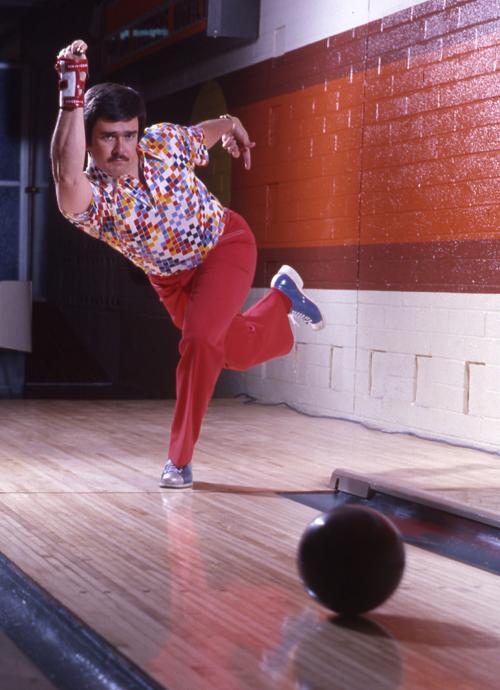
July 4, 1972 – Catalina High School grad Paul Colwell wins the Tucson Open on the Pro Bowlers Tour
Paul Colwell’s road to the Pro Bowling Association Hall of Fame began at the most unexpected place: on a concrete, outdoor bowling lane at 3425 E. Grant Road.
Yes, outdoor bowling.
Yes, concrete lane.
It wasn’t Cactus Bowl or Golden Pin Lanes. It was the Colwell Backyard Lane.
One day in 1957, Colwell returned home from a day at school and saw his father, Ottis Colwell, pouring a cement slab in the back yard of the family residence.
Given his son’s interest (and early success) in bowling, Ottis Colwell, sales supervisor for the Hostess Cake operation of Southern Arizona, built a 42-inch-by-60-foot bowling lane to match those Kegler’s Lanes, an old Stone Avenue facility where Colwell began bowling two years earlier.
People are also reading…
From those unique beginnings, Paul Colwell became the most accomplished bowler in Southern Arizona history.
He won nine PBA titles when pro bowling was a staple of the American sports landscape, televised live on ABC most Saturday and Sunday afternoons. He won the 1974 ABC Masters and the 1976 PBA National Championship, two so-called “majors” of the sport.
In 1991, he was inducted into the PBA Hall of Fame in Akron, Ohio.
Now an executive in the Freedom Equity Group, an insurance/investment firm in Tucson, Colwell thinks of his old concrete bowling lane when he drives past the intersection of Grant and Palo Verde roads. A mini-storage facility has replaced his childhood bowling mecca.
“I practiced every day on that concrete lane,” he remembers. “My dad made it the perfect dimensions and almost as smooth as one you’d play at Kegler’s Lanes. My friend Butch Rice and I would each bowl from one end, reset the pins, and alternate. Sometimes we’d do it for hours and hours.”
By the time he was 14, entering Catalina High School, Colwell was on the cover of AJBC bowing magazine. He led the nation’s junior bowlers with a 196 average.
This wasn’t just some wanna-be bowler passing time. Colwell knew that to be as good as he wanted to be, he had to spin his bowling ball on the not-so-smooth concrete surface.
“You have to spin the ball to make the pins mix,” he says. “And I couldn’t loft the ball on that concrete lane or it would bounce all the way to the pins. It taught me to be exact. It taught me to be smooth.”
It taught him how to be a champion. His first check was $600 at the Tucson Squirt Open in July of 1969.
On his 23rd birthday, on leave from his position as airman at Davis-Monthan Air Force Base, Colwell entered the 1972 Tucson PBA Open. He had made occasional appearances on Tour, earning $1,950 in 1969 and almost $8,000 the next two years as he fulfilled his military obligation.
No few predicted the local kid could actually win the Tucson Open against that day’s heavyweights. He did just that, beating one of the era’s top stars, Don Johnson, in the finals, 231-222.
Colwell was paid $4,000. He soon left the Air Force and went on tour. Over the next six years, he earned about $210,000 in official prize money. His most celebrated championship was the 1976 national title in Seattle.
In the final frame, Colwell opened with a gutter ball. The TV analysts were almost speechless. They had rarely seen a pro bowler, especially in the final frame of a four-day tournament, one of the two remaining bowlers, put it in the gutter.
“I can’t believe it,” he told reporters. “I lost it. I was so nervous I really couldn’t concentrate. Sometimes you need something like that to jolt you.”
Colwell completed the 10th frame with a spare and a strike and won the $9,000 first prize.
When bowling surfaces began to change in the early 1980s, to a more synthetic material, Colwell’s mechanics and roll of the ball were notably affected. By 1983, he stopped touring full time. He was married and had two young daughters.
Instead of being on the road for about 40 weeks a year, he chose to walk away from competitive bowling. He had done more than enough to get into the Hall of Fame.
Where are they now? Colwell, 66, still bowls periodically in Tucson leagues. Last fall, he had a lifetime-best series of 845. He had scores of 300, 278 and 267. “I’m more casual now,” he says. “I had a good run.”