

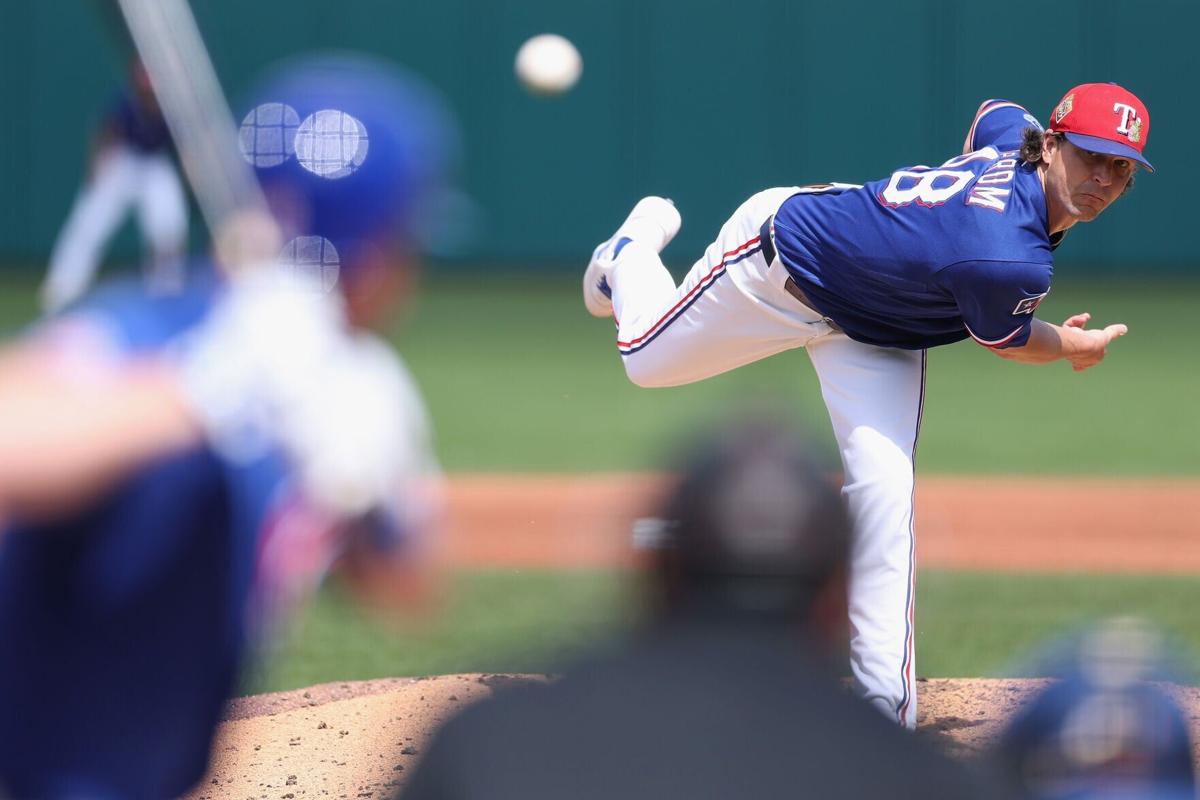
DALLAS — Tom House was ahead of his time as the pitching coach of the Texas Rangers from 1985-92, which is to say people didn’t get it back then. Especially the footballs. I can still see his pitchers in right field during warmups throwing the prettiest spirals you ever saw. Joe Namath couldn’t have spun it any better. Problem was umpires insisted they use baseballs, which seemed like foreign objects in comparison.
Someone once asked Charlie Hough, the old knuckleballer, if the footballs helped anyone’s delivery.
“No,” he said, “but we lead the league in third-down conversions.”
The Rangers’ semi-sordid history of pitching would seem almost quaint now if you hadn’t lived through it, and now here they’re coming off a season in which they led the league in ERA. Felt funny just typing that, frankly.
People are also reading…
In fairness, it’s not like they haven’t done something similar at times. The late ‘70s in particular. Just that they haven’t done it often enough to change the trajectory of the organization.
Now, it’s not like I’m breaking any news here, but good pitching matters. Do you know how many times the Rangers have had so much as a league-average or better ERA? Thirteen. Ten came in winning seasons, including all three World Series appearances, which is not a coincidence.
So, no, it’s not as if the Rangers simply underestimated the importance of pitching all these years.
They did it just often enough to give the organization a bad reputation. Consider how things might have been different if not for a handful of cases.
The first and foremost example, of course, was the sacrifice of David Clyde. His first managers, Whitey Herzog and then Billy Martin, tried to protect him, but Bob Short needed money, and Clyde sold tickets. Tom Grieve, who spent most of his adult life as a player, executive or broadcaster with the Rangers, is on record that the rush job cost Clyde what should have been a nice 10-year career.
Think what Clyde might have learned from late ‘70s/early ‘80s staffs that included Gaylord Perry, Bert Blyleven, Rick Honeycutt, Frank Tanana, Jon Matlack, Doyle Alexander, Fergie Jenkins, Danny Darwin and Hough. All of the above had nice numbers in Arlington. Hough still holds most of the club’s pitching records. But Darwin was the only one who came up through the system. The rest were just passing through.
Some who could have made a difference never got a chance.
Late in 1977, Brad Corbett, the man who bought the Rangers from Short, made a package deal to get Sparky Lyle, the New York Yankees’ fine reliever. Going to New York in the trade was a former first-round pick considered the Rangers’ best pitching prospect. Dave Righetti would become a two-time All-Star in New York and pitch for 16 years in the big leagues.
Footnote: Corbett was told to make sure the package included Damaso Garcia, an infielder who would make two All-Star teams with Toronto, but something got lost in translation. The Rangers ended up with Domingo Ramos instead.
Fast forward to April Fool’s Day, 1982. Grieve, then the Rangers’ assistant farm director, was at a meeting with his boss, Joe Klein, in Plant City, Fla., when Klein got a call from the Rangers’ general manager, Eddie Robinson. He told Klein he’d just made a deal with the New York Mets. The Rangers were getting Lee Mazzilli, an outfielder, for Ron Darling, a former first-round pick, and Walt Terrell, another highly regarded pitching prospect.
When Klein and Grieve tracked down Darling that night at a par-3 golf course under the lights to give him the news, he didn’t believe it any more than they did.
“You think I’d be out here on this crummy golf course in the middle of the night if it weren’t true?” Klein said.
Here’s how a one-sided disaster affects your club for a decade or more: Darling won at least 12 games in six of his nine seasons with the Mets and was an effective starter until he was 32; Terrell won at least 11 in five of eight seasons with the Mets and Detroit Tigers.
Mazzilli? Told he’d play left field, he called it an “idiot’s position” and shortly thereafter became the Yankees’ problem.
“You can’t just toss ‘em aside as bad decisions,” Grieve said recently. “Those two decisions right there might be the reason why the pitching wasn’t above league average for 10 years. If they were here for 10 years, that’s 40% of a starting rotation.
“Throw in Righetti and see how much difference that makes.”
Everyone knew the Rangers were getting stiffed on those deals, Grieve said. Most times it isn’t nearly so obvious. Like when Jon Daniels sent a soft-tossing, former 8th-round pick out of Dartmouth to the Chicago Cubs for Ryan Dempster at the 2012 trade deadline. No one objected even when Dempster, who pitched only one more season in the big leagues, failed to help the Rangers’ playoff chances.
Meanwhile, Kyle Hendricks put up 12 seasons in the big leagues, winning an ERA title and starting for the Cubs in a World Series.
Occasionally it’s simply a case of bad luck. Edwin Correa “might have been the best young pitcher we ever had,” Grieve said. Fastball hit 96 and his changeup reminded everyone of Pedro Martinez’s. Made his big-league debut at 19.
Done at 21.
Grieve called Correa’s career-ending shoulder injury “heartbreaking.” Every organization has a story just like it. The Rangers simply didn’t have enough talent to overcome their heartbreakers. You can blame scouting or poor front-office decisions or owners who couldn’t pay the going rate. Kenny Rogers, one of the farm system’s greatest success stories, once told me free agent pitchers didn’t want to come to Arlington because of the heat and wind. Grieve called it a moot point. Most of his tenure, he said, they didn’t have the money to bid on high-priced talent.
“The only guy we broke the budget for was Nolan Ryan,” he said, “and the only reason Eddie Chiles did it was because he’d heard of him.
“He told us, ‘You sign Nolan Ryan right now and let me worry about how we’re gonna pay him.’”
Worked out pretty well for the Rangers, at that. Changed the perception of the club, inside and out. Nolan was a big fan of Tom House, by the way. Credited him with prolonging his career. Tom Brady, Dak Prescott, Jared Goff and a host of other quarterbacks also swear by House. Probably helps when you’ve finally got the right guys throwing spirals.
____


