

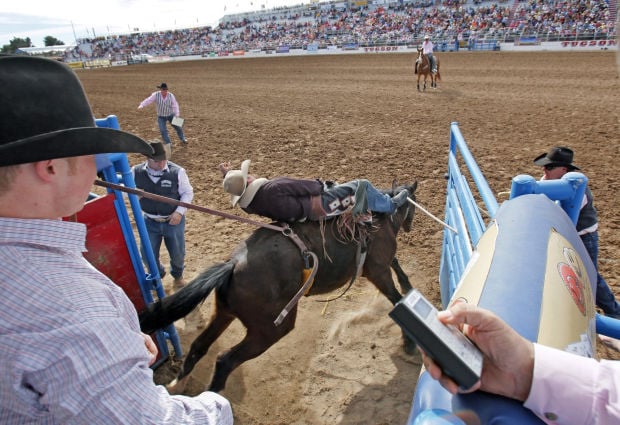
He straps the padding onto his neck.
It’s like a neck pillow, made out of the type of padding found in yoga mats. It helps with the whiplash.
Some participants wear protective vests, but not Will Lowe.
He wears a pad on his right arm, though, to avoid forearm splints.
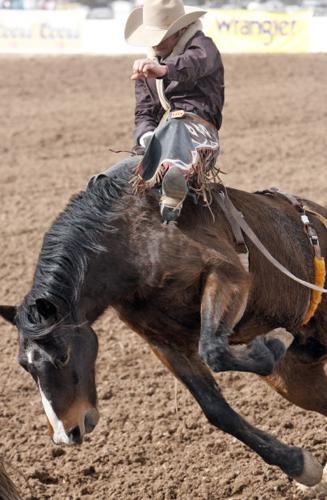
There’s no helmet, but he does wear that trusty cowboy hat, which provides some protection, however minimal.
“Plus,” Lowe said, “pictures don’t look near as good if you don’t have a hat on.”
Before he jumps onto his assigned horse — this one’s name is Rustler — he prays.
Then, he’s off. Out of the chute, his right hand latched onto the rigging — similar to a suitcase handle — as his left arm flails in the wind. If it touches the horse, at all, he’ll be disqualified.
People are also reading…
The horse jumps and kicks outward with its hind legs, over and over again, running in a tight circle as Lowe’s body flails around — kind of like those tall, wacky, waving inflatable arm-flailing tube-men that often sit outside car dealerships.
On Sunday at La Fiesta de los Vaqueros, Lowe lasted the required eight seconds — like he usually does — and scored the day’s high score of 84 points.
Lowe is a bareback rider, and he’s one of the best in the biz.
“For as long as Will has rodeoed, he still does a great job,” said Bennie Beutler, the stock contractor who has long worked the Tucson Rodeo. “He really does. Most guys don’t last that long. Bareback riders, if they last 10 years that’s something. Most of them last five or six years.”
Lowe, from Canyon, Texas, has qualified for the National Finals Rodeo 11 years in a row, banked more than $2 million in career earnings, won the world title three times, finishing in second four more. Plus, he’s a two-time Tucson Rodeo champion.
Even more impressive, though, has been his ability to survive his injuries because, when it comes to bareback riding, they’re a little more severe than the occasional bump and bruise.
“You get beat up every time you ride,” Lowe said, “so staying healthy is a huge part of it.”
He once messed his shoulder up enough that it bothered him for years before he got it fixed. Then, at a competition in San Francisco a few years ago, he broke his leg when a horse ran him into a wall and “tore everything.”
Elbow and neck injuries are common in bareback, as are shoulder injuries. A lot of that is the whiplash.
Plus, there are the concussions.
“The what?” Lowe said, laughing. “Yeah, I’ve had quite a few concussions.”
There are times where, halfway through, he got knocked in the head hard enough that he forgot the ride ever happened. He’s got bucked off the horse and landed on his head, too.
“But,” he said, “what are you gonna do? That’s part of it. We know the risks we’re taking, and concussions, that’s a serious injury but there’s a lot worse things that can happen.”
Beutler calls bareback the most physical ride in rodeo. Sure sounds like it.
Mike Rich, the executive director for the Justin Boots sports medicine team on site, concurs.
“Everybody thinks that bull riding is worse,” Rich said, “but we treat more bareback riders.”
Lowe rode his first bucking, bareback horse when he was 14, and he still does it now that he’s 31.
Consider him an anomaly.
He’s been launched into the air, trampled over, and thrown into a wall.
There’s the whiplash and, of course, those concussions.
Lowe isn’t all too worried.
“Heck,” he said, smiling, “I don’t need too many of them brain cells. I’m old enough anyway.”


