
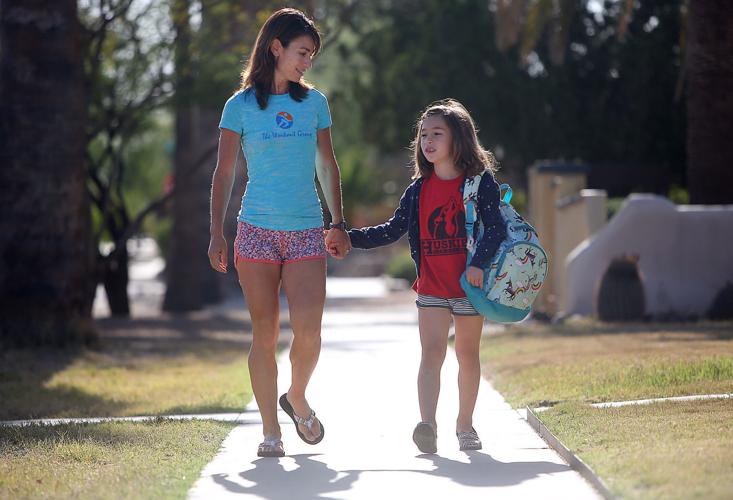
The question would normally make Tia Accetta do a backflip off the couch.
“We’re going on the trampoline outside, see who can do the most flips. Want to come?” asks her husband, Randy.
She wants to go so, so badly. To feel the air underneath her feet as her kids, 6-year-old Anabelle and 8-year-old Aric, bounce and fly around her.
Instead, today, she sinks deeper into the couch.
“But I’m the best flipper here,” she says quietly, to no one in particular.
This vivacious, energetic, marathon-running, kid-toting, 39-year-old is afraid. Afraid of what has happened to her already, afraid of the lack of answers, afraid of what could come next. She is afraid now of a trampoline, of one wrong jerk or twist or bend. Of her son’s backpack.
People are also reading…
She is afraid of a life that could mean no more jumping, or running, or playing.
•••
Mother’s Day was supposed to be Tia’s day.
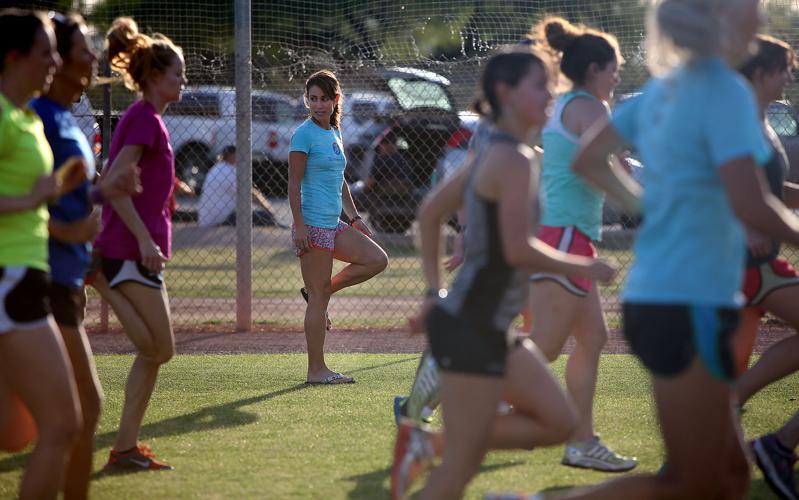
On the schedule was the Eugene Marathon in Oregon, birthplace of both Nike and the running phenomenon that has continued to sweep the nation. The Accettas lead the pack, certainly in Tucson.
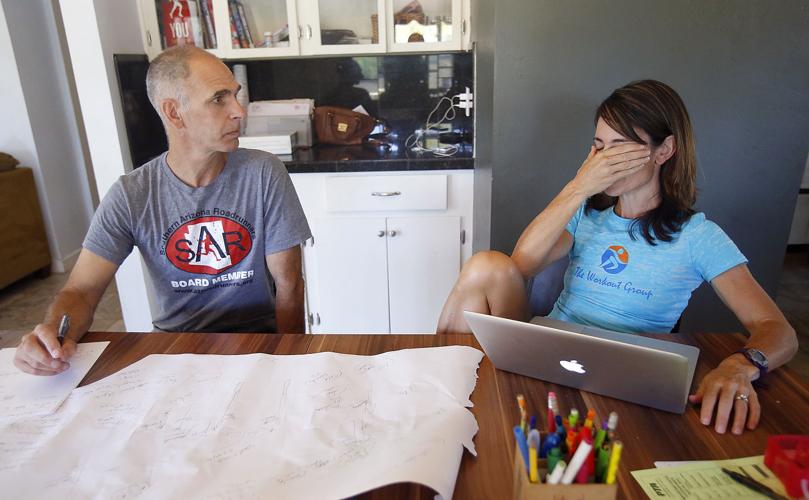
Randy is the director of coaching education for the Road Runners Club of America and together they operate RunTucson.net, organizing races and racers alike.
Her goal: 26.2 miles in 2 hours, 43 minutes — fast enough to qualify for the United States Olympic trials.
For nearly a half-decade, since her children were old enough for preschool, 2:43 has been her Holy Grail. She has run 40 miles a week, 60, 80, 100, all across Tucson, entire neighborhoods at a time.
She’s run Chicago and St. Louis, won races all over this city. Randy calls Tia one of the top five or 10 marathoners in the state; her personal best is 2:48.05. But 2:43 would put her in elite company, among the top 100 or so women in the country. She knows she could never realistically have a shot at the Olympics. The chasm between her and the top runners is too wide.
Still, she runs.
Her alarm goes off at 4:45 a.m., when most of Tucson is still sleeping. She wants to get in a dozen miles or so before the kids get up.
It is her time, alone, pushing herself forward a personal goal.
So she runs — 16 miles, 18 miles, and by mid-April, 20 miles, maybe more a day.
The week before April 20, she clocks in near the century mark. This is her shot.
And then, a stumble.
•••
The Thursday before the Sunday that changed her life, Tia may have almost killed herself.
That week was “go” time, the final push before her Mother’s Day date with destiny.
She ran miles and miles and miles. And then, on April 17, she did something that she usually never does — something Randy, her running coach, strictly forbids. She cross-trained.
She did 40 Superman exercises: Face down on the floor, she simultaneously raised her arms, legs and chest off the ground, like a post-phone-booth Clark Kent soaring above Metropolis.
Early in the 40-Superman set, she felt a twinge in her neck. She kept going. Friday, more training. Saturday, even more.
Sunday, a long run, with friends Lucas Tyler and John Chamberlain.
“They talk about that runner’s high — you’re elated you’re done, you did well. You’re feeling great, but you’re tired. You’re feeling a little tipsy,” she says. “Then this general feeling, this exhausted-but-on-cloud-nine feeling hits after a really tough run.
“You’re thinking about what you’re gonna eat. That’s always a major thing for me. How many pancakes are you gonna have?”
She finished her run along the Rillito River Path and had her cool-down. Time for pancakes? She had to get in some carbs, some protein. She gobbled down some food, but she was still tired. This was … different. The family — Randy, Aric, Anabelle — was waiting for her about a half-mile away, at Tucson Racquet and Fitness Club. She told her running partners she didn’t need a ride, that she’d jog over to her family.
She waved goodbye, then started jogging.
She stumbled, and crumpled to the ground. Her body didn’t feel right. She stayed on the ground for a few moments to collect her thoughts. She got back up and Lucas offered to drive her to her family.
She had a headache, piercing, in the back left of her head. She felt nauseated. She told Lucas she was fine — “No, wait, I had a stroke, take me to the hospital,” — no wait, she was fine. She was mumbling. They made it to the Racquet Club, to Randy.
It was heat stroke, they thought, or maybe just exhaustion. They went through the general protocol, ran through their checklist. Fatigue, check. Hunger, check. Thirst, check. Weak muscles, check. Vertigo, check. She didn’t mention the numbness on her left side.
“It was not a very dramatic event,” Lucas says. “She just kinda went through it, didn’t even look like she was in much pain. Which might be the scarier thing.”
A few weeks later, she describes it like this: “My left leg felt like it was not attached. My left arm felt like it was floating in space. I had a tiny little panic attack, like I’m having a stroke. Oh my gosh, no. I didn’t believe it.”
How could she?
She’s 39, in peak physical condition, ready to qualify for the Olympic marathon trials, for heaven’s sake.
A stroke?
They got some cold water in her, got her home, resting. She napped for a while, woke up, and nothing seemed the worse for wear. She went about her day. She woke up the next morning, and at about 9 a.m., she knew something was not right.
“There’s no pain involved; it’s just a very odd sensation that starts here,” she says, grabbing the back left side of her head. “And then it went down into my arm and started tingling, and I got very dizzy. And when it happened again, I felt, ‘This is not normal.’”
She tried not to panic. She called Randy and drove herself to urgent care. There, a nurse gave her a quick EKG, looked at the results, and told her to immediately go to the emergency room.
There, she heard the word: She’d had a stroke. Two, actually.
The doctors were, predictably, incredulous.
•••
Dr. David Teeple has been Tia and Randy’s navigator through this perilous journey.
The director of the Stroke Care Program at Tucson Medical Center and an assistant professor in the University of Arizona’s Department of Neurology, he calls Tia “an anomaly.”
He suspects that at some point in her training, she suffered a dissection of the vertebral artery, one of the four main arteries to the brain. This minor trauma may have caused a tear in the lining of the artery, which exposes the membrane that is prone to forming blood clots.
Tia hits none of the primary markers for stroke susceptibility — high blood pressure, diabetes, obesity, smoking. She may have had a predisposition for her artery tearing more easily.
Another possible cause — although her doctors doubt it was a factor — is a small hole in her heart discovered during a visit to the cardiologist last week. It is fairly common, and typically has zero effect in patients who have it.
Theoretically, if a clot in her leg were to break free and travel to the left side of the heart, it could “cross over” to the right side, and perhaps travel up into the brain. But that tends to happen to people with clotting disorders. “For Tia, that’s a pretty big stretch,” Teeple says.
Early last week Teeple told the Accettas it looked fairly certain Tia’s stroke was caused by a dissection, and that, in a month, she’d be pretty much good to go. She walked out of the office feeling great.
Then a few days later, her cardiologist said he wasn’t so sure.
“I walked out of there feeling every little weird thing on my body, feeling, ‘Oh no, it’s happening again,’ Tia said. “It’s such a mind game, it really is. Until I hear someone say this is what it is and here’s how we can fix it, it’s scary.”
•••
The fear is the hardest part.
Could she die from this? Could it follow her for the rest of her life, one false step spelling doom? Could she face a life on the sidelines — or, worse, on the couch?
“I’m blind to that,” Randy says. “I can’t conceive of there being something so big that she wouldn’t be able to exercise.”
His research has led him down some dark paths. For someone with a curious mind and a question to answer, the Internet can be a black hole. He followed a trail on social media to the website Triathlon.com, and there he found a story about a world champion who discovered she has a heart problem, and isn’t able to exercise.
He won’t accept the idea for his wife — for her aspirations, her passions, her livelihood to be cut short. That is one scenario he can’t allow.
“Normally, athletes, all of us — ball sports and elite athletes and recreational athletes — our time as an athlete fades away. You get injured, you come back, you get injured, then you’re not as good. It takes maybe a decade. That’s the normal order of things,” he says. “This right now is so severe, so unnatural, it’s so easy to stay in the denial phase of, ‘No, dude, there’s no way she’s done.’”
That number still beckons, like a siren calling to her — 2:43.
Can she really get to the base of Kilimanjaro, stumble to the ground, and not will herself up the mountain?
“I’ll be devastated if at some point I realize I can’t go for it again — the mileage and the work,” she says. “I’m either naïve or optimistic that I’ll be able to get back to where I was. I feel like I have to try it again.”
Randy, the professional running coach, draws a parallel between this challenge and those other marathons.
“Short term, it’s like, ‘Let’s get through this mile,’ not, ‘What is gonna happen in 10 miles?’ You start looking two weeks, you freak out.
“That ability is what is carrying both Tia and me, the ability to stay in the moment.”
So now, they wait. They ask questions. They Google, always trying to avoid the cloud of doubt hanging above their heads.
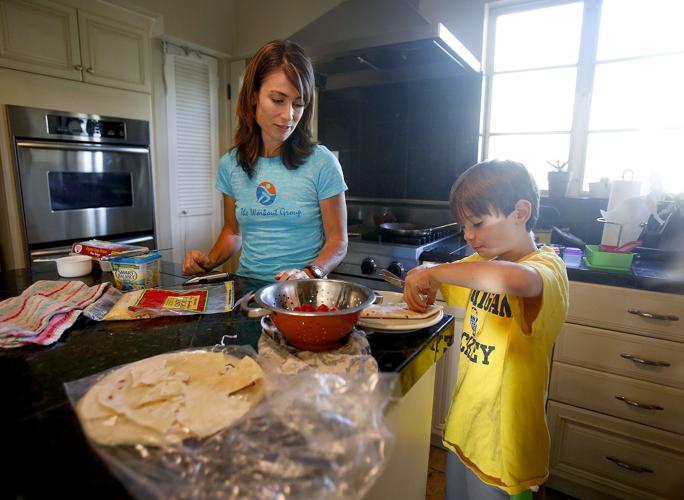
And life goes along. But their plans change, of course, starting with Mother’s Day.
They’re not flying to Oregon to run a marathon, obviously. Tia is still too wary to really test herself.
Normally, she says, they’d go have breakfast and go for a swim. Maybe Arizona Inn for brunch. She’s not sure. She’s not sure about much these days.
Imagine waking up every morning not knowing what tricks your mind has played on itself in your sleep. You are tentative, unsure of yourself and the world underneath you. She found an article on the Internet that described that first step of every day, when your body presents the great unknown: “They said they lived liked they were made of glass.”
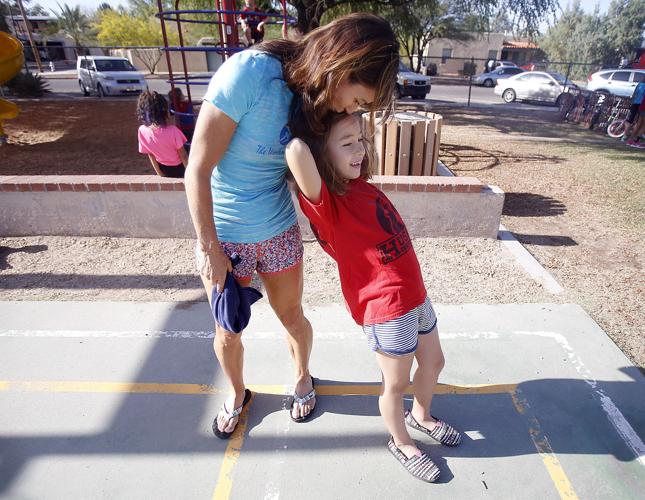
She can relate. She has two rambunctious young children, unburdened by the stresses of life, most worried about the next fun activity that their parents will present to them. They tickle her, prod her, leap on her, tug on her. She has to peel them off.
She can’t take the chance that they’ll do anything that might, well — she doesn’t know.
That might do nothing. That might do everything.
“I’m like, ‘No, don’t touch me there, don’t throw your backpack at me,’” she says. “That’s no fun. We have a trampoline out back. To walk out and sit in a chair and watch the family jump in the trampoline? This is not how I want to spend the rest of my life. I want to be jumping.
“I don’t want to be the sick one.”