

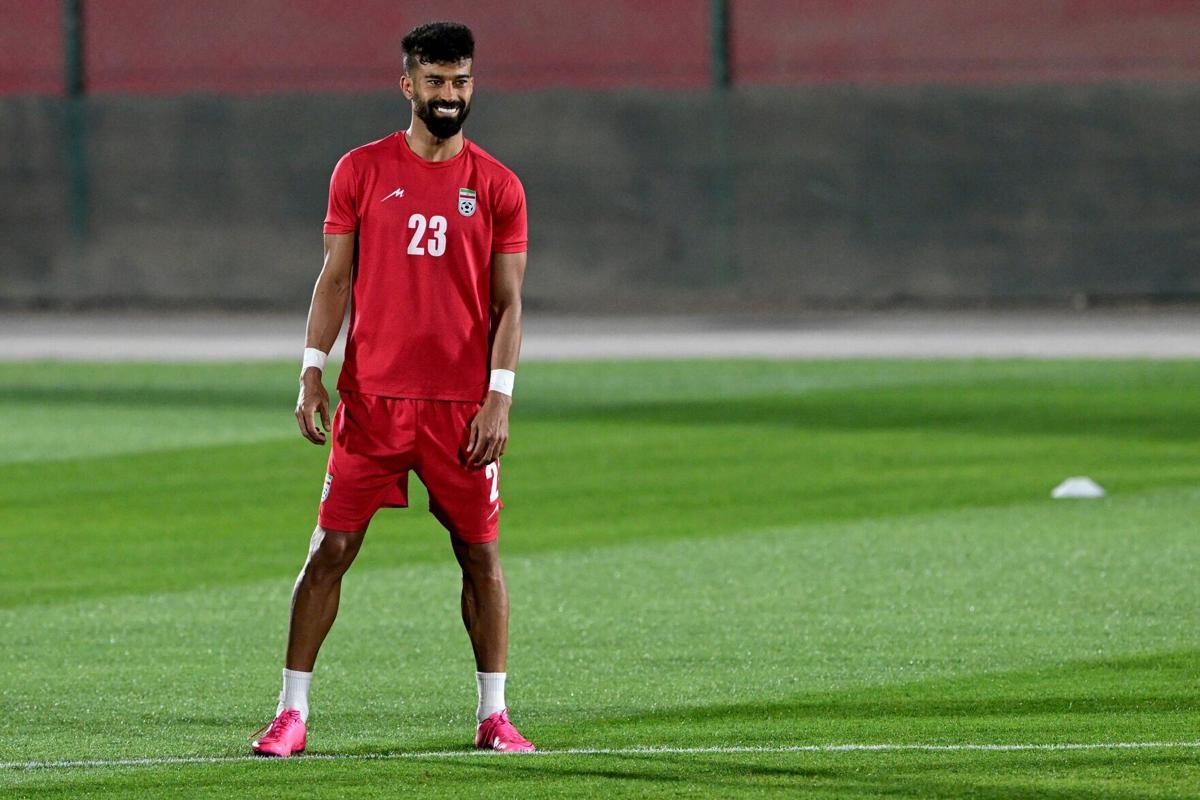
DOHA, Qatar — When Ramin Rezaeian scored his first World Cup goal to seal Iran's victory over Wales last week — just the country's second tournament win in 24 years — it should have been a moment of pure joy.
Yet Rezaeian tweeted afterward that he didn't know "whether to laugh or cry" — feeling trapped along with his teammates between a government that views their success as a propaganda tool and Iranian protesters mounting the most dangerous challenge to the country's theocratic rulers in four decades.
Those conflicting emotions could become even more complicated Tuesday when Iran meets the U.S. in a game that will determine which team moves on in soccer's premier tournament and which goes home.
With the United States considered by many in Iran to be the "Great Satan" — a term the Ayatollah Ruhollah Khomeini made famous amid the 1979 hostage crisis — the game has taken on a political fervor not directed toward an American team since the days of the Cold War. On Monday, in the final news conference before the match, U.S. coach Gregg Berhalter and captain Tyler Adams listened as several Iranian journalists took the microphone to make lengthy political statements before asking the Americans to explain the presence of U.S. warships in the Persian Gulf and the status of race relations in the U.S.
People are also reading…
Iran's players have been stuck in a similar no-win situation since this tournament began.
A wave of popular fury has sent millions of Iranians into the streets in recent months to protest the death of 22-year-old Mahsa Amini in police custody after being detained for wearing her hijab incorrectly. The demonstrations have divided the country, and now both sides are trying to use the national soccer team to further their cause.
Many players expressed support for the protests, only to be silenced by the threat of retaliation from the government. But the protesters, who have seen more than 440 people killed and more than 18,000 arrested by authorities over the past two months, see that silence as cowardice and are demanding the players pick a side and make a statement for World Cup's global TV audience.
"These are brave people. And they expect these players, because they have the attention of the world, to do more," said Shirin Behzadi, who was arrested twice by the so-called morality police — the second time because she was carrying a book — before emigrating from Iran to the U.S. in 1984. "I understand they are going to be facing persecution if they do anything. They're in a really difficult position. But also it doesn't dismiss the anger that people have for them."
Soccer has long been more than a sport in Iran. It's a symbol that under the Islamic regime is often open to interpretation, said Kevan Harris, an associate professor of sociology at UCLA and author of "A Social Revolution: Politics and the Welfare State in Iran." That's been compounded by the organic nature of the protest movement.
Cristiano Ronaldo made history by becoming the first player to score in 5 different World Cups but who has scored the most World Cup goals?
"Because this ongoing movement is so charged with nationalist symbols and slogans, as is the counterpropaganda espoused by the government itself, football was inevitably going to be bound up in the politics of it no matter what the team did," he said.
Some activists sympathetic to the protesters wanted to ban Iran from the World Cup and replace it with Ukraine, saying the national team represented a corrupt government. Supporters of the Islamic regime, meanwhile, view the team the same way they see the country's foreign policy; as a tool to project Iran's power and values internationally.
There is no way to bridge such a wide chasm, leaving the players to walk a tightrope over it.
Before their first game in Qatar, they stood at attention, arms draped over one another's shoulders, but did not sing the national anthem. After England won that game 6-2, Yahya Golmohammadi, a former national team captain, tweeted the result was "God's punishment."
When the players sang the anthem before Iran's second game, a 2-0 win over Wales, riot police celebrated even as they engaged in pitched street battles with protesters.
Iran's internal politics are often as fractious as its international dealings, and sports — especially soccer — was never immune. But until this month, the national team was still seen as something of an icon: Iranians referred to their team as the "Brazil of Asia," comparing their prowess to the perennial South America soccer superpower.
In January, when Team Melli — Farsi for national team — qualified for the World Cup, hundreds of thousands flooded the streets in celebration.
That all changed with the protests, with the team drawing ire after its members visited Iranian President Ebrahim Raisi before leaving for Qatar, with pictures of players Roozbeh Cheshmi and Alireza Beiranvand bowing to Raisi going viral on social media.
On the streets, protesters burned Team Melli banners, something that would have been almost unthinkable a few weeks before. Calls spread for boycotting the team — including from Ali Daei, the second-highest goal scorer in international soccer history, who had to turn down FIFA's invitation to attend the games in Qatar after Iran revoked his passport. Ali Karimi, another former soccer star, was one of the first celebrities to support the protest movement and regularly tweeted against Team Melli.
The sport of soccer, despite the national team's independence, has a long history of inspiring women's protest movements in Iran. Before the 1979 revolution, women were allowed to attend men's soccer matches. But that changed under the Islamic Republic.
In the mid-2000s, a group of female activists started the White Scarves Campaign, named after the headscarves they wore, in an attempt to rally the public and change the law banning them from the stadiums. The campaign was largely unsuccessful. Then in 2019, a fan named Sahar Khodayari set herself on fire in front of the Revolutionary Court of Tehran after being handed a possible sentence of six months in prison for having tried to enter a stadium.
Khodayari died from her injuries, and amid a public outcry and pressure from FIFA, soccer's global governing body, the ban was lifted.
Soccer "is such a great indicator of what's happening in the country," said Shima Oliaee, a journalist and first-generation Iranian-American whose ESPN podcast series "Pink Card" focuses on the women who fought for the right to attend football games in Iran. "My mother's great memories there, her way of talking about where she came from, was all wrapped up in soccer stories."
But, she added, "the same way that the sport can unite the people, it can also distract."
Or divide. Although Iran is just a win away from advancing to the World Cup knockout stage for the first time since the Islamic revolution, the fan base remains at odds over what it would mean, interviews with people in Tehran, Qatar and the U.S. suggest.
"There's no honor in this," Farideh, a 61-year-old mother of four who gave only her first name for reasons of safety, said of any success the team has at the tournament. "Many innocent people have been killed. Our children are suffering: Team Melli shouldn't have honored the Islamic Republic's flag."
But others say boycotting the national squad could antagonize potential protest movement supporters.
"We are all opposed to the brutalities carried out on the streets, but the team belongs to all of us, we pay for it with our own money," said Amir, a 45-year-old banker in Tehran. "They showed their support by not singing the anthem and wearing black wrist bands."
Mojtaba Najafi, a social activist and university lecturer in Iran, agreed. Though he was no government supporter, he said, he thinks the boycott is a foreign-led initiative doomed to backfire.
"Team Melli is too deeply integrated into Iranian life. It was a mistake for the opposition to fall for this," he said. "Team Melli's win could turn out to be the strongest kind of anti-government protest."
Behzadi, who stressed she is not an activist, said viewing the protests — or the soccer — simply in political terms misses the point.
"Listen, I'm a fan. We watch it. We love it," said Behzadi, who runs her own consulting business. "But at the end of the day this is not politics. It's human beings dying for just wanting to have their voices heard. So whatever happens, whether they win or lose, it's already taken the joy out of this game."
Players to watch at the 2022 World Cup
Harry Kane, England

The captain of the Three Lions has averaged a goal per World Cup game. The Tottenham star needs just two international goals to match Wayne Rooney’s 53 goals as England’s all-time top scorer.
Robert Lewandowski, Poland

The 34-year-scoring machine has not slowed down. He has 18 goals in his first 19 games for Barcelona after leaving as the top scorer in Germany’s Bundesliga for the past seven seasons. He scored 41 goals in the 2020-21 season.
Lionel Messi, Argentina

The Paris Saint Germain legend has won seven Ballon d’Or awards as the world’s best player. He has broken seemingly every record in European soccer since arriving at Barcelona as a diminutive pre-teen. He is widely considered the greatest player of his generation due to his vision and jaw-dropping skill. The one thing he has never done is win a World Cup trophy. He is 35, says this is his last World Cup, so he and his teammates are highly motivated to check off the one empty box on his remarkable resume.
Kylian Mbappe, France

Who is “The Next Messi”? Mbappe could certainly end up in the running. The 23-year-old has scored 28 goals for France. He is known for his creativity, speed and ability to change pace. He has helped lead PSG to five French league championships and was a key in France’s 2018 World Cup championship run.
Sadio Mane, Senegal

Scored 120 goals in six seasons at Liverpool before leaving for Bayern Munich over the summer. Mane, who is recovering from injury and may miss a few games, is one of the greatest African players of all time. He is known for his fancy dribbling and explosiveness.
Virgil Van Dijk, Netherlands

Van Dijk, Liverpool’s 6-4 defensive anchor, is captain of the Dutch team and eager to help Netherlands make a run after it failed to qualify for the 2018 Russia World Cup. Holland has been runner-up three times but has never won. Van Dijk is considered among the best center backs in the world.
Pedri, Spain

At 19 years old, Pedri is among the many rising stars for Barcelona and the Spanish national team. The midfielder was named the Best Young Player of the Euro 2020 tournament and could have a breakthrough in Qatar.
Luka Modric, Croatia

Real Madrid playmaker Modric is the best-ever Croatian player and one of the best in the game today. At 37 his career is winding down, but he is still one of the most dangerous players as he can score and create magic for teammates.
Cristiano Ronaldo, Portugal

He is 37 and having issues with Manchester United, but there is no question Ronaldo remains one of the most lethal strikers in front of the goal. Ronaldo has scored 117 times for Portugal and loves the big stage, so look for him to try and make a statement in Qatar.
Neymar, Brazil

He has flair, finesse and speed. He has scored 75 goals for Brazil. He can play as a striker, a winger or a midfielder. He can score from all over the field, with either foot. He can knock it in with his head, too. There isn’t much Neymar can’t do. If Brazil wins a sixth World Cup title, you can bet Neymar will have been a big part of it.
COUNTDOWN TO THE 2022 WORLD CUP

— Where: Qatar
— When: Sunday-Dec. 18
— Who: 32 teams divided into eight groups. The USA is in Group B with Wales, England, and Iran
— Defending Champion: France (runner-up Croatia)
— TV: Fox, FS1, Telemundo


