Editor’s note: This is part of the Star’s ongoing “Big 12 Blitz” series, where we introduce U of A fans to the on- and off-field need-to-know details surrounding each member of the new 16-team Big 12. Today: The University of Houston, located in the nation's fourth-largest city.
The Star's Big 12 Blitz is presented by Tucson Appliance Company.


Tucson Appliance Company has something for everyone! We specialize in new, reconditioned, scratch-and-dent, and high-end appliances. Known for…

is the longtime sports columnist for the
Arizona Daily Starand
Tucson.com.
The most successful football coach in Houston Cougars history, Hall of Famer Bill Yeoman, should’ve, could’ve and would’ve been an Arizona Wildcat three times — as a player in 1945 and as the UA’s head coach in 1957 and again in 1959.
People are also reading…
Instead, he never played or coached a snap for the Wildcats.
Imagine how the football histories of Arizona and Houston might’ve been switched had Yeoman been hired by UA president Richard Harvill in either ’57 or ’59.

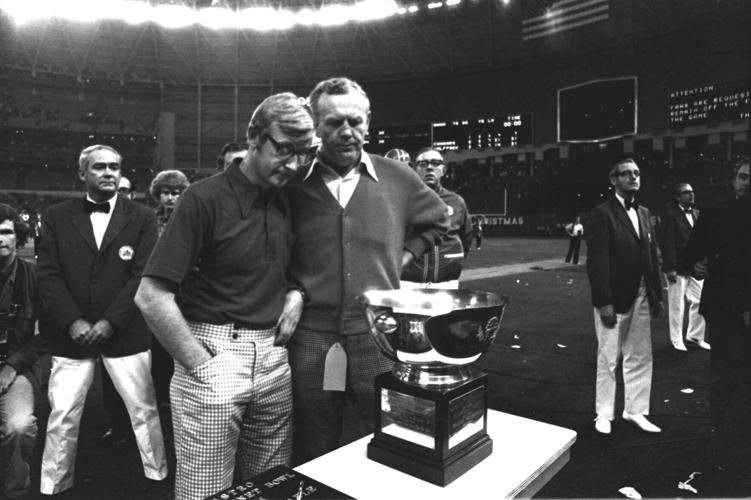
In this Dec. 23, 1974, file photo, North Carolina State coach Lou Holtz, left, and Houston coach Bill Yeoman look over the Astro-Bluebonnet Bowl trophy in Houston. The teams played to a 31-31 tie, but Yeoman awarded the trophy to North Carolina State after the game. Yeoman was a longtime Houston football coach who led the Cougars to four Southwest Conference titles and a school-record 160 victories.
Why, from 1968-79 alone, Yeoman coached Houston to nine finishes in the AP’s Top 20. By comparison, Arizona has finished the season in the AP poll just eight times in history.
Yeoman, an innovative offensive wizard, invented the Veer offense in the early ’60s. His Cougars scored 100 points in a game, a 100-6 victory over Tulsa. One of his Houston clubs set a then-NCAA record for averaging 42.5 points in a game.
When new Big 12 partner Houston played its last football game in Tucson, the 1986 season opener, Yeoman’s career had ebbed. The Cougars lost 37-3 at Arizona Stadium. Yeoman was fired at season’s end after a 1-10 finish.
Here’s the what-might’ve-been story he told me a few days before that game:
After an all-state career at Glendale High School in 1944, Yeoman wanted to play football for Arizona. The feeling was mutual. Yeoman was perhaps the state’s top high school lineman in many years, possibly ever to that point.
But after shutting down its football program for World War II in 1943 and 1944, the UA chose to go slowly, scheduling just five games in 1945.

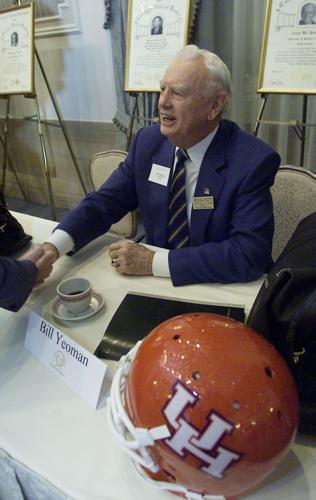
Former Houston head coach Bill Yeoman shakes hands during a news conference Tuesday, Dec. 11, 2001, in New York. Yeoman is one of 3 coaches and 13 players who will be inducted into the College Hall of Fame Tuesday night.
Yeoman balked. He wanted to play a full season. His brother, Elmer Yeoman, also wanted Bill to be a Wildcat. Elmer, a UA grad who became a heart surgeon at the Tucson Medical Center, went on to become one of the UA’s most high-profile boosters for the next 25 years.
But Bill never did get to Tucson. He instead accepted a scholarship to Texas A&M and later transferred to Army, where he became an All-American, blocking for Heisman Trophy winners Doc Blanchard and Glenn Davis.
After his playing days and two years in the Army, Yeoman became an assistant coach for two of Michigan State’s 1950s Rose Bowl teams, earning a reputation as one of the game’s rising coaching stars.
When Arizona fired coach Warren Woodson in 1956, it flew Yeoman to Tucson for a job interview. Athletic director Pop McKale told him the job was his. McKale would get in touch and plan a press conference a few days later.
The Daily Star captured a photo of a smiling Yeoman pointing to a “Tucson’’ sign at the Tucson airport.

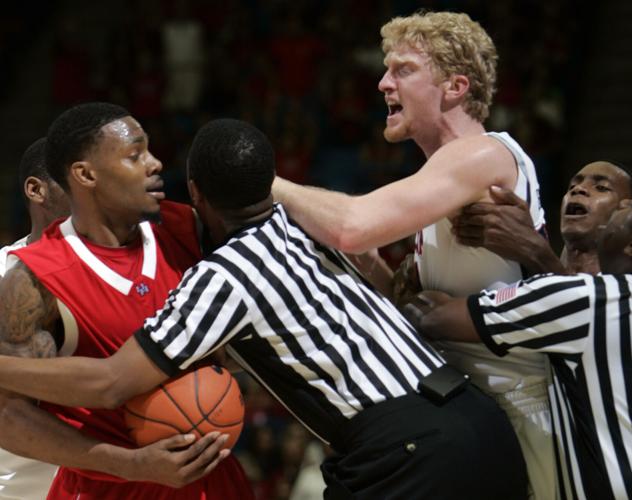
There have only been a few truly memorable moments in modern history between the Arizona Wildcats and Houston Cougars across all sports, but a men’s basketball game in Tucson on Jan. 24, 2009 is certainly one of them. Arizona’s Chase Budinger takes issue with Houston’s Aubrey Coleman after Coleman stepped on Budinger’s face during the heated matchup at McKale Center. After a long delay, a flagrant foul was called and Coleman was ejected from the game. Arizona won 96-90.
“I went home and waited,’’ Yeoman told me. McKale never called. Instead, UA president Richard Harvill stepped in and ordered McKale to hire former ASU head coach Ed Doherty, who would go 3-7 and 1-8-1 at Arizona before being fired.
“I threw up,’’ Yeoman told me. “I was sick for three days.’’
When Doherty was fired, new Arizona AD Dick Clausen phoned Yeoman, who was still at Michigan State. Clausen offered Yeoman the job over the phone. This time, UA vice-president Swede Johnson stepped in and rescinded Clausen’s offer. Johnson instead hired former Houston assistant coach Jim LaRue.
It turned out to be a stroke of good fortune for Yeoman. As Arizona limped through a losing football decade in the ’60s, Houston hired Yeoman two years later. He became and remains the most successful Houston football coach in history, above those of successful coaches such as Jack Pardee, Bill Meek, Kevin Sumlin, Art Briles and Tom Herman.
Yeoman and his Houston coaching career have returned to the national spotlight this year, but in a controversial manner. It is a touchy subject that leads back to Arizona coach Dick Tomey.

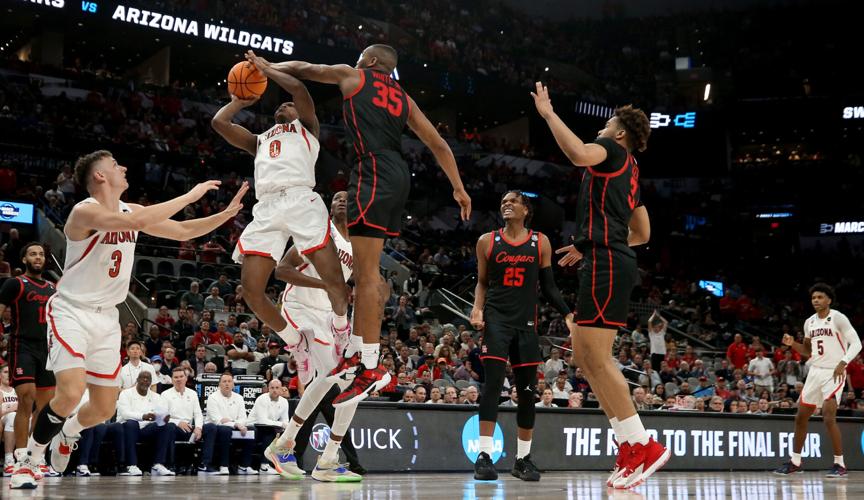
Most recently, Arizona played Houston in men’s basketball on March 24, 2022 in an NCAA Tournament Sweet 16 matchup in San Antonio. Kelvin Sampson’s Cougars, viewed by many experts as underseeded in the tournament at No. 5, upset the No. 1 Wildcats 72-60 to advance to the Elite 8 in Tommy Lloyd’s first season leading the Wildcats.
In 2001, the National Football Foundation and College Football Hall of Fame inducted Yeoman. Few, if any, raised an eyebrow. Yeoman was probably good enough as a lineman at Army to make the Hall of Fame. On the surface, his coaching record of 160-108-8, also seems Hall of Fame worthy.
But Yeoman’s career winning percentage of 59.4 does not meet the Hall of Fame’s criteria; it says each coach must have a 60% winning percentage. It does not round up.
That became a debate this year when the late Mike Leach, former head coach at Texas Tech, Mississippi State and Washington State, was denied a spot on the Hall of Fame ballot because his winning percentage is 59.6.
Hall of Fame spokesman Steve Hatchell told reporters: “At some point, you have to say, ‘those are the rules.’’
Tomey completed his coaching career with a 55.7 winning percentage. The Southern Arizona Chapter of the College Football Hall of Fame has appealed several times to make Tomey an exception. All were denied.

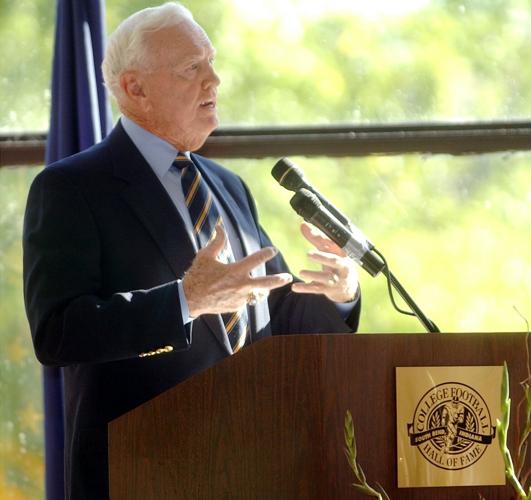
Former Houston football coach Bill Yeoman speaks at the Mayor’s Breakfast as part of the College Hall of Fame Enshrinement activities Friday, Aug. 9, 2002, in South Bend, Indiana.
Yeoman remains the only coach below 60% in the Hall of Fame. The list of those in the same neighborhood are ex-ASU coach Todd Graham (59.6), former Arizona head coach Rich Rodriguez (59.3), ex-UA assistant coaches Ron McBride (58.3) and Pat Hill (58.2) and former Arizona head coach Tex Oliver (57.9).
Yeoman, who died in 2020 at 92, has also been inducted into the Texas Sports Hall of Fame and the Houston Sports Hall of Fame. When Houston plays its first Big 12 football game against Arizona on Nov. 15, a Friday night at Arizona Stadium, it will be the 80th anniversary of Yeoman’s senior year at Glendale High School.
On a November night in 1944, Yeoman and his undefeated Glendale team lost to Tucson High School in the state semifinals, a game played at Arizona Stadium. The man who wanted to be a Wildcat instead became an Aggie, a Black Knight, a Spartan and a Cougar.
No matter how you spin it, Bill Yeoman was a winner.
Contact sports columnist Greg Hansen at GHansenAZStar@gmail.com. On X(Twitter): @ghansen711

Greg Hansen
Columnist