The goal immediately in front of the Arizona men’s basketball team is to make the Elite Eight.
The Wildcats haven’t gotten that far in the NCAA Tournament since 2015 under Sean Miller — who just so happens to be in San Jose coaching Texas against Purdue in the game preceding Arizona-Arkansas.
Funny how this made-for-TV tournament works sometimes, isn’t it?
Anyway, back to the Elite Eight. Arizona hasn’t participated in one in over a decade. But this particular UA club has an elite eight — the eight-man rotation that has carried the Wildcats to the brink of a breakthrough.
What we’re attempting to do today is power-rank those eight players based on their overall impact. The two main criteria are productivity and indispensability. Who does the most? Whom could Arizona least afford to be without?
People are also reading…

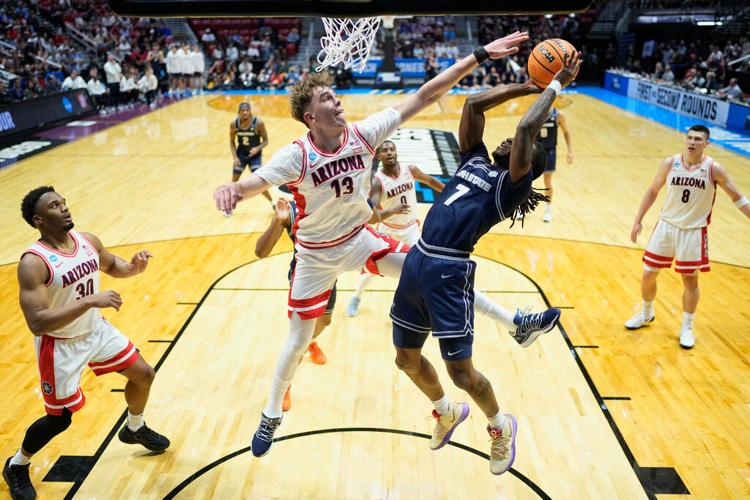
Arizona center Motiejus Krivas guards Utah State guard Kolby King during the first half in the second round of the NCAA Tournament Sunday, March 22, 2026, in San Diego.
I’m sure Tommy Lloyd and his players hate this idea; after all, it’s the Wildcats’ collective humility — a teamwide suppression of egos — that makes them click.
But this exercise actually spotlights what makes this team special: Any number of players could rank atop the list.
Without further ado, here are the 2025-26 Arizona men’s basketball power rankings:
TIER 1
1. C Motiejus Krivas
Notable numbers: 10.4 ppg, 8.2 rpg, 1.9 bpg, 57.3 FG%, 78.2 FT%
The rationale: Krivas isn’t Arizona’s leading scorer or rebounder. But no other Wildcat can do what he does best — provide a towering last line of defense. The 7-foot-2 junior is averaging 3.5 blocked shots per game in the NCAA Tournament. He has altered countless other attempts. It is noticeably harder for opponents to score in the paint when Krivas is on the floor. His season-long defensive rating of 92.8 (estimated opponent points per 100 possessions) ranks third in the Big 12. And make no mistake — it was defense and rebounding that enabled Arizona to hold off pesky Utah State on Sunday. Krivas made only 2 of 7 shots but had 14 boards and three blocks and went 7 of 8 from the foul line. In the second half, he had 10 points, nine rebounds and two blocks and went 6 of 6 from the line. He was, literally, the biggest factor in the game.

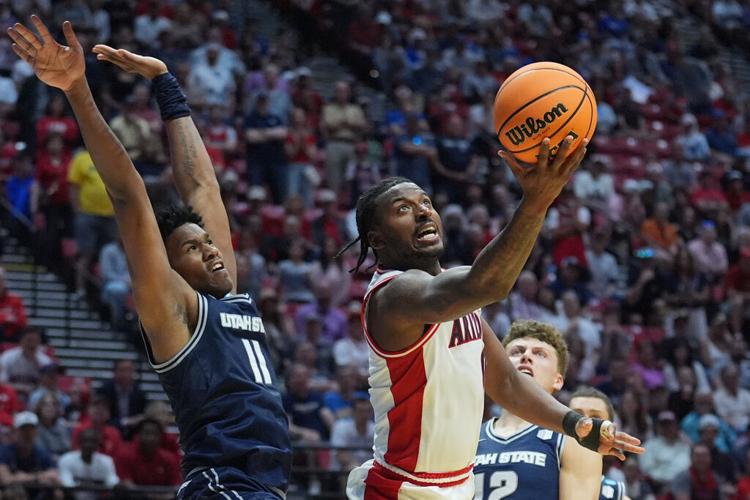
Arizona guard Jaden Bradley (0) shoots around Utah State forward Garry Clark (11) during the second half in the second round of the NCAA Tournament Sunday, March 22, 2026, in San Diego.
2. G Jaden Bradley
Notable numbers: 13.3 ppg, 4.4 apg, 3.5 rpg, 1.5 spg, 39.7 3FG%, 80.0 FT%
The rationale: Wait, the Big 12 Player of the Year isn’t the most impactful player on his own team? Seriously? The case against Bradley is that he isn’t a 7-2 rim-protector extraordinaire. The case for him is that no one is better in crunch time. Bradley did not play well in the first half vs. Utah State, making just 1 of 9 shots from the field. In the second half he was 5 for 7 — and man, did Arizona need him. The Aggies bottled up the Wildcats’ halfcourt offense in a way few opponents have. Arizona had a season-low eight assists and shot under 40% for only the third time this season. Bradley has a unique ability to sense what his team needs and deliver the goods. Utah State cut its deficit to less than six points five times in the final 7:27. Bradley responded with buckets three times. The other UA points in those scenarios came courtesy of Krivas.
3. G Brayden Burries
Notable numbers: 16.0 ppg, 4.8 rpg, 2.5 apg, 1.5 spg, 49.9 FG%, 39.2 3FG%, 80.0 FT%
The rationale: One could easily argue that Burries is actually Arizona’s best player. His stats certainly would support that contention. Not only is he the Wildcats’ leading scorer with elite shooting percentages, he also provides defense and rebounding. Burries came within one rebound of a double-double vs. Utah State. He’s had double-digit boards three times — all in conference games that Arizona won. He also possesses the clutch gene. With Utah State still within striking distance at 70-64 with less than 2:30 to play, Burries buried a 3-pointer. The Aggies never seriously threatened again. Burries has the highest NBA upside of any current Wildcat and will be their highest-drafted player in June should he elect to leave school. But this power ranking is about the here and now. Burries is a very strong No. 3.

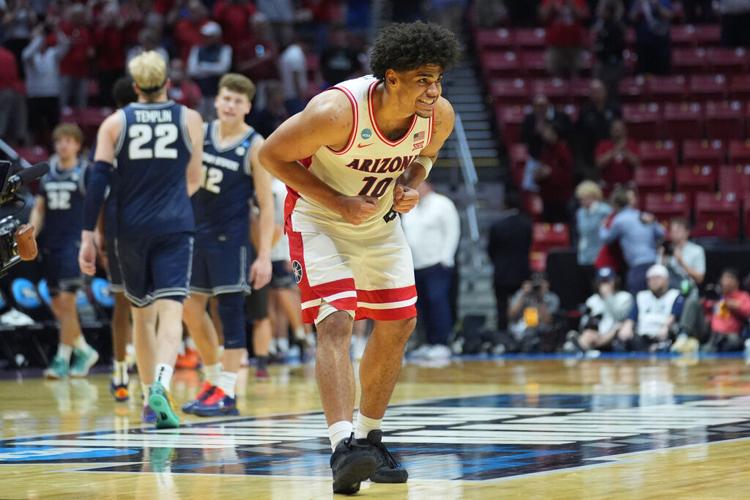
Arizona forward Koa Peat (10) celebrates as Arizona defeats Utah State in the second round of the NCAA Tournament Sunday, March 22, 2026, in San Diego.
TIER 2
4. F Koa Peat
Notable numbers: 13.7 ppg, 5.5 rpg, 2.7 apg, 53.3 FG%
The rationale: It was a really tough call between Peat and fellow power forward Tobe Awaka. I gave Peat a slight edge because of his versatility. If needed, he can handle the ball against pressure and create his own shot. He’s also a winning basketball player. Whether it’s international competitions, high school or college, Peat’s teams win. He’s had some standout performances in March, including a 25-point outburst in the regular-season finale at Colorado, a team-high-tying 21 points vs. Houston in the Big 12 Tournament title game and his fifth double-double of the season vs. Utah State. Peat has improved his free-throwing shooting, too, hitting 18 of 26 (69.2%) in the past three games.
5. F Tobe Awaka
Notable numbers: 9.3 ppg, 9.3 rpg, 58.8 FG%
The rationale: What a luxury it is to have the nation’s best rebounder coming off your bench. Awaka doesn’t have the most rebounds in the country, but that’s because he plays only 21.1 minutes per game. Awaka ranks second nationally in total rebound rate (percentage of available rebounds he grabs) at 23.7% and first in offensive rebound rate at 20.4%. He averages an absurd 17.7 boards per 40 minutes. Awaka seldom approaches that total because Arizona has two stellar frontcourt alternatives and because Awaka can be a bit foul-prone at times. He also has struggled at the line lately, making just 7 of 21 in the past six games. But if anyone personifies the selfless nature of this UA team it’s Awaka, who volunteered to come off the bench for the greater good.

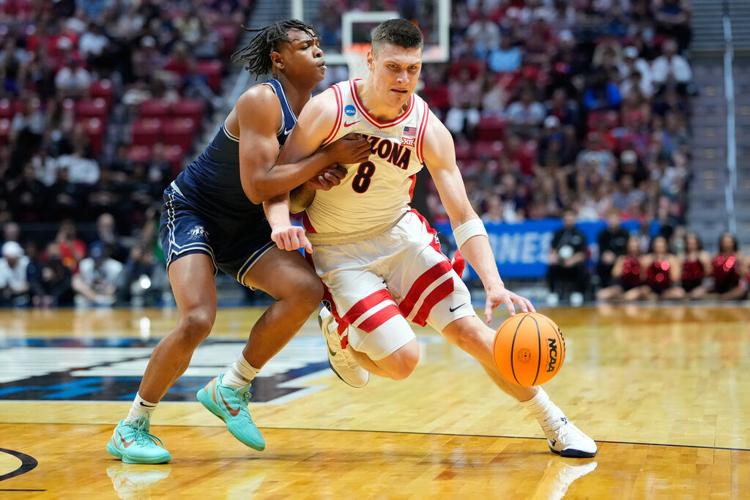
Arizona forward Ivan Kharchenkov (8) drives against Utah State guard Elijah Perryman (1) during the first half in the second round of the NCAA Tournament Sunday, March 22, 2026, in San Diego.
6. F Ivan Kharchenkov
Notable numbers: 10.2 ppg, 4.3 rpg, 2.3 apg, 1.4 spg, 48.9 FG%, 72.6 FT%
The rationale: The perpetually underrated Kharchenkov seldom gets the respect he deserves. I’m as guilty as anyone of overlooking his across-the-board contributions. I can’t tell you how many times I wanted to give Kharchenkov his own item in “Five Takeaways” only to leave said item on the cutting-room floor. Kharchenkov plays a little out of control at times on offense and needs to become more consistent on catch-and-shoot 3’s. But his energy and defensive production are critical to Arizona’s success. He can guard multiple positions, disrupt passing lanes and turn defense into offense. Kharchenkov ranks third on the team in “stocks” (steals plus blocks) with 60. Krivas is first with 93. Burries is second with 62.
TIER 3
7. G Anthony Dell’Orso
Notable numbers: 8.8 ppg, 2.1 rpg, 1.9 apg, 82.5 FT%
The rationale: It’s been an up-and-down season for Dell’Orso, and that has continued in the postseason. “Delly” had a season-high 26 points on 10-of-14 shooting (6 of 9 from 3) in the Big 12 semifinals against Iowa State. In the four other games, he has a total of 21 points while shooting 6 for 22 (27.3%). Dell’Orso went through a horrific slump in January before rebounding in February, including back-to-back 22-point games. He can deliver a heat check off the bench; you just never know when it’s going to come. Dell’Orso leads the team in free-throw percentage and gives Lloyd an extra ball-handling option in late-game scenarios in which Arizona is trying to protect a lead.
8. F Dwayne Aristode
Notable numbers: 4.1 ppg, 1.8 rpg, 48.4 FG%, 45.3 3FG%
The rationale: Someone has to be the eighth Beatle. Aristode remains the rawest of the rotation regulars, limited to, for the most part, a 3-and-D role. He played only three minutes vs. Utah State, all in the first half, and had only one shot attempt. But he knocked down that 3-pointer as if he were a fifth-year senior; Aristode is, in fact, Arizona’s most efficient 3-pointer shooter, albeit with a lower volume. Aristode has averaged just 9.4 minutes per game since returning from an illness, down from 15.6 minutes before he got sick. Unless someone gets hurt, that likely won’t change the rest of the way. So we’ll only see flashes of Aristode’s immense talent. But would it surprise you if he drilled another key 3 in a critical situation?

Michael Lev is a senior writer/columnist for the Arizona Daily Star, Tucson.com and The Wildcaster.
Contact sports reporter/columnist Michael Lev at mlev@tucson.com. On X (Twitter): @michaeljlev. On Bluesky: @michaeljlev.bsky.social

Michael Lev
Sports Reporter/Columnist


 Sweet and sour: Arizona’s 5 best — and 5 worst — moments in the Sweet 16