The Randolph Golf Course opened in 1925, and the Star soon editorialized that it was to be “a place where everyone can go and enjoy 480 acres.”
“Picture in your mind a great park, shade trees, stretching green lawns, a park bench in a cool spot, the children enjoying the sunshine out of doors ...”
Golf flourished. The “great park?” Not so much.
Randolph became one of America’s busiest municipal golf facilities. In 1958, the city approved a second 18 holes — now known as Dell Urich Golf Course — and by the 1990s Golf Digest magazine reported that the Randolph Golf Complex was No. 2 in America for rounds played per year.
The “park bench in a cool spot” idea was forgotten, overwhelmed by Tucson’s love for golf and its profitability.
Now, almost a century after the Randolph golf course opened, the City of Tucson is three months deep into a campaign to “reinvent and reimagine” the Randolph and Dell Urich golf courses.
People are also reading…
It has hired a landscape architect and an urban planner. It has engaged special-interest groups — birdwatchers, skateboarders, disc golfers — to, among other things, “develop opportunities to create park space within the current golf course boundaries.”
The Big Item: a public walking path smack between the No. 1 hole at Randolph and No. 18 hole at Dell Urich, from Alvernon Way to Hi Corbett Field and Reid Park.
No word on whether hard hats will be sold or rented for the walk. Or whether “Quiet Please!” signs would be posted every 20 yards.
“The next step,” said City Parks and Recreation deputy director Greg Jackson, “is to conduct a more broad community survey online, listen to everybody, and then make our recommendations to the Mayor and City Council.”

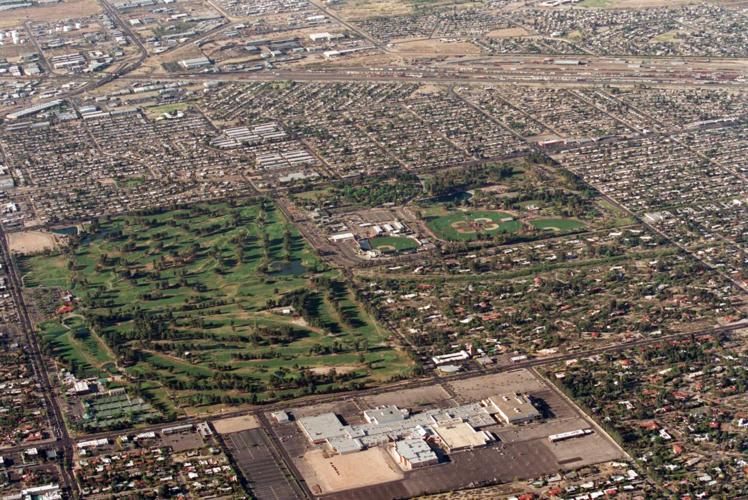
The Randolph North and Dell Urich golf courses in midtown Tucson can be seen is this aerial view.
For 90 minutes Saturday afternoon, Jackson, a landscape architect and urban planner, presented these possibilities to about 15 representatives from Randolph’s various and long-established men’s and women’s golf clubs.
I expected a contentious meeting.
A walking path through the middle of the heavily played Randolph and Dell Urich golf courses? Are you nuts? Can you imagine the confrontations between walkers and golfers and potential litigation?
Instead, after viewing architectural plans, after learning that there are about 40 unused acres on the boundaries of the two golf courses — having heard prominent Tucson golf course architect Ken Kavanaugh say that it can be a win-win situation — I was encouraged by the possibility for making changes within the footprint of the two popular golf courses.
It’s doable. I am surprised to be typing this.
Full disclosure: I play about 100 rounds of golf each year at the Randolph complex and figure and my golf partners and I all spend close to $4,000 per year to do so. We have become possessive and territorial of the five city courses and would strongly prefer that politicians stick to politics and leave our sainted golf turf alone.
My only complaint about the Randolph Golf Complex is that a few years ago groundskeepers at Dell Urich cut down about 50 mature trees lining the fairways — beautiful, shade-producing, shot-wrecking trees — and did not replace them.
Otherwise the course is a gem.
It’s not that the Randolph Golf Complex is in financial distress. It’s just the opposite.
Only two Southern Arizona public golf courses — Crooked Tree and The Views, both on the far northwest side of town — can match the amount of rounds played each year.
In the fiscal year 2021, the Randolph Golf Complex had $2.1 million in revenues from golf fees and another $787,000 for cart rentals against a payroll of $1.4 million. It reported a net profit of $650,641.
So why change anything?
The city’s letter to stakeholders refers to it as a “reinvestment plan for the entire complex” and “feasibility of open space for public enjoyment.” It almost sounds like the Star’s 1925 editorial.

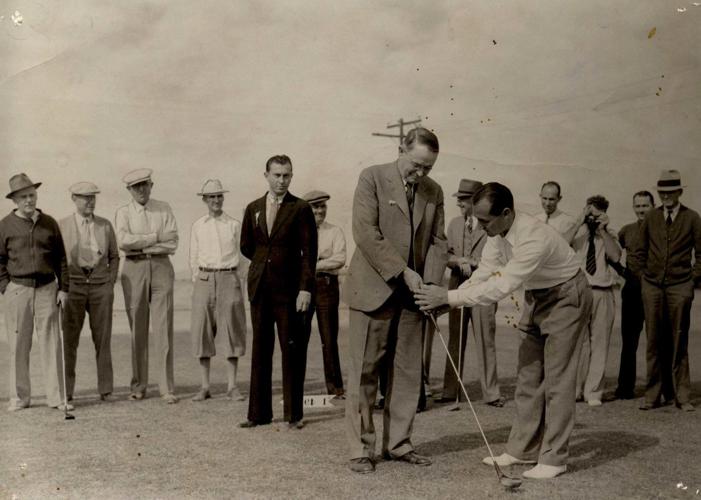
Pro Dell Urich gives a tip to Tucson Mayor Henry O. Jaastad on the opening day at the newly grassed Randolph Golf Course in 1936. The course opened in 1925 with dirt fairways. This photo was taken on the first tee, now the 18th hole on the north course.
Predictably, these changes can work if the funds are available. That’s a big if.
The only way to avoid potentially dangerous and angry collisions between golfers and those on a walking path between Dell Urich and Randolph would be to redesign Randolph, which is basically the same as it was 50 years ago. That would cost, what, $10 million?
The Tucson Conquistadores and Rio Nuevo organization have a partnership that could possibly pay for a third of that amount. The influential Conquistadores previously hoped a redesign of Randolph into a championship course — redoing all 18 holes and making it a 7,300-yard course (it currently is 6,900 yards) — would be a perfect fit for the University of Arizona men’s and women’s golf programs and the PGA Tour Champions Cologuard Classic.
But that plan, which could have accelerated the reimagining of the Randolph Golf Complex, died when the UA chose to spend $14.5 million to build a golf compound at Tucson Country Club. The Cologuard Classic has now been moved to La Paloma Country Club.
This, too, is likely to become a follow-the-money enterprise.
If the city is willing to invest a large sum to improve connectivity to the Randolph Golf Complex and its green spaces, it would be a win for the community.
<&rule>
Phil Mickelson held a news conference before his practice round on Wednesday at The Gallery leading up LIV Golf's first event in Tucson.
Contact sports columnist Greg Hansen at GHansenAZStar@gmail.com. On Twitter: @ghansen711

Greg Hansen
Columnist

 Hansen's Sunday Notebook: Mock NBA drafts say Arizona's Azuolas Tubelis, west's other stars, not 1st-round worthy