

"We'll all go down together," Les Hibbert sang jokingly in his London accent, as he led a flotilla of 10 mostly neophyte kayakers across the choppy waters of Lake Powell's main channel.
Hibbert is both co-owner and guide for a company with a long history of river-running the Grand Canyon. Kayaking trips in the recesses of the lake are a relatively new offering.
Adventure tourists sign on for an outdoor experience that includes camping, boating, kayaking and hiking. On arrival in Page, they attend an orientation in which each person is issued a "dry bag" containing a sleeping bag and space for his or her gear.
Early the next morning, everyone convenes at a marina near the Glen Canyon Dam and hops on a custom-designed 30-foot pontoon boat. Kayaks are stacked on the boat's roof; people and provisions go inside; dry bags and tents are lashed onto the deck. On a five-day expedition, the boat, powered by two 130-horsepower engines, heads roughly 50 miles up the 200-mile lake, where the guides set up base camp on the sandy beach of a sheltered cove.
People are also reading…
A kayaking lesson
Next, it's time to test the waters. The long, narrow kayaks now bobbed in the shallows. People eyed them with a "no, you go first" look.
The trick is to straddle the kayak, then lower your body, butt first, into that tiny opening called the cockpit. Then in go your legs, one at a time, in a balancing act to keep the craft from flipping.
While instructions were issued on how to escape should it tip over, a guy named Jim leaned too far to one side, winning the distinction of being the first and only to dump his kayak and land in the lake. "When you're not sure what to do," commented Hibbert with a grin, "do nothing and you won't go over." To everyone's relief, the sport proved reasonably easy to master.
Lake Powell and the Glen Canyon Dam
In the 1960s, the Glen Canyon Dam was constructed, creating a reservoir by flooding a vast segment of the Colorado River and its tributaries, in the wilderness known as the Glen Canyon. The reservoir, Lake Powell, lies just upriver from the Grand Canyon, astride the Arizona-Utah border.
Nearly a hundred navigable side canyons flow into the lake's main waterway. Colorful names like Dirty Devil, Dangling Rope and Padre Canyon evoke the history of this area that was once explored by Spanish priests, miners, Mormon settlers, and Civil War Gen. John Wesley Powell, the lake's namesake.
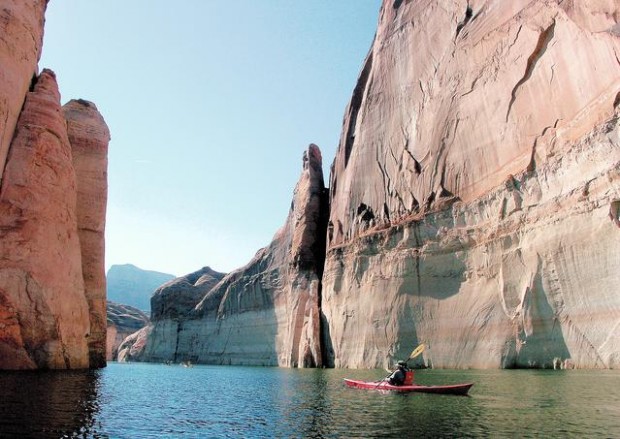
Too narrow for larger boats to access, many of these remote canyons are a kayaker's nirvana. Striated sandstone cliffs layered in rose, buckskin and terra cotta soar hundreds of feet above the water, dwarfing kayakers as they cut through the twisting canyon recesses. Sometimes the only sound is the swish of paddles and the echo of voices bouncing off the rock face.
In recent drought years, the water level has sunk nearly 100 feet from "full pool," its highest point — it's now around 400 feet deep at the dam — revealing a wide, chalky white band on the rock surrounding the lake, in stark contrast to the color above. To the delight of hikers, the low water has added plenty of length to canyon trails.
Hiking the slot canyons
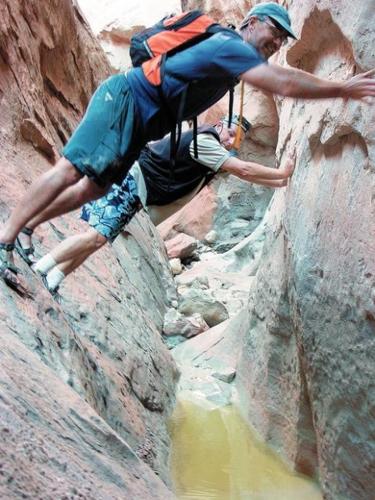
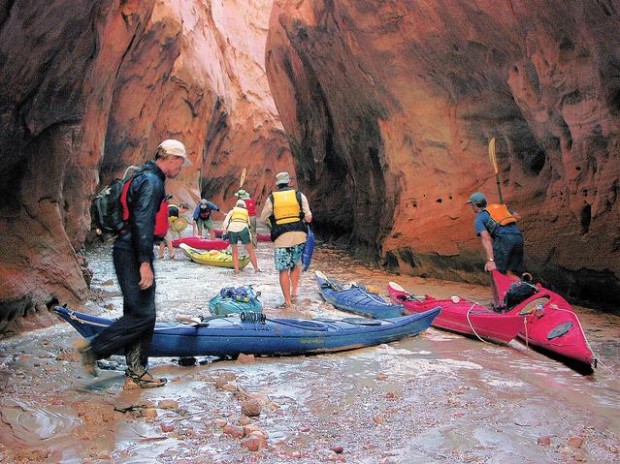
An afternoon paddle up winding Cascade Canyon, under a dazzling blue sky, ended on a muddy beach where the kayaks were ditched and a slogging trek through a tight "slot canyon" began. Slot canyons are sandstone rock outcroppings, chiseled and sculpted into towering, narrow chasms by flash floods over millions of years. The longer the hike up-canyon, the more tapered and shadowy they become. Where the trail became too muddy or rocky, the daring, driven by curiosity about what lay around the next bend, tested their "stemming" technique. They placed their feet on the sloping rock wall and hands on the opposite wall in a bridgelike posture, stepping sideways in a spider crawl to clear any obstacles in their path.
A thunderstorm and flash floods
Hibbert and the other guide are men of many abilities: Coast Guard-certified boat captains, expert kayakers and hikers, not to mention talented camp cooks. Their sunrise wake-up call is the hiss of a propane tank that heats water for morning coffee.
One day, after a bracing breakfast of pancakes and sausage, they informed the group that, according to the weather radio's commentator, heavy rains were predicted for the afternoon. Translation: The danger of flash floods meant a self-imposed ban on slot canyon hiking that day, but not a veto on a paddling foray into nearby Anasazi Canyon.
After the morning's kayaking adventure, a climb to the buttes above the lake yielded expansive views and armloads of driftwood for the evening's campfire.
Then the group lunched on a spread of sandwiches, sliced fruit and cookies. Still no storm had materialized. Tempting fate, the other guide motored the group to a floating dock for a trek to Rainbow Bridge, the nearly 300-foot natural stone span billed as the world's largest.
During the return, the deluge finally hit, together with high winds, thunder and lightning. By the time everyone was safely back under the boat's canopy, the parched sandstone cliffs had sprung dozens of enormous, raging waterfalls, some in multiple surges, others plunging and spraying hundreds of feet down with little vegetation to hold the water back. People made a game of naming the temporary cascades: Horse's Tail, Fire Hose, Broom, etc.
The next and final day of the trip found the group paddling up Twilight Canyon in the early morning to witness the aftermath of the prior day's flash flood. The pale moon was just setting between two distant peaks. The rock, still wet to a water line 10 feet above the now-muddy river, in addition to islands of floating brush and masses of fallen boulders, hinted at the force of the flood. Everyone had gained a new reverence for nature.
Five days' camping, kayaking and hiking is a worthwhile challenge when the reward is access to the pristine beauty of Lake Powell's remote side canyons.
Touring options:
● Hidden Canyon Kayak in Page offers five- and six-day kayaking trips from $825. Kayaks, camping gear, all meals and transport upriver via pontoon boat are included: 1-800-343-3121, www.hiddencanyonkayak.com
● REI Adventures offers a seven-day trip with a different itinerary for $1,999 per person, double occupancy, for REI members (join REI for a one-time $15 fee), $2,200 for nonmembers.
The excursion includes return transportation from the airport in Salt Lake City to Lake Powell's Bullfrog Marina, kayaks, tents, all meals and houseboat support (transport upriver, bathroom and shower).
Take your own sleeping bag: 1-800-622-2236. www.rei.com
● Twin Finn Diving in Page rents kayaks from $35 per day: 1-928- 645-3114, www.twinfinn.com
When to go:
For the best weather, choose March, April, September, October and November. Avoid the hot, crowded summer months.
How to get there:
Page is approximately a 61/2-hour drive from Tucson. Take Interstate 10 to Phoenix, Interstate 17 from Phoenix to Flagstaff, and U.S. 89 from Flagstaff to Page.


