

ROME — The light splashes gold over marble columns in the Roman Forum and the faded facades of Baroque palaces in the distance. Nearby, a heated dialogue resonates in the hearty Roman accents that infuse everyday interactions with playful theatricality.
I am standing in the center of Rome, amid its absurd profusion of gorgeous monuments, historic sites, religious wonders — and everyday contemporary life.
A man on a scooter drops off dry cleaning next to a 1,900-year-old temple. A woman in extravagantly high heels heads to her office, housed in a 17th-century papal palace.
This is why Rome, majestic and down-to-earth, has a hold on me like no other city. Every turn down a cobblestone street hides yet another magnificent piece of art and history that feels decadently ignored and singularly mine.
Trying to get in all the sights is virtually impossible — I didn't make it even when I lived here for six months. Now that I barely manage a weekend a year, I have developed my own walking itinerary of favorite spots.
People are also reading…
Here is my personal pick of what to see in Rome if you have only two days. Best of all, every site listed here is free, except for the Vatican Museums (about $20, free the last Sunday of the month, www.vatican.va) and the Roman Forum, which includes the Colosseum (about $16, www.romaturismo.it/v2/ allascopertadiroma/EN/musei08.html).
Caput Mundi
Let's start in the morning at Piazza Venezia, the logistical center of the metropolis that a couple of millennia ago called itself — and for centuries indeed it was — caput mundi, the "head of the world."
Climb the grand ramp up the Capitoline Hill to Michelangelo's Piazza del Campidoglio, then walk to the terraces on either side of Rome's town hall.
There it is: The heart of the Roman Republic and Empire lies in ruins at your feet, a sweeping vista of muscularly carved arches, columns, statues and basilicas.
Imagine yourself in the power center of the ancient world by walking down the length of the Roman Forum along the Via Sacra, the sacred way.
Reputed site of Caesar's cremation
I'm oddly, movingly reminded of this city's breathing history every time I see the faded wreath of fabric flowers lying in front of the Temple of Caesar at the reputed site where his assassinated body was cremated.
I circle around the Colosseum, inaugurated in A.D. 80 to a crowd of about 50,000 spectators and for 300 years the site of bloody battles between gladiators and beasts. Then I head back along Via dei Fori Imperiali.
On the right are the Imperial Forums, built as the Roman Forum started to be too tight for the growing empire. The most impressive ruins are at the end, as you reach back toward Piazza Venezia.
The Mercati Traianei were Rome's mall, with about 150 shops along several floors, and just past them rises the 98-foot Colonna Traiana, a column whose spiraling bas-reliefs depicting Rome's campaigns against eastern European tribes are a masterpiece of Roman sculpture.
I always stop for lunch just across Piazza Venezia, down Via del Gesu. When I want to sit down to such classics as saltimbocca (thin veal slices rolled with prosciutto and sage), I head to Enoteca Corsi.
If I feel compelled to keep going, I step into any of the compact, family-run grocery stores, like the Tiberi brothers', a couple of doors down from the enoteca (Italian for wine shop), for a slice of pizza bianca — chewy, crusty pizza dough — filled with arugula, mozzarella di bufala and prosciutto crudo.
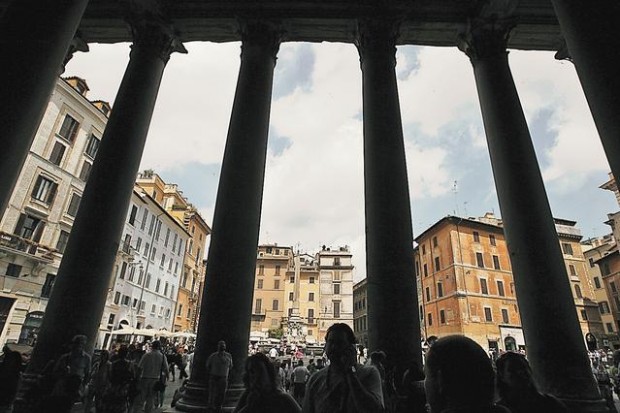
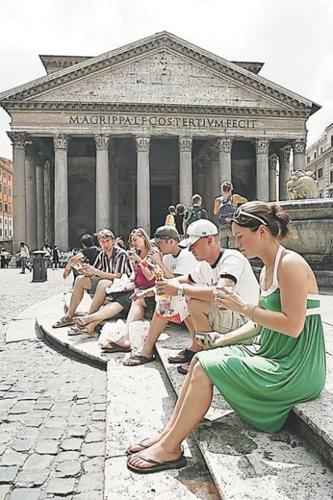
I usually take my pizza break on the low wall next to the Pantheon (Piazza della Rotonda), marveling at perhaps the best-preserved monument of ancient Rome — this perfectly proportioned, vast dome-topped structure has been a temple for 1,900 years, the last 1,400 as a Christian church.
Armed with ice cream from one of the nearby gelaterie, I amble through the contorted medieval streets, past Renaissance and Baroque palaces, all in the earthy ocher and golden tones of Rome, until I make my way to the most annoyingly tourist-thronged attraction of all, Fontana di Trevi (Piazza di Trevi).
The view
Poor Neptune, sculpted in 1762, had to stand by as Anita Ekberg epically bathed in the large fountain in front of him in Fellini's "La Dolce Vita," and he continues to tolerate the ritual that I can't resist: Tossing a coin in, said to ensure a prompt return to Rome.
There's more "sweet life" down the street at the inordinately expensive boutiques lining Via dei Condotti. The street ends at the masterpiece of 18th-century theatricality, the volubly shaped Spanish Steps (Piazza di Spagna).
Walk up and a few hundred yards along the road, into the Villa Borghese park to the terrace on the Pincio hill, overlooking vast Piazza del Popolo.
It's the best place to watch the sunset, as the red and golden light infuses the umbrella pines, the marble arches and the ornate church domes — including St. Peter's — in the panorama of Rome at your feet.
For dinner, I head back south to any of the restaurants along Via del Governo Vecchio.


