


We need to account for the Coriolis force to correctly analyze the large-scale movement of air in the atmosphere and water currents in the ocean.
Q: What is the Coriolis force?
A: Newton’s laws of motion mathematically describe how objects move when forces are exerted on them.
Earth is spinning like a top, even though to us who are standing on Earth, it seems that we are not moving. Newton did not account for Earth’s spin in his equations. The Coriolis force appears as an extra term when Newton’s laws are transformed to account for Earth’s spin.
Italian scientist Giovanni Battista Riccioli described the effect in 1651, explaining that Earth’s rotation causes a cannonball fired to the north to deflect to the east. Gaspard-Gustave Coriolis published a paper in 1835 describing the force mathematically.
The Coriolis force acts in a direction perpendicular to Earth’s rotational axis. Objects in the Northern Hemisphere are deflected to the right, while objects in the Southern Hemisphere are deflected to the left.
People are also reading…
The magnitude of the Coriolis force depends on the speed of the object and its latitude. The Coriolis force is zero at the equator and increases toward the poles.
The Coriolis force also is proportional to Earth’s rotation rate. Earth completes one rotation per day, so for everyday motions, like throwing a ball or an apple falling from a tree, the Coriolis force is very small compared to other forces and is negligible. Its effects become noticeable only for motions occurring over large distances and long periods of time.
Because Earth spins, we need to account for the Coriolis force to correctly analyze the large-scale movement of air in the atmosphere and water currents in the ocean. It is too small to explain the rotation of draining water in sinks and toilets.
Photos: See tornadoes' deadly destruction over the years
May 22, 2011: Joplin, Missouri

In this May 25, 2011, photo, Beverly Winans hugs her daughter Debbie Surlin while salvaging items from Winans' devastated home in Joplin, Missouri. The deadliest tornado to hit the United States in the last several decades struck on May 22, 2011, leveling a miles-wide swath of Joplin and leaving 161 people dead.
April 2011: Southeastern U.S.

Tuscaloosa Fire Lt. Brian Phillips climbs a pile of rubble in search of survivors or bodies at an apartment building in Tuscaloosa, Ala., after 362 tornadoes hit the southeastern United States over three days in April 2011, killing an estimated 321 people. Alabama was the hardest hit, with a death toll of more than 250 in that state alone.
Feb. 5, 2008: 'Super Tuesday' outbreak

New cars and trucks at a Chevrolet dealership sit under the wreckage from a tornado that hit Mountain View, Ark., on Feb. 5, 2008. The so-called Super Tuesday outbreak of 87 tornadoes in the southeastern United States killed 57 people.
April 2014: Southeast and Midwest

An American flag waves from a makeshift flag pole in front of a concrete slab that once was a house in Louisville, Miss., after an April 28, 2014, tornado destroyed the house. An outbreak of dozens of tornadoes, stirred up by a powerful storm system, hit the Southeast and Midwest over a three-day period in April 2014 and killed 32 people in Iowa, Oklahoma, Arkansas, Mississippi, Alabama and Tennessee.
May 20, 2013: Moore, Oklahoma

A tornado killed 24 people on May 20, 2013, in Moore, Oklahoma. The tornado had winds over 200 miles per hour, giving it the most severe rating of EF-5.
March 18, 1925: Missouri, Illinois and Indiana

This March 1925 photo shows an overturned house that was carried more than 50 feet from its foundation following a tornado in Griffen, Ind. The March 18 tornadoes that hit Missouri, Illinois and Indiana killed nearly 700 people, topping the list of the deadliest tornadoes in the United States.
May 11, 1953: Waco, Texas
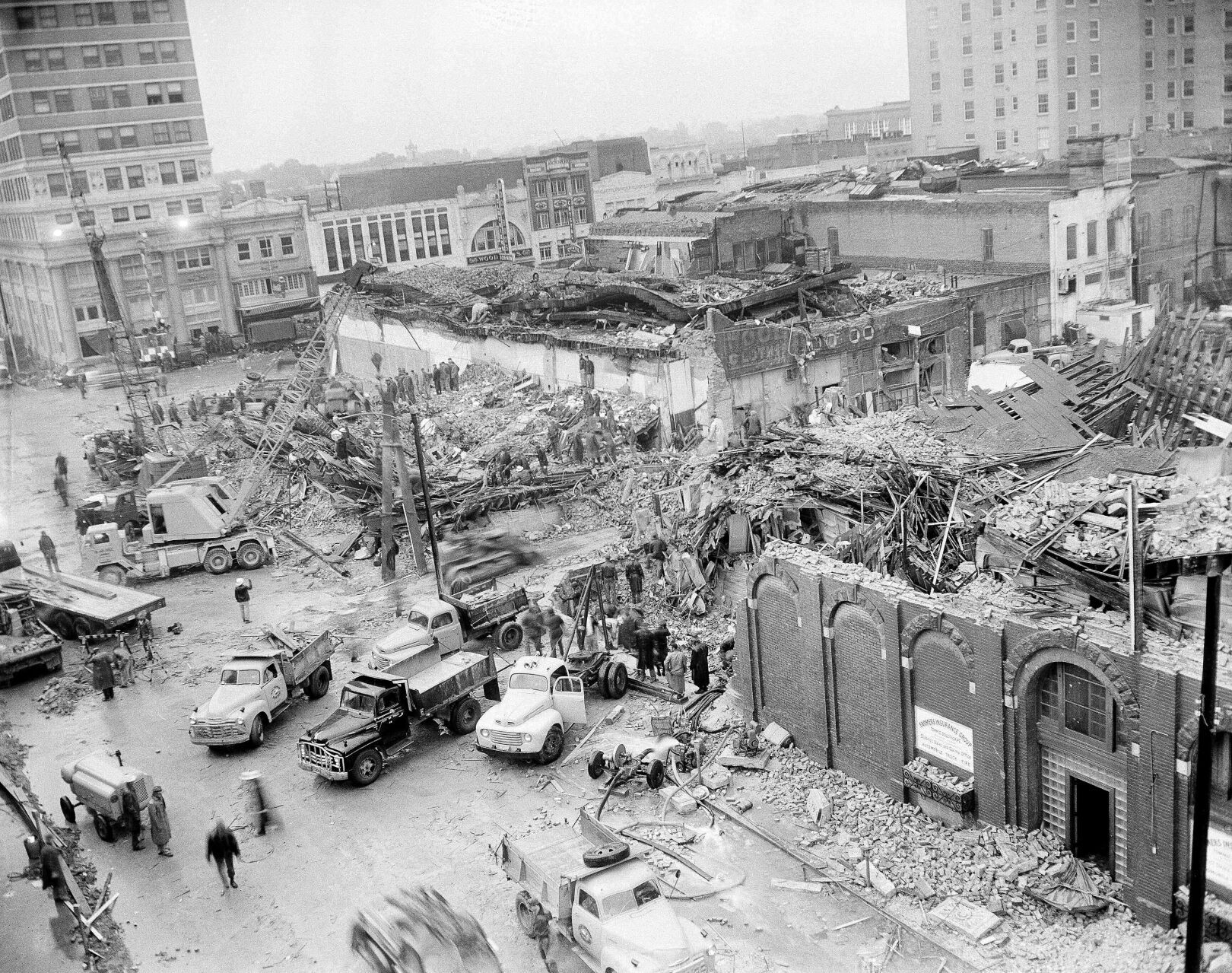
Bolstered by heavy equipment, workers start the gigantic task of cleaning up wreckage remaining in the downtown area of Waco, Texas, in the aftermath of a May 11, 1953, tornado. It was one of the top 10 deadliest tornadoes in U.S. history, killing 114 people.
Nov. 6, 2005: Evansville, Indiana

As others stand intact, debris from destroyed mobile homes litter the Eastbrook Mobile Home Park in the aftermath of a tornado in Evansville, Ind., on Nov. 6, 2005. The tornado ripped across southwestern Indiana and northern Kentucky, causing 20 deaths, wrecking homes and knocking out power to thousands.
May 10, 2008: Southwest Missouri
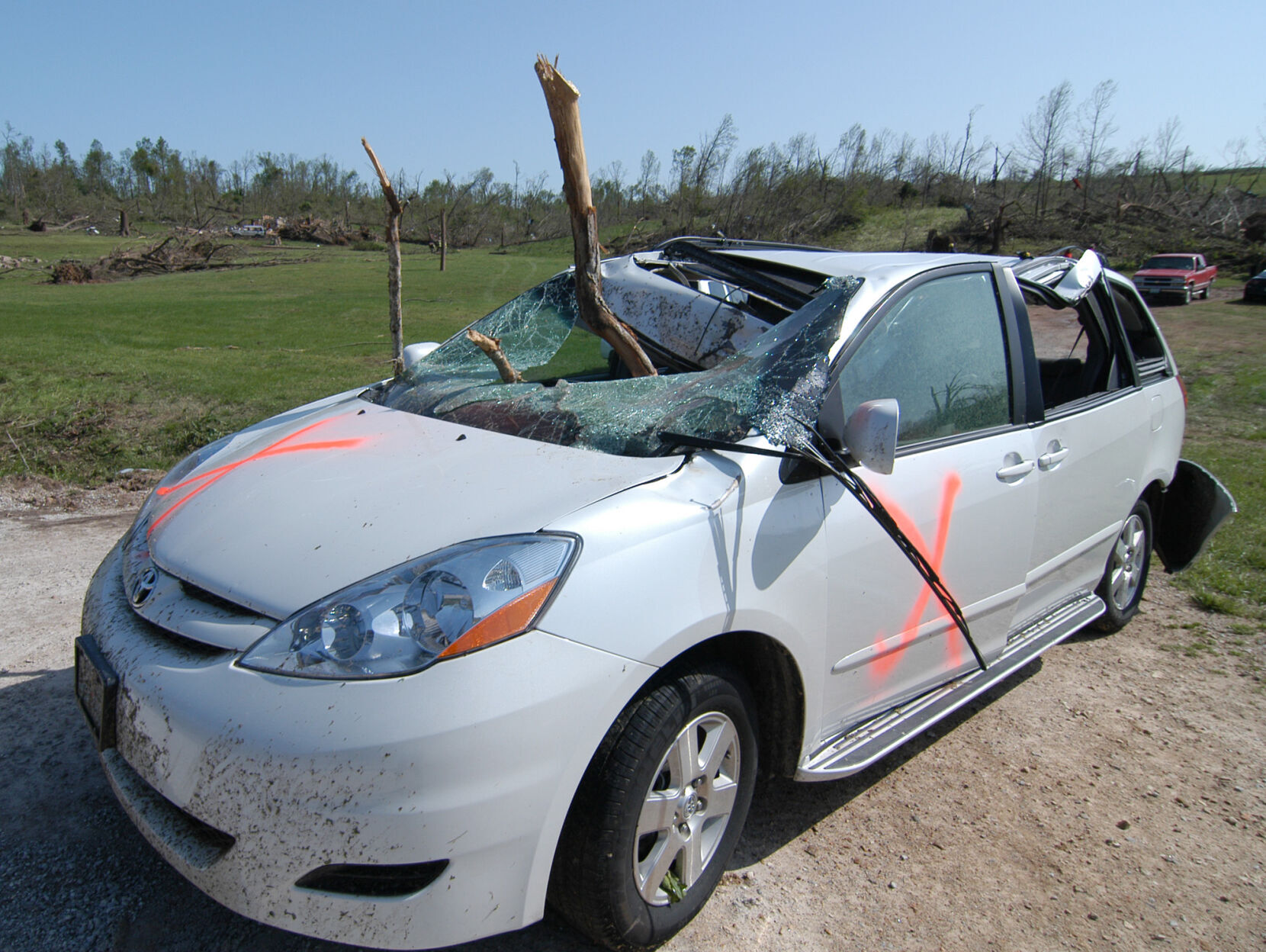
A vehicle was dumped along highway 86 north of Racine, Mo., by a tornado that hit the area in southwest Missouri on May 10, 2008. Fourteen people were killed and hundreds injured in the tornado.
May 25, 2008: Iowa

The first floor of a house is all that remains on Sept. 8, 2008, in Parkersburg, Iowa, more than three months after a May 25 tornado that destroyed and damaged hundreds of homes in the area and left nine people dead.
Feb. 29, 2012: Illinois

Family members and friends try to salvage what they can on Feb. 29, 2012, in Harrisburg, Ill., after a tornado destroyed their neighborhood homes. The devastating EF4 tornado claimed eight lives.
Feb. 11, 2009: Oklahoma

Three-year-old Brooklyn Hickman helps look through the rubble of her grandfather's trailer home in Lone Grove, Okla., on Feb. 11, 2009, after a tornado struck, killing eight people. Weather woes including an unusual series of February twisters were among the top Oklahoma news stories of that year.
April 28, 2011: Virginia

Downed traffic lights are seen after an EF3 tornado struck on April 28, 2011, in Glade Spring, Va. Three people were killed, and several homes and truck stops along I-81 were severely damaged.
June 8, 1984: Barneveld, Wisconsin

As dawn broke on June 8, 1984, rescuers got their first view of a destroyed Barneveld in Wisconsin. An F5 tornado ripped through the village, killing nine people and destroying most of the small community. The powerful tornado had winds over 300 mph.
May 1955: Udall, Kansas

Photos of destruction from the 1955 tornado that destroyed Udall, Kan., are displayed in the town's museum. The May 1955 tornado is among the top 25 deadliest in U.S. history, killing 80 people.
March 2, 2012: Indiana

People clear debris from a farm field on the outskirts of Marysville, Ind., after a tornado with 150 mph winds raked through the southern Indiana hamlet on March 2, 2012. The storm was part of a tornado outbreak that left 13 people dead in southern Indiana.
October 2013: Nebraska

Several buildings sit damaged Oct. 5, 2013, in Wayne, Neb., after a deadly storm system that buried parts of Wyoming and South Dakota in heavy, wet snow also brought powerful thunderstorms packing tornadoes to the Great Plains, causing millions of dollars in damage. Some of the greatest damage from tornadoes was in Wayne, a town of 9,600.
May 4, 2003: Missouri

Steve Jones lifts his grandfather's headstone into place at the Stockton City Cemetery in Stockton, Mo., after most of the headstones and nearly all the trees in the cemetery were knocked over by a May 4, 2003, tornado that killed five people.
June 11, 2008: Iowa

Remains of a ranger's house can be seen after a tornado ripped through the Little Sioux Scout Ranch in the remote Loess Hills, Iowa, on June 11, 2008. The EF3 tornado killed four people.
July 8, 2014: Upstate New York

People sort through debris of a destroyed house after a July 8, 2014, storm, in Smithfield, N.Y. The National Weather Service confirmed that a tornado destroyed homes in upstate New York where four people were killed.
Dec. 10-11, 2021: Kentucky, Tennessee, Ohio Valley, southern US

An overturned tree sits in front of a tornado-damaged home Dec. 11, 2021, in Mayfield, Ky. On Dec. 10-11, violent and rare December tornadoes ripped across Kentucky and several other states. Kentucky’s death toll alone from the storms is now 80. All together, the storms killed more than 90 people in five states. The National Weather Service recorded at least 41 tornadoes on Dec. 10 and 11, including 16 in Tennessee and eight in Kentucky. According to the National Oceanic and Atmospheric Administration, eight states — Kentucky, Arkansas, Tennessee, Missouri, Illinois, Georgia, Ohio and Indiana — reported tornadoes.
"Weather Guys" Steve Ackerman and Jonathan Martin are professors in the University of Wisconsin-Madison department of atmospheric and oceanic sciences.