

Editor’s note: This is the second in a two-part series on Dr. James Douglas, namesake of the border city. Read the first part at azstarnet.com/douglas online.
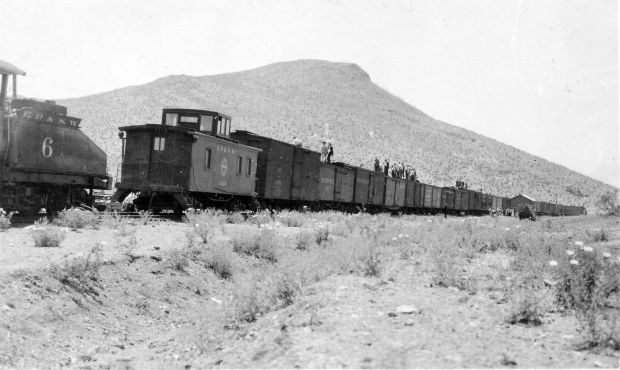
Early challenges in railroad transportation during the 1880s and ’90s led managers at Phelps Dodge, owners of the Copper Queen Mine, to seek better rail connections.
One of those challenges was the rising cost of transporting ore by mule-drawn wagons to distant railroad transportation hubs such as Benson and El Paso, from which the ore would be freighted for smelting and refining in Pennsylvania.
Neither the existing Santa Fe Railroad nor the Southern Pacific Railroad were interested in building a line to Bisbee — Phelps Dodge asked Southern Pacific management to run a line from Lordsburg, N.M., to Douglas, but the company wasn’t interested.
People are also reading…
That, combined with rising railroad rates, figured in Phelps Dodge consultant James Douglas’ decision to build a direct line east to the major railroad hub at El Paso and a spur line for the Santa Fe Railroad at Deming, N.M. This he did despite altercations with Southern Pacific.
The new El Paso & Southwestern Railroad that Douglas established opened up access to coal mines at Dawson in northern New Mexico by means of the El Paso & Northeastern Railroad.
The coal, along with timber from other sources, would be used for Phelps Dodge’s smelter operations in Southeastern Arizona — local timber sources, including the Mule Mountains, had been depleted.
Douglas’ history in railroad management eventually included developing 400 miles of railroad as president of the El Paso & Southwestern Railroad, the Southwest Railroad, the Nacozari Railroad and the Morenci Southern Railroad.
In 1924, the Southern Pacific Railroad bought the El Paso & Southwestern for $64 million.
When Phelps Dodge & Co. incorporated in 1908, Douglas became its first president. Although he lived in New York he traveled several times a year on consultation visits to Phelps Dodge properties in Arizona, New Mexico and Mexico. Those properties included the Copper Queen Mine, the Morenci mine, the United Globe Mines at Globe, and the Nacozari mines in Sonora, Mexico.
By 1910, the Copper Queen, often considered one of the richest copper mines in the world, had 100 miles of underground workings that included access to rich oxides, carbonates and iron sulfides. The deepest shaft at the time was 1,800 feet.
Copper Queen miners, though, didn’t have it as good — they complained that Crossey’s general store sold only inferior, expensive products. Douglas recognized that selling quality goods at affordable prices would boost morale and, as a result, have a positive result on daily mining operations.
He resolved the matter by acquiring the store and incorporating it along with others into what became known as the Phelps Dodge Mercantile Co.
By 1919, Phelps Dodge operated six company stores with 595 employees.
Phelps Dodge, at Douglas’ urging, built many of the schools, libraries, churches and hospitals in the company towns that Phelps Dodge operated.
His good works did not go unrewarded: When he died, in 1918, he left behind a fortune of $40 million.
Sources: “Bisbee: Queen of the Copper Camps” (Lynn R. Bailey, 1983); Mining and Metallurgical Society of America Bulletin, Issues 116-127, 1918; “The Encompassing Story of Mankind’s First Metal” (Ira B. Joralemon, 1973); Mining and Scientific Press, Vol. 116, 1918; “Vision & Enterprise: Exploring the History of the Phelps Dodge Corporation” (Carlos A. Schwantes, 2000); “Who’s Who in Arizona,” Vol. I, 1913. compiled and published by Jo Conners, press of the Arizona Daily Star.
William Ascarza is an archivist, historian and author of five books, including “Southeastern Arizona Mining Towns” and “Zenith on the Horizon: An Encyclopedic Look at the Tucson Mountains From A to Z.” The books are available at Antigone Books, Cat Mountain Emporium, the Arizona-Sonora Desert Museum and the Arizona Geologic Survey’s Arizona Experience Store. Email Ascarza at mining@azstarnet.com
