

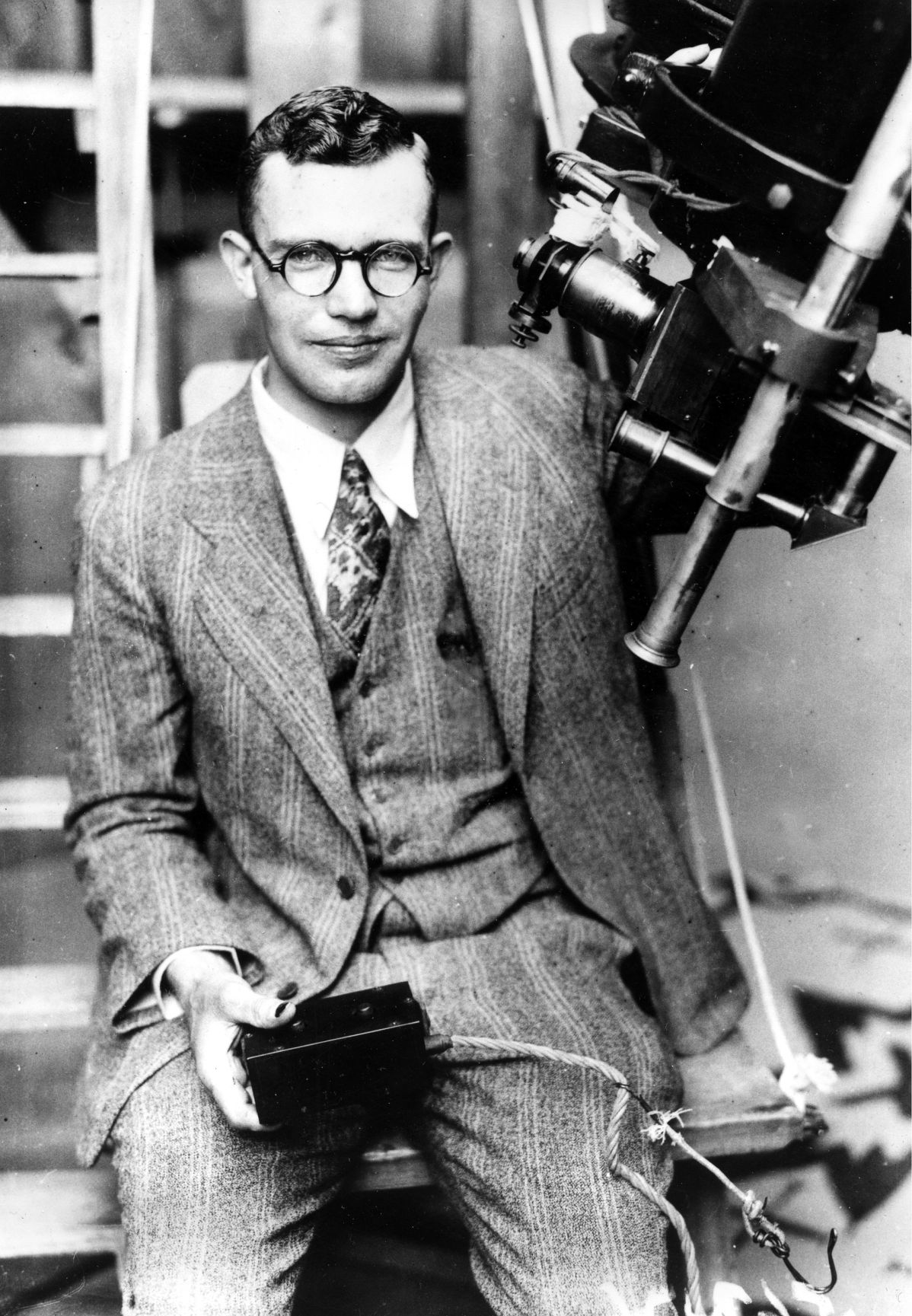
Clyde Tombaugh poses with the telescope through which he discovered the planet Pluto at the Lowell Observatory on Observatory Hill in Flagstaff, Ariz., 1931. (AP Photo)
On February 18, 1930, at the Lowell Observatory in Flagstaff, Clyde Tombaugh discovered Pluto. The search for a ninth planet had taken 25 years.
The news went public March 13, and the planets new name was announced on May 1.
From the Arizona Daily Star, March 14, 1930:
ANOTHER PLANET DISCOVERED BY YOUTH, 23, AT FLAGSTAFF; FORECAST BY LOWELL IN 1905
__________
Discovery Made on February 18 by Extremely Delicate Photographic Telescope at Lowell Observatory
__________
ANNOUNCED BY DIRECTOR V. M. SLIPHER
__________
Ninth Planet in Solar System Is Beyond Neptune; Is Forty Times as Far From Earth As the Sun
__________
FLAGSTAFF, Ariz., March 13.—AP—A twenty-five year search of the skies by astronomers connected with the Lowell observatory here has ended—Dr. V. M. Slipher, director, having announced today that a ninth planetary member of the solar system had been discovered—the object of the search.
In 1905 the search started under the direction of Dr. Percival Lowell, astronomer. Nine years later he published an article predicting that some day a ninth planet would be found "somewhere beyond Neptune," and today, on the anniversary of Dr. Lowell's birth, Dr. Slipher announced it was on a line with "and far beyond Neptune," the new and nameless body in the skies had been located.
For years C. W. Tombaugh, photographer for the Lowell observatory has almost nightly taken pictures of the planets and their environs.
Several weeks ago, in looking over a finished picture, he noticed a faint "star-light splotch." Another picture, taken the next night, of the space near Neptune, showed the same hope of a startling discovery.
The photographer called C. O. Lampland, assistant director of the observatory. Lampland studied the photographs and then trained a high-powered telescope on the space where the sensitive photographic plate showed there was light. After several nights he was rewarded—for the first time the new planet had actually been seen.
Brother astronomers of Dr. Lampland were called, and they, too, saw the planet through the eye of the telescope that Dr. Lowell, many years before, through mathematical calculations, predicted existed "beyond Neptune" and the ken of man.
Dr. Slipher, in announcing the discovery of the new solar body, said it was of the fifteenth magnitude, and that on March 12 its position at three hours Greenwich mean time was seven seconds of time west from Delta Gemnorum, "agreeing with Dr. Lowell's predicted longitude."
The Lowell director said the distance of the new planet beyond Neptune had not been computed, nor had its orbit been calculated.
The Lowell staff is enthusiastic over the discovery, and nightly observations of the "find" are made.
Announcement that the planet had been discovered, Dr. Slipher said, was not made until "we were absolutely sure of it."
The Steward observatory, at the University of Arizona, was notified yesterday of the discovery of the new planet, the notification coming from Harvard observatory, after that institution had been told of the find by the Lowell astronomers, it was stated last night by Dr. Edwin F. Carpenter, assistant professor of astronomy at the university here.
In explanation of the position of the new planet, he stated that it was approximately 10 degrees south of Castor, and was very close to the third brightest star in the constellation Gemini, or the Twins. Its brilliance (or lack of it, since the star is of the fifteenth magnitude) is not of such a degree that it can be observed readily while a bright moon is in the sky.
The planet is out of the range of the human eye entirely, and its being found with a telescope on a brilliantly moonlit night would be a difficult task. The Steward observatory will make observations of the new planet, Dr. Carpenter stated.
People are also reading…
Of course, just about everyone knows that Pluto is no longer considered a planet. The discovery is important nonetheless.
