

10-year price tag for project has been set at $20 million
"It's an Air Force responsibility, and we're paying for it."
Col. Gary E. Hagen, Air Force senior officer at Hughes Aircraft Co., didn't mince words last month about the ground-water contamination at Air Force Plant No. 44.
The Tucson facility is the primary — and in some cases the exclusive — production plant for many of the U.S. military's missile systems.
And it's the only one of 13 Air Force-owned, contractor-operated plants in the nation that has caused a serious environmental problem off its property.
In 1982, a year after its own wells were closed because of reckless but not illegal chemical dumping at Hughes, the Air Force accepted responsibility for its manufacturing wastes.
People are also reading…
On the basis of its consultants' reports, it came forward as the guilty party that polluted ground water — south of Los Reales Road.
At that time, three years ago this month, the Air Force promised to clean up the water that Hughes contaminated and to pay for it.
The price tag was set at $20 million for 10 years of pumping, cleaning and reinjecting — over and over until the level of TCE reached the state guideline of 5 parts per billion.
That could be quite a task and take 20 or 30 years more, the Air Force says. That would also require millions more of taxpayer dollars.
From Hughes' consultants' own reports, TCE contamination was at 10,000 parts per billion in some places in the aquifer.
Well No. 1, which had brought water to Hughes' employees up until 1978, along with another drinking-water well, was contaminated at 4,600 parts per billion.
The plume is 15,000 feet long and 3,000 feet wide at a concentration of 10 parts per billion.
The Air Force did not provide information on how large it was at 5 parts per billion or 1 part per billion.
Unchecked by large-scale pumping, it moves with the ground-water flow north and northwest from 500 to 1,000 feet a year.
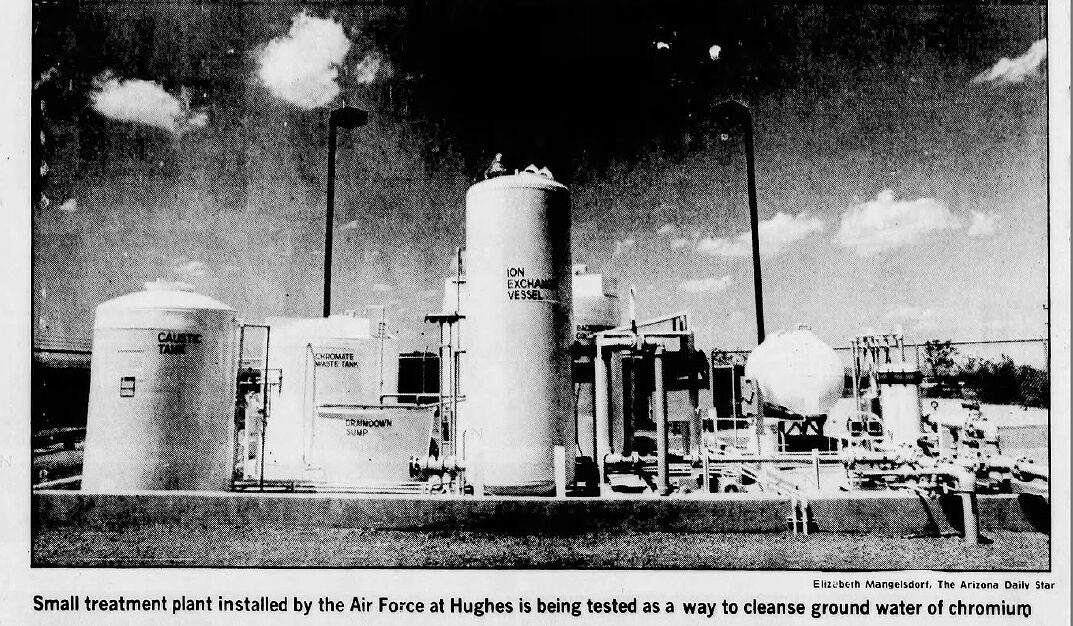
Last month the Air Force unveiled a small treatment plant on site at Hughes that can treat 430 gallons a minute and put it back into the aquifer.
By next year, the Air Force hopes to have in place a 5,000-gallon-a-minute treatment plant to rid the aquifer of TCE, 1,1,1-trichloroethane, 1,1-dichloroethylene and chromium.
All were discarded by Hughes in huge unlined waste ponds, pits and trenches since 1951 when it started manufacturing the Falcon missile in Tucson with 4,500 workers.
***
There have been no court orders, no legal compliance schedules, no fines, no penalties — only the Air Force's agreement to clean up.
Under the heat of publicity after the pollution was first discovered in Tucson, much attention was focused on Air Force-formed committees. Representatives of the military, the Environmental Protection Agency, the state and the city were supposed to cooperate and share data.
But the meetings fell off. None has taken place since September.
Now federal, state and city representatives await a committee meeting in June to review the Air Force's Remedial Action Plan.
EPA official Don Harvey in Region IX in San Francisco said, "From my experience with other Air Force facilities, there are no formal agreements" to clean up.
"I think that is changing. I believe we're working out a system where there is a compliance agreement with the federal facility."
Barry Hatfield, who heads the Hughes cleanup project as top civilian official for the Aeronautical Systems Division at Ohio's Wright-Patterson Air Force Base, believes there has been cooperation.
He defends the amount of time that it has taken to get the pilot treatment system on line and the Remedial Action Plan out to the other agencies and the public. "When we first started, we put together a plan that the Remedial Action Plan would go up through the Pentagon chain in January or February, and that has happened.
"We had some growing pains in the beginning. I think we're doing very well in moving right on out.
"We're in the normal five-year Defense Department budget. I'm no different than the local people who were in there trying to get Superfund money. "We've gone just about as fast as we could go and get a quality end-product. I'm highly convinced that the things we're doing out there are right.
"I'm familiar with how the state and the EPA work on other big projects. It appears that the time period we're having for response is a little better than EPA's. Everything takes extreme investigation. It's a very critical problem. There's nothing one can do to short-circuit it if you're going to do it the right way.
"I think we're easily within the spectrum of most large cleanup activities."