

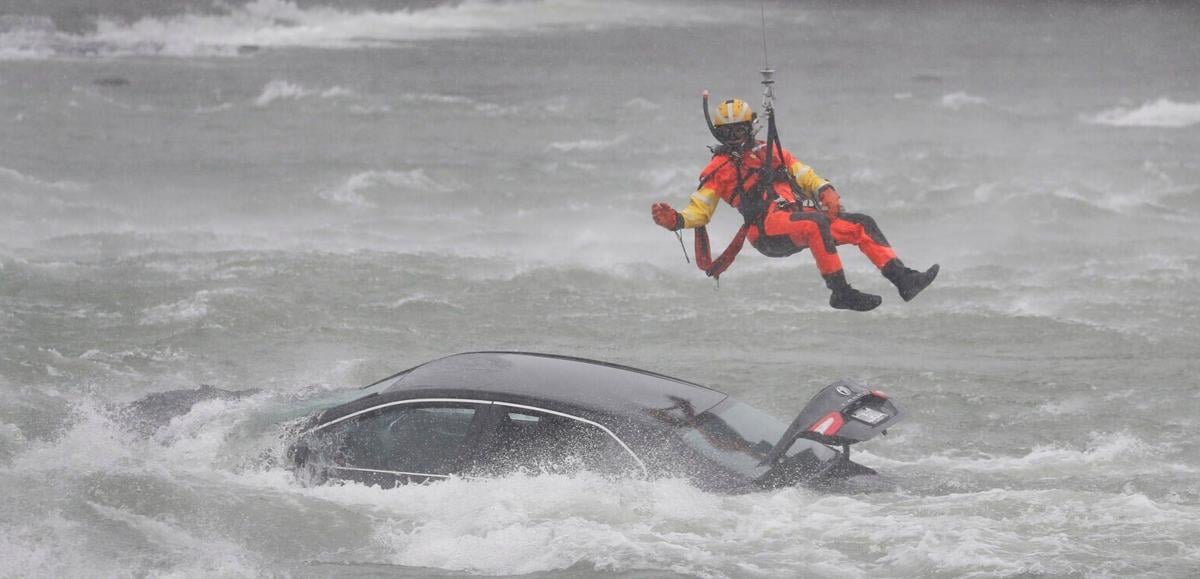
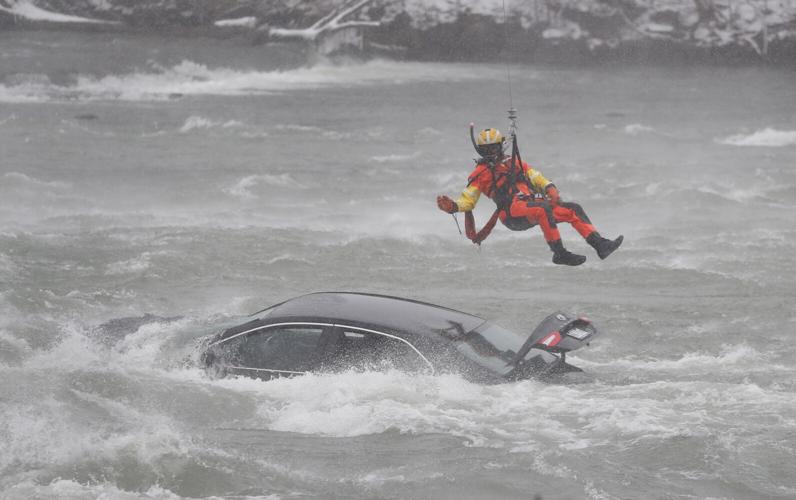
Images of Wednesday’s daring attempted rescue of a woman in a car stuck in the swift-moving Niagara River near the brink of the American Falls captivated an international audience.

The rescue attempt ended with the somber news that the woman in the vehicle was already dead before the diver was lowered by helicopter to the vehicle, opened the passenger door, pulled her out and lifted her to shore.
It was harrowing enough to watch online or from the riverbank – what was it like for the man dangling from a hovering Coast Guard helicopter in frigid winds over the churning waters?
“As I was coming down on the cable, the only thing that was going through my head was, ‘How am I going to get to this survivor?’ ” said Petty Officer 2nd Class Derrian Duryea, who did not know at the time that the woman was already dead.
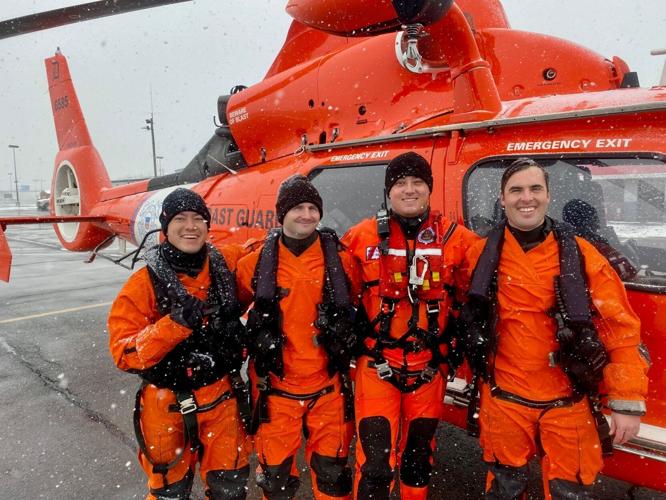
Duryea, 28, is a helicopter rescue swimmer and part of the four-member crew that flew to Niagara Falls from the Coast Guard’s Air Station Detroit to take on the difficult assignment.
He told The Buffalo News on Thursday, about 24 hours after the incident at the falls, that the crew members regularly train for challenging rescue attempts, including those in rough waters.
People are also reading…
But there’s no way to directly prepare for a mission involving a person trapped in a vehicle 50 yards from the precipice of the American Falls.
“This isn’t something that we train for every day. This was a very unique situation. To the best of my knowledge, this is the first time a car’s been this close to the falls,” Duryea said.
Duryea’s account begins with the call his station received at about 12:30 p.m. that a Coast Guard team was needed to fly to Niagara Falls to help get someone out of a car that was stuck in the river above the falls.
Duryea, officially known as an aviation survival technician, is a Connecticut native who said he visited Niagara Falls once as a child.

NOTE: The images in this collection are graphic and may be upsetting.
“We did the whole Maid of the Mist tour. So I had seen it from the bottom side before, but, obviously, this is the first time being up top,” Duryea said.
He said the flight from Air Station Detroit to Niagara Falls took about an hour and required flying through some severe winter weather, particularly a snowstorm near London, Ont., that reduced visibility to half a mile.
“We were actually following a road for a while, in between some windmills,” Duryea said.
Duryea said the crew had not received definitive word that the woman inside the vehicle was dead before they arrived at the scene, so they had to treat the situation as a rescue attempt, instead of a recovery.
He said the air temperature at the time was about 20 degrees, so mist rising off the falls caused icing on the helicopter that added another element of danger to the operation.
The MH-65 rescue copter hovered in a light snow over the vehicle for several minutes as Duryea and his colleagues considered the best angle of approach.
“We were looking at the car and talking about, as a crew, what was the best way to get me inside that vehicle,” Duryea said.
They could see that the rear, driver’s side window was open, as was the trunk, but Duryea brought an ax with him in case he had to break open a window to reach the occupant.
They opted to do a direct deployment, which would put Duryea within 2 or 3 feet of the vehicle, but had to consider all possible scenarios.
For example, Duryea said, “If this car starts to move, with me being down there, what is our plan?”
The crew lowered Duryea, who was wearing a dry suit to protect him from the cold air and water, toward the passenger side of the sedan, where he grabbed on.
Duryea said the front passenger door was unlocked, and he was able to get it open despite the water’s currents. He said the woman in the vehicle appeared to be unconscious when he initially saw her.
Duryea, buffeted by wind and currents, with the helicopter holding steady overhead, managed to connect her to his harness and raised his arm as a signal to the crew to slowly hoist them into the air.
He said they determined the best thing to do was to bring the two of them over to the riverbank, where EMTs and firefighters awaited.
As the copter drew closer to dry land, the roar of its engine grew louder and the rotor wash sent reporters and other onlookers backpedaling.
The copter gently dropped the pair to the ground and they were quickly surrounded by emergency responders.

"Cause and manner of death is still yet to be determined through autopsy," New York State Park Police Capt. Christopher Rola said in a statement.
The woman, who has not yet been identified by State Park Police, was taken away by ambulance. Officials say they believe she intentionally drove into the river, and she likely was dead throughout the rescue process. They have not released a cause of death.
It’s not the outcome Duryea and the others who responded to the emergency wanted.
Still, for Duryea and his crewmates – aircraft commander Lt. Christopher Monacelli, co-pilot Lt. Jacob Wawrzyniak and Petty Officer 2nd Class Jon Finnerty – the rescue attempt was a success.
That’s because, Duryea said, unlike many of their other search and rescue missions, they were able to recover the body of the victim in this case.
“Any time that we can bring someone home for their family, that’s the best thing that we can do,” he said, noting the motto of the Coast Guard’s rescue swimmers is “So others may live.”
After it was over, the copter flew to the Niagara Falls International Airport, where the crew waited for the ice buildup on the aircraft to melt.
They were back at their home station near Detroit by about 8 p.m.
Duryea deflected credit for his role and praised his team members for their efforts on a day when millions around the world were transfixed by photos and videos of the harrowing rescue attempt.
Asked why he believes so many were enthralled by their actions at the Niagara River, Duryea said, simply, “It’s not something you see every day.”
