


Tucsonan Alex Hamilton spends her days running an in-home day care and tending to her 2- and 4-year-old children.
In her free time, she works a part-time job wherever she wants, as long as she wants, and takes breaks whenever she feels like it.
And she pulls in an extra $2,000 a month.
If you're thinking this sounds like a get-rich-quick scheme, think again. Hamilton, 23, is one of 756 Tucsonans who work as "guides" for ChaCha.com.
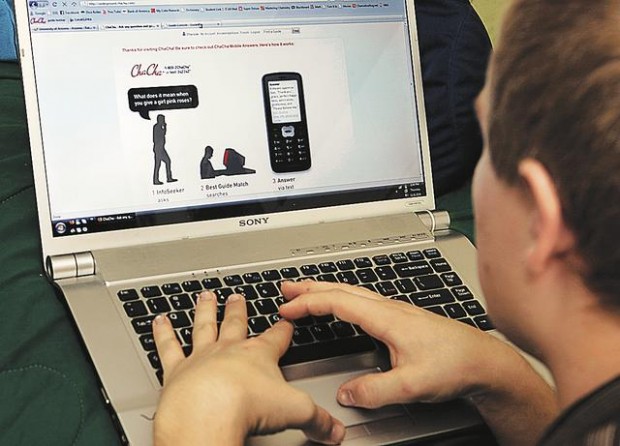
ChaCha is a free search engine that uses real people, the guides, to answer millions of questions each day from curious, desperate, or just plain bored individuals. Users reach ChaCha by sending a text message to 242-242 (ChaCha) or by using a mobile phone to call 1-800-224-2242.
Recently, the company sent out a text message saying it limits users to 20 free questions per month.
People are also reading…
The types of questions ChaCha guides receive range from "What's the best place for sushi in Tucson?" to "Where is the safest place to invest now?" to "What should I do with my life?"
"It's really cool," said Hamilton, who heard about the job in April from a friend in her moms group. "If you can't think of something, like the words to a song or who was in a movie, or directions, then you can just call or text and get an answer in usually two to three minutes."
The objective behind ChaCha is to simplify the search process by delivering a single, accurate answer from a real person to a phone while on the go. The service also advertises itself as an alternative to sorting through pages and pages of results online.
"I love ChaCha," said Angela Davidson, a 20-year old UA nursing junior. "It's like the poor man's Internet — if you don't want to pay for Internet each month, you can just use ChaCha."
How to become a guide
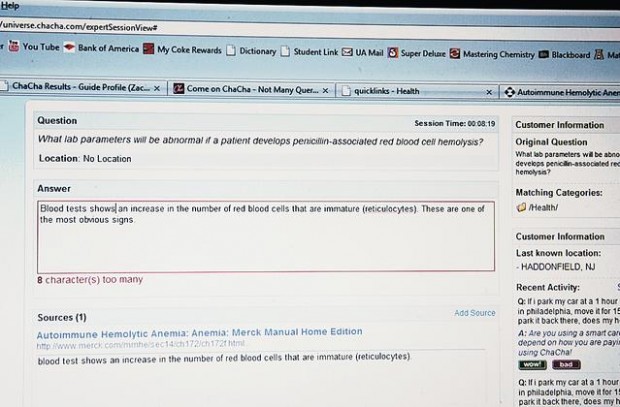
So how do you become a ChaCha guide? After applying online at ChaCha.com, applicants are taken through a series of short tests, such as a typing test and aptitude test.
"It's not called an IQ test, but it's kind of like that," said Kyle Halberg, a 19-year-old business major at Northern Arizona University. Halberg has been a guide since July.
Then, potential guides answer practice questions that they are graded on. If they pass with flying colors, they become a guide temporarily.
"You're on a probation period for a week, and you have to answer 100 questions or something, and then they evaluate you," Halberg said.
The evaluation process consists of a quality-control team checking responses for accuracy.
"We can't go through every question, but we want to be particularly accurate on political questions, and make sure the guides are giving non- partisan answers," said Susan Marshall, vice president of marketing.
Guides aren't allowed to use sites like Wikipedia to find answers, but instead use ChaCha's own search engine or other reputable sites online. They must also include a link to the source where they found their information at the bottom of every response, and answers usually come with fun little reminders like, "Don't forget to do the ChaCha!" and "Even the worst dancer can ChaCha!"
Opinion-based responses to certain questions, like "What's a really good 'yo mamma joke?' " or "What should I have for dinner?" are the types of questions that don't require sourcing information. And those are exactly the kind of questions Zach Parizek spends his hours at work answering. For the dinner question, Parizek said he looks up recipes online, picks the one that looks the best to him, and suggests it to the perplexed user.
Parizek, an 18-year-old UA chemical engineering fresh-man, answers an array of questions for ChaCha, but specializes in jokes and video-game queries, two topics he chose when he became a guide. Those types of questions are first routed to guides like Parizek.
"Someone once asked me, 'What should my pirate name be?' " he said, laughing. "It seems like a lot of them are from drunk people or kids in class that are bored."
Guides earn $3 to $10 an hour
ChaCha guides are paid between 10 and 20 cents for each question they answer, depending on their experience and performance. That roughly translates into earning between $3 and $10 an hour.
ChaCha offers guides immediate payment with a debit card, or an option that provides them with a lump sum after each month.
ChaCha also offers a rewards program for referring friends. Each friend who becomes a guide then becomes a part of your "team," and you will receive 10 percent of the pay from each question they answer.
"It's only one or two cents for each question, but it adds up," said Hamilton, who has 12 people on her team.
Kris Shermer, a 19-year-old UA sophomore, said she has only made $60 from ChaCha since she started working in August because she has been so busy with school. But she hopes to make more.
"I'm saving up all of the money in my account for Christmas shopping," she said.
There are more and less profitable times for ChaCha guides to work, Hamilton and Parizek said. The daytime hours can be slow.
Hamilton said many of the questions she receives during the day are from junior high school students wanting help with their homework.
From 6 p.m. to 2 a.m., the questions roll in.
"I get asked really strange questions all the time," she said. "Obviously at night it's just teenagers goofing off, which is cool, because I guess they're lonely and want to talk to people. But I get a lot of serious questions, too . . . a lot of people wanting to know how things work."
The work offers guides other perks, too.
"I like the fact that I get to stay home in my pajamas and make lots of money," said Hamilton. "I learn something new every single day, and I have a wealth of knowledge of trivia questions."
For example?
"I get asked how many licks it takes to get to the center of a lollypop a lot," she explains.
She waits a millisecond before answering.
"Anywhere from 250 to 405 licks, depending on the size of the tongue and amount of saliva."
Where ChaCha came from
Scott Jones and Brad Bostic came up with the idea when chatting one day about the inconvenience of search engines, Bostic said in a recent interview.
"Scott and I were talking about the problem of search engines in general. We started with the question, 'Imagine if you could ask anything and receive one definitive answer,' " Bostic explained.
The mobile service was launched in January and has already captured 7 percent of the mobile text-to-search market with a quarterly growth rate of more than 800 percent, according to the ChaCha Web site. Services like GOOG-411 and AskMeNow are similar to ChaCha in that they deliver information to a user via phone, but ChaCha is the only human-powered text messaging service to date.
Recently, ChaCha cut the number of texts that users can send, from unlimited to 20 per month. Bostic was unable to be reached to comment on the change.
The free service makes money by placing advertisements at the bottom of text messages.
"We launched our add network on Aug. 30, and (Barack) Obama actually bought a bunch of inventory," said Susan Marshall, vice president of marketing.
When ChaCha guides received questions about the election from 10 battleground states, they provided a link to information about Obama in their responses. Obama's campaign paid ChaCha $30 for every 1,000 ads that were sent out with that information, Marshall said. The same general concept is used with other companies that advertise with ChaCha.