

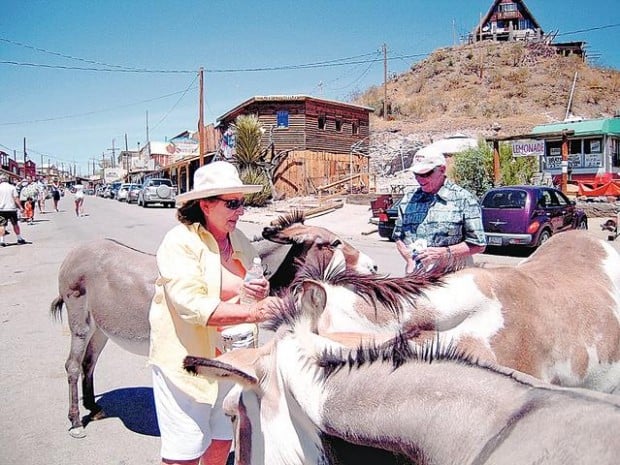
OATMAN — Give burros care, not carrots.
That's one of many draft slogans the Bureau of Land Management has issued, asking people to stop feeding the wild burros in the tiny western Arizona community of Oatman.
"The Oatman burros have been fed so much they are sick and fat," said BLM Public Affairs Officer Mike Brown. "They're being loved to death."
The BLM is asking Oatman shopkeepers, residents and tourists to stop feeding the wild burros carrots, hay pellets, salt cubes and even water.
"Frankly, the wild burros that live around Oatman are far healthier than the burros that come to town," Brown said.
Burros can get all the nutrients and sustenance they need from the vegetation in the desert areas around Oatman, which is about 15 miles southeast of Bullhead City, Brown added.
People are also reading…
With thousands of tourists buying bags of carrots and hay pellets to feed to the burros, Brown said the burros are sick from hoof disease, behavior problems and are extremely overweight.
"One carrot won't harm the burros," Brown said. "But it's the 10,000 more they are being fed every year that will kill them."
The Oatman burros are more likely to become ill and to die early than the 300 or so wild burros that stay out of town, Brown said.
Brown said the burros will not suffer from any kind of delirium or other illness if they cannot have carrots and hay pellets.
"We've seen this before where we cut off the burros and the only side effect is that they get healthier," Brown said.
But some Oatman shopkeepers dispute that.
"They are getting aggressive because they are not being fed like they used to," said John Nowak, owner of the Oatman General Store.
Shopkeeper Jolene Brown, who owns Amargosa Toads, agreed, saying that the burros have practically been "kicking her door in" to get food.
All of the burros are managed by the BLM's Wild Horse and Burro Program, legislation that passed Congress in 1971. All wild horses and burros are under the jurisdiction of the Department of the Interior, and the BLM is responsible for keeping statistics on their numbers, health and safety.
Brown said the BLM came up with the idea of an indefinite moratorium on feeding the burros after several town-hall-style meetings with the local residents and shopkeepers.
Shopkeepers have been asked to stop selling carrots and pellets in their stores and to post signs asking tourists not to feed the burros any carrots or other treats they may have brought with them.
Nowak said just because shops will no longer sell carrots doesn't mean people will stop feeding the burros other types of food.
"Part of my shop is a grocery store and I see people buying cookies and potato chips for the burros," he said. "Is the BLM going to ticket people for feeding them other foods, or food they brought to town?"
Changing a culture of many generations of tourists to Oatman won't be easy, Mike Brown acknowledged.
"Think about when the National Park Service asked people to stop feeding the bears at Yellowstone," he said. "It didn't happen overnight, but people eventually stopped doing it."
Judy Love, who owns and operates the Classy Ass Gift Shop, said the health of the burros is her main concern and doubts the burros will disappear if people stop feeding them.
"I've been here 21 years, and burros wandered through town before we started feeding them carrots," she said.