


It's an old idea: roof shingles that not only keep your home dry but capture solar power and convert it to electricity.
But a Tucson solar firm and the world's largest chemical company are partners in a newer approach.
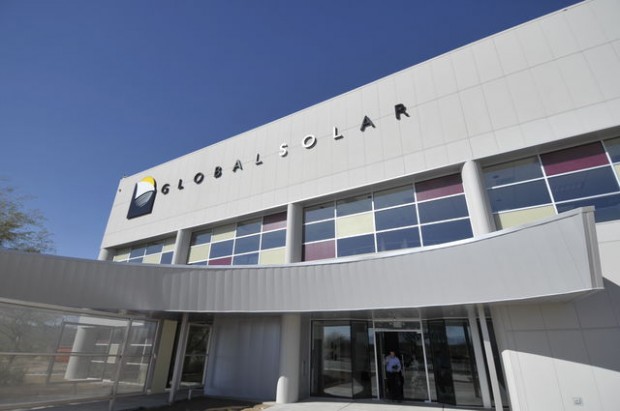
Global Solar Energy of Tucson manufactures a thin, flexible photovoltaic film.
At a plant in Midland, Mich., Dow Chemical Co. runs the film through a $2.5 million machine known as "The Beast," which molds thermoplastic roof shingles while integrating the solar cells.
The two companies have been working together for a year.
Dow, which has annual sales of $58 billion and customers in about 160 countries, sells products ranging from pharmaceuticals to paint. The goal is to sell solar shingles for homes in North America by 2011.
People are also reading…
"The target and the business opportunity is to make this product the same price as the traditional electricity from your local power facility," said Charles Gambill, corporate product director for Global Solar.
When Dow came knocking after a worldwide search, the Tucson firm was the only one in full-scale production of the type of thin-film solar cells Dow needed, Gambill said.
The flexible material lets Dow develop a product in an array of configurations that costs less to install, he said.
Builders generally love the look and ease of integrated shingles. There's no need to build the roof and then install photovoltaic panels above it, said Katharine Kent, an engineer and former Dow employee who is president of The Solar Store, 2833 N. Country Club Road.
But historically solar shingles tend to cost more and produce less electricity than typical solar panels, she said. And the electrical output of some shingles, especially with the traditional crystalline or silicone-based solar cells, can plummet when they get too hot.
"The challenge will be for them to find a way to reduce the heat-degradation issue and keep the performance up," Kent said of manufacturers.
The efficiency of a solar cell is the percentage of sunlight that it converts into electricity.
Traditional crystalline solar cells run about 14 to 15 percent, while thin-film cells have ranged from about 7 to 9 percent.
Global Solar, however, has achieved 10 percent, the highest in the thin-film industry, Gambill said. And unlike some other thin-film products, the type used by Global Solar, known as copper indium gallium diselenide, or CIGS, has the potential to become increasingly competitive with traditional solar cells, he said.
Joe Verrengia, a spokesman for the U.S. Department of Energy's National Renewable Energy Laboratory, said thin-film solar cells in lab tests have moved much closer to the efficiency of the traditional cells.
He said the gap is likely to keep narrowing in the commercial world, too.
Global Solar makes portable solar chargers and other products at its plant at 8500 S. Rita Road and in Berlin, Germany.
"The target and the business opportunity is to make this product the same price as the traditional electricity from your local power facility."
Charles Gambill, corporate product director for Global Solar