

Think "Star Wars" at sea.
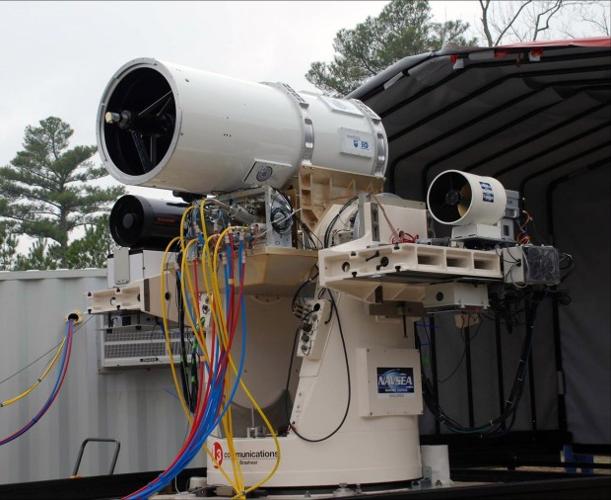
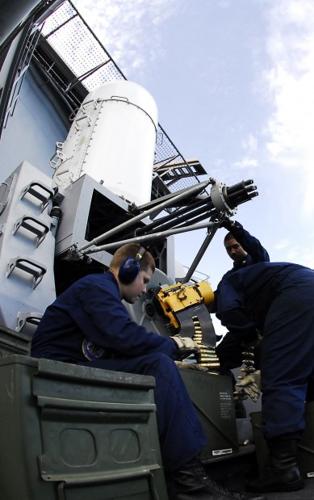
The Navy and Tucson-based Raytheon Missile Systems have adapted Raytheon's Phalanx ship-defense system - sometimes nicknamed R2-D2 - to fire a laser at enemy aircraft.
Last week the Navy's Laser Weapon System, known as LaWS, successfully tracked and destroyed a "threat representative" unmanned aircraft at San Nicholas Island, off the California coast near Los Angeles.
The test marked the first time the LaWS system detected, engaged and destroyed such a simulated threat aircraft over water, and the second time the system tracked and downed an unmanned aerial vehicle in flight.
A Navy spokesman said the recent tests concluded a test and evaluation stage of the program, leading to possible funding as a formal weapons program.
"We've proved that it worked," said Alan Baribeau of the Naval Sea Systems Command, or NavSea, in Washington, D.C.
People are also reading…
Any decision on further development would be made at higher levels of the Defense Department, he said.
Using largely off-the-shelf solid-state laser hardware, the Navy has spent less than $30 million on the testing program since 2007, Baribeau said.
An official of Raytheon Missile Systems in Louisville, Ky., where the Phalanx Close-In Weapon System is made, said the latest test was significant because it simulated a combat encounter at sea.
"The big deal here is it was an over-the-water scenario," Raytheon spokesman John Eagles said.
"Water is not very friendly to lasers," he said, noting that the sea mist can absorb or deflect beams.
The system was developed and tested by several Navy agencies, led by NavSea's Directed Energy and Electric Weapon Systems program office, along with Raytheon, which developed the interface linking the laser unit to the Phalanx system.
Raytheon's Phalanx system is a rapid-fire, computer-controlled radar and 20-millimeter cannon designed as a ship's last line of defense for low-flying, supersonic anti-ship missiles.
Its robotic action and prominent radar dome have prompted the nickname "R2-D2" after the plucky little robot from the "Star Wars" movies.
The Navy mounts the Phalanx on every class of surface combat ship, and Raytheon has sold more than 900 of the systems to 25 allied nations. A land-based version, the Centurion, was deployed to Iraq in 2005 and has been used to shoot down mortar rounds.
"Eventually, we want to go from the lab to a prototype system for operational evaluation," Eagles said.
The laser allows multiple firings without storing or expending costly missiles, Eagles said, adding that the laser could be mounted alone or in tandem with the existing Phalanx cannon to provide two defensive options.
"The speed-of-light engagement at this range has so many benefits," he said. "As long as you have enough power aboard the ship, to power up the laser system, there's not a need to reload."
A few years ago, Raytheon developed a laser version of the Phalanx, called the Laser Area Defense System. While the military passed on that design, Eagles said, Raytheon is ready to move forward with the Navy program.
Even so, the earliest the Navy would be able to field such a system would be around 2018, Eagles said.
Navy Capt. David Kiel, the LaWS program manager, said in prepared remarks that the LaWS test successes demonstrate the usefulness of directed-energy weapons at sea.
Further development with more powerful lasers will boost the range and the set of targets the system can engage and destroy, Kiel said.
'Star Wars' over the oceans
Contact Assistant Business Editor David Wichner at dwichner@azstarnet.com or 573-4181.