

Jennifer Palaganas needs spinal surgery and, to her, it is essential she have it now.
Ever since a procedure in September, the 42-year-old Orchard Park resident's pain has made it difficult to sit or stand for more than a few minutes.
That's what made it so frustrating when she received a call at 2 p.m. Wednesday that her microdiscectomy scheduled for 10:30 a.m. Thursday at Erie County Medical Center was canceled.

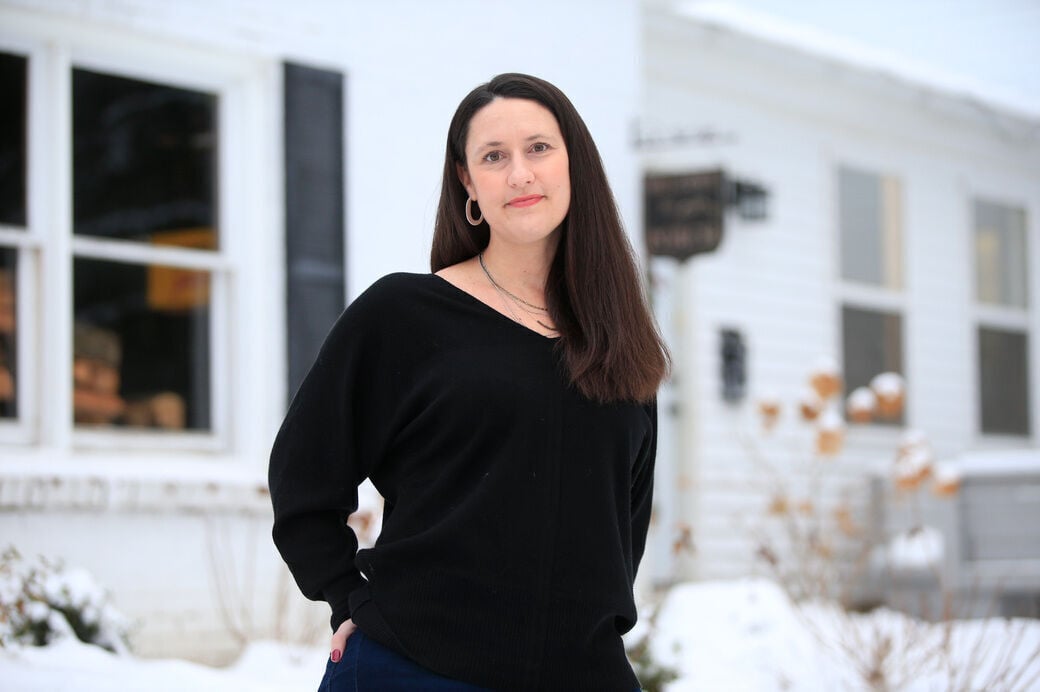
Jennifer Palaganas, a 42-year-old Orchard Park resident who had her spine surgery canceled Thursday at Erie County Medical Center, is pictured outside her home on Thursday, Dec. 9, 2021. After Palaganas sent an email to ECMC executives Thursday morning, her surgery was rescheduled for Tuesday, Dec. 14.
It was among the procedures ECMC decided to postpone in preparation of a state order that limited nonessential elective procedures, starting Thursday, at New York hospitals with limited staffed bed availability.
Feeling like she was in limbo, Palaganas fired off a 450-word email at 11 a.m. Thursday to a few ECMC executives – at least to the ones whose emails she correctly guessed.
People are also reading…
Two hours later, her surgery was back on, rescheduled for Tuesday.
"Advocating for yourself, even if that means being pushy, is sometimes the only way you're going to get something," said Palaganas, who works in human resources.
Palaganas' whirlwind 24 hours may not be all that unusual, a reality for many in recent months as hospitals have had to reshuffle surgery schedules to preserve available beds.
It's something that has become increasingly common as hospitals have faced staffing shortages, difficulties discharging patients to nursing homes and now an executive order meant to save hospital capacity for rising Covid-19 hospitalizations.
"Complying with the recent state mandate suspending elective surgeries, ECMC's clinicians regularly review surgical procedures on a case-by-case basis, which are prioritized according to their assessment," ECMC spokesperson Peter Cutler said in a statement.
The postponement of elective surgeries also deals a financial blow to hospitals, since those procedures are moneymakers.
It's what critics feared could happen when the order on surgical procedures started – that hospitals would be forced to make the uncomfortable decision of which and whose procedures are truly essential.
Just the term "elective" is misunderstood, which could indicate some procedures are optional when, in fact, they could resolve pain and debilitation that affects the physical and mental health of patients, Dr. John DiPreta, president of the New York State Society of Orthopaedic Surgeons, said in a statement last week.
"Governor Hochul's order to begin limiting certain surgical procedures is well-intended policy that unfortunately may do more to increase the suffering of New York's patient population," DiPreta said. "The intent of the order is to reserve hospital capacity for potential Covid patient surges. However, as a blanket policy, it fails to consider and incorporate several critical factors."
There are other factors pressuring local hospitals, from employee shortages to difficulties discharging patients who need to be in long-term care facilities that don't have room.
The order, which applied to nonessential procedures scheduled on or after Thursday, currently affects 32 hospitals across the state with fewer than 10% of staffed acute care beds available, including six in the five-county Western New York region.
ECMC, one of the six locally, has been full or nearly full for a couple of months. On Tuesday, for instance, all 343 of its staffed acute care beds were occupied, according to state Health Department data.
As such, ECMC hasn't done inpatient elective surgeries since September, but the order also forced it to defer nonessential elective outpatient procedures within the hospital.
Palaganas' surgery is considered outpatient, since the procedure will take about an hour and she could leave the hospital just a few hours later to begin her recovery from home.
Guidance from the Health Department sent to the affected hospitals lists which procedures "are considered essential and not covered" by the order: Cancer, including diagnostic procedure of suspected cancer; neurosurgery; intractable pain; highly symptomatic patients; transplants; trauma; cardiac with symptoms; limb-threatening vascular procedures; dialysis vascular access; and patients who are at a clinically high risk of harm if their procedures are not completed.
In addition, the Health Department said it has the discretion to add, remove or change restrictions for regions and facilities, taking into account Covid-19 transmission and hospitalization rates as well as other public health considerations.
Hochul's executive order that enabled the limiting of nonessential procedures is set to expire Jan. 15, unless it is renewed before then.
"Any patient with concerns regarding their elective procedures should consult their provider directly," the state Health Department said in an email to The Buffalo News on Thursday.
That's exactly what Palaganas did. In her email to ECMC, she thought her situation could have qualified as intractable pain, highly symptomatic or high risk of harm if the procedure was not completed.
"The fact that your hospital will deem spine surgery non-essential is mind boggling," Palaganas wrote, as she thought about the pain she would have to live through during the holidays, about how her work schedule would be upended and about how her deductible would have to be met again in 2022 when the surgery eventually happened.
Palaganas understands the hospitals are full, unable to staff as many beds, struggling to discharge and grappling with more Covid-19 inpatients.
That last point is particularly troubling, she noted, because she is vaccinated, received her booster shot and wears a mask in public. And to have her surgery canceled at the 11th hour made her feel like she was the one being punished.
With her surgery back on, and rescheduled for just a few days later than originally expected, Palaganas is hopeful her pain, which she said no medication has alleviated, will soon be resolved.
That way, she won't have to send any more emails.


