Both men made significant contributions in the field of agriculture.
Both were publicly accused, but neither charged nor convicted, of serious crimes.
Both men have buildings named after them on the University of Arizona campus.
But only one building, the Cesar Chavez building, is being considered for renaming, after allegations of sexual assault emerged against Chavez this year.
The other building, the Kemper Marley building, still bears the Arizona farm-and-liquor magnate's name despite the existence of some evidence that he instigated the car-bomb killing of Phoenix reporter Don Bolles in 1976. That agricultural research building was named after Marley when his foundation agreed to donate $6 million to the university, in 1992.

Don Bolles
No such donation put the Chavez name on the former Economics building at the UA campus in 2003, and now change is likely coming. The University of Arizona will begin a listening period on the possible renaming of the Chavez building at 4 p.m. Thursday, April 30, in a forum at the Integrated Learning Center on campus.
People are also reading…
You're probably familiar with the reasons why: In March, the New York Times published an investigation revealing allegations that Chavez sexually assaulted girls from families in his movement, as well as the renowned co-founder of the United Farm Workers, Dolores Huerta.
Around the country, institutions and governments began removing Chavez's name from buildings, streets and other memorials almost immediately. In Tucson, the city removed a statue of Chavez from Five Points, the intersection of South Stone Avenue, South Sixth Avenue and East 18th Street. His name was also removed from an arch at that intersection.
The city and Pima County also removed Chavez's name from a holiday in his honor, and Arizona's Legislature ended the state's Cesar Chavez holiday as well.
Chavez died in 1993, and he was never charged with these alleged crimes, but that hasn't stopped people from moving fast to strip his name from public recognition. The university, in fact, has been comparatively deliberate in the pace of its review.
Marley's consistent denial
Marley and his family and friends have long denied he had anything to do with Bolles' murder, which they consider an unfair stain on his highly successful career in farming, liquor distribution and other areas. But there are tantalizing pieces of evidence that do point toward him. Most of it comes from the man who was convicted of planting the car bomb, John Adamson.
Adamson said that a protege of Marley named Max Dunlap, who was convicted of the murder, approached him with the idea of killing Bolles because of negative press coverage, said Jeremy Duda, a Phoenix-based reporter for Axios who has just published a book on the Bolles killing, called Murder in the Fourth Estate.
"Adamson said Dunlap wanted three people killed," Duda said. "And all three were people who were in some way a thorn in kemper Marley's side."
At the top of that list was Bolles. Bolles' colleague in the Arizona Capitol press room, Bernie Wynn also testified of a strange message that then-Gov. Raul Castro relayed to Bolles through Wynn.

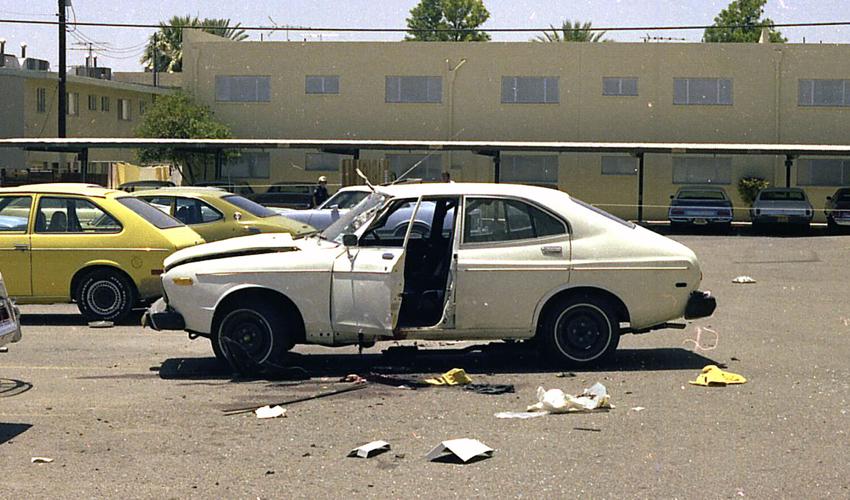
A 1976 Phoenix Police Department photo of the scene in the parking lot of the Clarendon Hotel where reporter Don Bolles was mortally injured after his vehicle was bombed.
"Shortly before the bombing, he testified, Castro called him to relay a very unusual message — tell Bolles to back off of the Marley situation," Duda writes in his new account. Castro denied giving that warning in later testimony.
There's also the fact that Marley wrote Dunlap a $5,000 check days after the killing, though Duda and others have noted that Marley had loaned Dunlap a lot of money over the years.
While some testimony in the first trials implicated Marley, he was never charged. But when the Arizona Attorney General's Office started a new investigation in the late 1980s, they ended up years later embracing the original concept investigators settled on in the 1970s.
As Duda writes: "After more than a decade of additional information and alternative motives, the AG’s Office still came back to the original theory of the case — Dunlap enlisted Adamson to kill Bolles to avenge Kemper Marley, and Adamson partnered with (James) Robison to do the deed."
Building named after Marley's death
Marley died in 1990, as investigators were combing through the evidence again and building cases for the retrials of Dunlap and Robison, whose convictions had been overturned.
In 1992, the Arizona Board of Regents agreed to name the new agricultural laboratory building after Marley in exchange for a $6 million donation from his family's foundation. That came despite significant opposition from the public, including the Arizona Daily Star's editorial page and former UA president John Schaefer.
The then-dean of the College of Agriculture, Eugene Sander, who later became UA president, argued in favor of naming the building after Marley, in honor of his contributions to Arizona agriculture. The Regents unanimously approved the plan.
The dedication of the new building occurred in March 1993. At the same time in Phoenix, Marley's protege, Dunlap, was being retried for his role in killing Bolles.
"We believe that Kemper Marley was ultimately behind this killing," prosecutor Fred Newton said during that trial, a month before the dedication.
But for many people looking back now, the picture is still unclear. The alleged motive for Marley to want to killl Bolles — that Bolles had helped derail Marley's appointment to the state racing commission — doesn't add up for Duda, because Marley's appointment was already in trouble before Bolles wrote about it, he said.
"I don’t believe that Marley ordered the hit or knew of Dunlap’s plans," Duda writes in the conclusion to his book.
Different standards?
The criminal accusations against Chavez are different, in that they are against him specifically, not part of a diffuse conspiracy. But they are no more formalized or litigated than the accusations against Marley were. In fact, Arizona authorities were quite convinced of Marley's involvement, even if they never could bring charges against him.
Even with the relative lack of formal investigation against Chavez, the university is methodically moving toward renaming the building named after Chavez in 2003. That's OK by me. The accusations seem well-documented and likely to be true.
But if that's the basis we're judging building names on, then we should also reconsider the name of the Kemper Marley building. The accusations were never proven, but they are also well-documented and relatively likely to be true.
Unless, of course, the contributions that get a building named after a person aren't contributions to their field, but contributions of money.
Contact columnist Tim Steller at tsteller@tucson.com or 520-807-7789. On Bluesky: @timsteller.bsky.social

Tim Steller
Columnist


 Tim Steller's column: New Tucson police chief has familiar strategy