

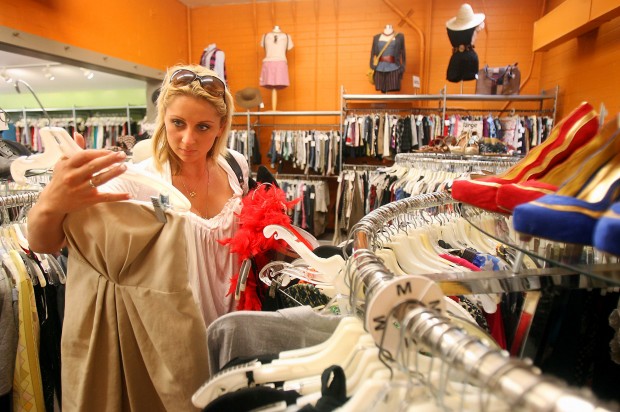
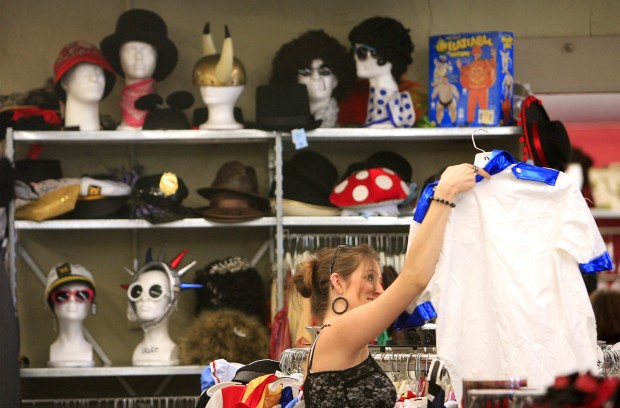
The Tucson-born Buffalo Exchange - recently ranked by Inc. Magazine as one of the fastest-growing private companies in America - is not letting the dwindling economy dent its expansion plans.
To the contrary, president and co-owner Kerstin Block attributes much of the company's recent success to the state of the economy. "Being able to buy nice clothes for less is appealing to customers," she said.
The trendy consignment-shop company is actively expanding, trying to open three new stores a year, said her daughter, company vice president Rebecca Block.
In the past five months the family-owned Buffalo Exchange has opened new stores in San Antonio and Boston, and it will open a third New York City store in November.
According to Inc. Magazine's 2010 Inc. 5000 report, Buffalo Exchange's three-year growth rate is 38 percent and its 2009 revenue was $60.5 million, placing it at number 3,850 on the magazine's fastest-growing private companies list.
People are also reading…
Buffalo Exchange is popular among college students and fashion-conscious bargain shoppers alike. "You don't have to sift through a lot of junk to find treasures here," Kerstin Block said. "I think that's what makes people come to us. We're really all about fashion."
The stores offers customers 50 percent in trades or 35 percent in cash for used clothing.
She also points to society's growing interest in "going green." Eighty percent of everything sold at Buffalo Exchange is recycled, she said.
The company's "Tokens for Bags" program encourages shoppers to take a token instead of a bag. In return, the store donates 5 cents to a charity of the customer's choice. The program has generated nearly $358,000 for nonprofit agencies since 1994.
Anita Bhappu, associate professor and division chair/research fellow at the University of Arizona's Terry J. Lundgren Center for Retailing, agreed that Buffalo Exchange's affordable prices and "go-green" mentality contribute largely to its success.
"They clearly filled a niche in the market that was not being filled by any other retailer at the time they opened," Bhappu said.
She said the company has done well in managing its growth. "They are very conservative in how they manage their books. They've always maintained a healthy business portfolio."
Buffalo Exchange is located in 14 states and made up of 37 company stores and two franchise stores. It is no longer offering franchise opportunities because of the legal expenses and lack of economic benefits, Kerstin Block said.
Its most popular locations are in Oregon, Texas and New York City, she said. "New York has been a really good market for us. We have one store in Brooklyn, one by NYU and this new one will be by the Fashion Institute."
Buffalo Exchange stores range from 2,500 to 3,500 square feet, giving the owners plenty of room to showcase their funky fashions.
As for the future, Rebecca Block said Buffalo Exchange doesn't have any plans set in stone. "We don't really do five-year plans," she said. "We're a much more opportunistic company. A lot of our expansion depends on whether or not something is available in the areas we're looking at.
"We are on the East Coast and do well there," she said. "We may expand in other parts of the South or Southeast as well, but we're not dead set on anything."
Key components the company keeps in mind when searching for new store locations are shared alternative customer-based businesses (think Trader Joe's), universities and music scenes.
"We have to go to a place and be there and then we can get a sense of whether or not it is the right place," Rebecca Block said.
DID YOU KNOW
In 1974, the first Buffalo Exchange in Tucson became the nation's first store (to the owners' knowledge) to buy, sell and trade clothing items and accessories on consignment.
Buffalo Exchange has two clothing stores in Tucson: 2001 E. Speedway and 6170 E. Speedway.
MORE INFO
Maggie Giuffrida is a University of Arizona journalism student who is an apprentice at the Star. Contact her at starapprentice@azstarnet.com