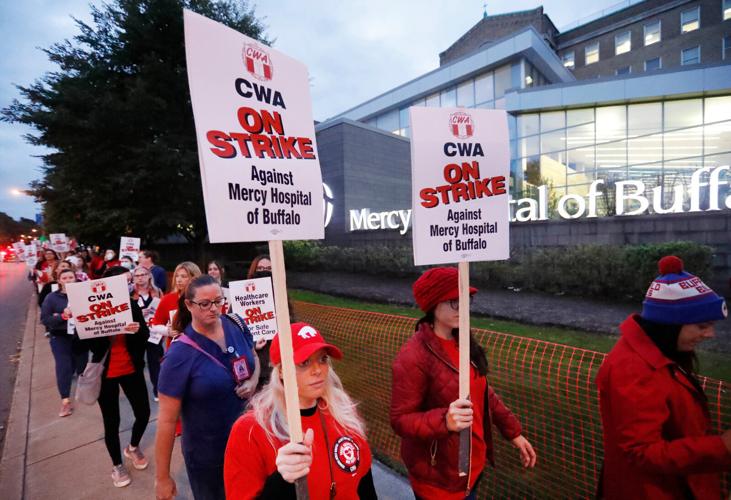
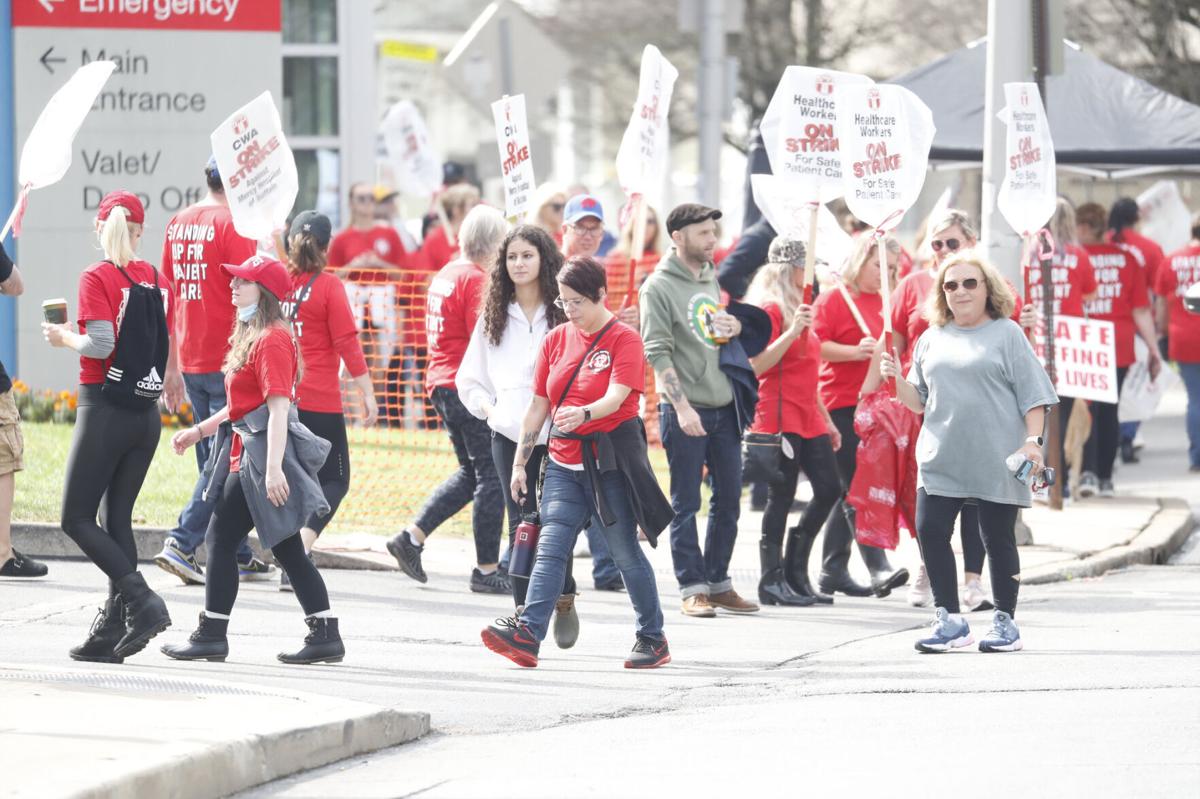
As the days pile up, so do the costs in the ongoing strike at Mercy Hospital in South Buffalo that is nearly one week in.
For Catholic Health, keeping Mercy Hospital open means paying higher wages to the replacement workers it is relying on. For each replacement worker, those costs add up to hundreds – or even thousands – of dollars in extra pay each week, compared with the workers they are replacing.
For striking workers, each day means more lost wages – and no income until strike benefits and unemployment benefits kick in.
Here's a look at the economic costs both sides are facing as the strike reaches its sixth day.
Catholic Health
The health system is paying "millions of dollars in installments" to Michigan staffing firm Huffmaster, which is providing replacement workers to keep Mercy Hospital operating.
People are also reading…
Catholic Health, CEO Mark Sullivan has said, pays the installments on Fridays, a big weekly expense that will continue as long as the strike does.
Asked at a Wednesday news conference about the strike's economic toll, Sullivan said "the impact is significant, but we have to care for our patients."
Sullivan said he was optimistic a deal with the union could be reached "very soon," and lamented that the strike - and the resulting costs - was not avoided.
Catholic Health has not disclosed the total cost thus far, but a side-by-side comparison of union wages versus job listings on Huffmaster's website provides some idea of the toll:
• A union-represented dietary aide or food service worker makes between $13.45 to $17 an hour, or a maximum of $680 over a 40-hour workweek at the high end of the scale.
Huffmaster, meanwhile, lists the same role "during a possible labor dispute at an Acute Care facility in New York State expected to occur at the end of September of early October" at $18 an hour.
So for every full-time replacement worker, that's an extra $40 to $182 in wages over a 40-hour week.
• Similarly, union environmental service workers or housekeepers also make $13.45 to $17 an hour, or up to $680 a week at the top end. A listing on Huffmaster notes an hourly pay rate of $24.
Over a 40-hour workweek, that's an extra $280 to $422 for each replacement worker.
• Some of the costliest replacements are the registered nurses, who can earn hourly wages that are three times more than the union nurses they are replacing.
Huffmaster lists registered nurse positions at a range of $115 to $150 an hour, or between $4,600 and $6,000 for a 40-hour workweek.

Hundreds of Mercy Hospital workers picket along Abbott Road early Friday morning after going on strike following a breakdown in contract talks with Catholic Health.
Meanwhile, the Communications Workers of America Local 1133 said the starting rate for its registered nurses is $32.83 an hour, while the most senior floor nurse makes $45.16, for a range of $1,313 to $1,806 for a 40-hour workweek.
So replacement registered nurses earn almost $3,300 to nearly $4,200 more than Mercy RNs over a 40-hour week.
So assuming a replacement registered nurse, at $150 an hour, worked a 40-hour workweek, that would be $6,000 in gross weekly income – the same pay rate as someone making $312,000 a year.
That's more than some of the top physicians at Catholic Health or more than its chief mission officer, according to the health system's most recent publicly available IRS Form 990.
All of the positions through Huffmaster also come with a 60-hour deployment guarantee, with provided air travel or reimbursed mileage, a daily per diem for meals and incidentals and single-room hotel accommodations. Those expenses could easily approach $100 a day for each replacement worker.
Catholic Health is continuing to pay health insurance benefits for the roughly 2,000 workers on strike.

CWA Area Director Debora Hayes provided an update Tuesday evening on negotiations with Catholic Health System, which resumed early Tuesday morning.
The hospital also has scaled back services.
For instance, all inpatient elective surgeries – a big moneymaker for hospitals – are currently suspended at Mercy Hospital. Mercy also is temporarily diverting incoming ambulances to alternate facilities and has suspended labor and delivery services, though labor and delivery continues at Sisters of Charity Hospital and Mount St. Mary's Hospital in Lewiston.
"Usually there's enough slack inside of many or most hospitals that if some surgery is deferred, it may well come back to the hospital later," said Alan Sager, a health law, policy and management professor at Boston University.
The great unknown, he noted, is how much of that profitable care is lost altogether.
That all could further stress Catholic Health's financial condition, which, like other health systems across the country, has become strained during the pandemic.
In April, Moody's Investors Service affirmed Catholic Health's investment-grade Baa2 rating, viewing the system's growth strategies and cost-reduction initiatives as capable of driving margin improvement. But, Moody's said, the rating has a negative outlook, reflecting the risk of a prolonged recovery from the pandemic. Many health care systems are in the same boat.
Moody's said it expected Catholic Health's "operating cash flow margin to remain weak in 2021 at around 2% to 3% due to the ongoing impact of the pandemic," making it hard to forecast when the system can return to the historical 5% to 6% margins.
Debbie Hayes, upstate New York area director for CWA, explains the three issues at the center of the strike by Mercy Hospital nurses.
New York State, in general, has one of the most financially challenged hospital industries in the country. The statewide average hospital operating margin is just 1.74%, compared to a national margin of around 7%, according to January data from the Healthcare Association of New York State.
“The rebuilding is going to take another year because it was the second wave of Delta variant that really put health care back on its heels," Sullivan said Sept. 30.
Based on 2020 unaudited financial statements for Catholic Health, the Moody's report noted the health system had 139 days of cash on hand, or about 4 1/2 months. But high short-term costs with less revenue coming in the door chews into that fund.
Striking workers
For the roughly 2,000 nurses, technical, service and clerical employees on strike at Mercy Hospital, the labor dispute also carries a heavy financial burden.
They're missing out on wages every day they're on strike.
The workers are not eligible to collect state unemployment benefits or CWA strike benefits until the 15th day of the walkout, according to the union.

Competition for low-wage workers has intensified as employers struggle to find entry-level and part-time employees, giving those workers more employment options to consider.
If and when those kick in, CWA's strike benefits are $300 a week after the 15th day and $400 a week after the 29th day of a strike. State unemployment benefits would pay workers a maximum of $504 a week, so the most a striking worker would receive is $804 a week after the 15th day and $904 a week after the 29th day.
"It's hard. I'm a single mom of two, and this is my only income," said Maria Morgante, who has worked at Mercy Hospital for 10 years in the dietary department.

"I can't wait for it to end," Maria Morgante said Monday on the picket line.
Morgante, a 38-year-old Blasdell resident, said she makes $16.25 an hour and would like to see wages rise in her department so they can retain staff and alleviate some of the shortages at the hospital.
Aside from the financial cost, being on strike also takes an emotional toll.
Morgante said she not only passes food trays at the hospital but she also spends time with the patients, listening and supporting them.
"I can't wait for it to end," Morgante said Monday on the picket line. "I want to get back inside. I want to be where I need to be. I'm like lost without being with my patients and my family. We're all like a big family."
And even when a deal is reached on a new collective bargaining agreement, it will take time for the workers to get back inside Mercy Hospital because the union and Catholic Health will have to negotiate a back-to-work agreement.
Long-term cost
Catholic Health must weigh the short-term blow of paying replacement workers versus the long-term cost of a multiyear contract on hospital finances. The union must measure the impact of the loss of wages now against the longer-term gains that may come with a settlement.
The union and the health network also have to consider the lingering effect on the culture at Mercy Hospital.
More than 400 miles east on Interstate 90, a nurses' strike at Saint Vincent Hospital in Worcester, Mass., has been ongoing for more than 200 days.
The strike's primary issue has been staffing, and while the two sides reportedly reached an agreement on that topic in August, negotiating a back-to-work deal has extended the dispute since the hospital hired many replacement nurses on a permanent basis.
Sager, the Boston University professor, said the nursing shortage combined with the stresses of clinical work in patient units over the last 18 months have created an "explosive mixture" in health care.
"The last thing an individual hospital needs is long-term injury to nurse-hospital relationships," Sager said. "The effect of a short-term strike can mend over time, especially if the two sides historically have had a good relationship."