

When Shelby Marmor started as a nurse at Mercy Hospital five years ago this February, she cared for four or five patients during a shift.
Then a pandemic happened, mentally and physically exhausting nurses in the South Buffalo facility and across the country as they worked long hours, scrambled to take care of patients and worried about spreading the virus to others.
Since then, Marmor watched as colleagues took early retirement, chased higher wages as travel nurses or, emotionally drained, quit health care altogether.
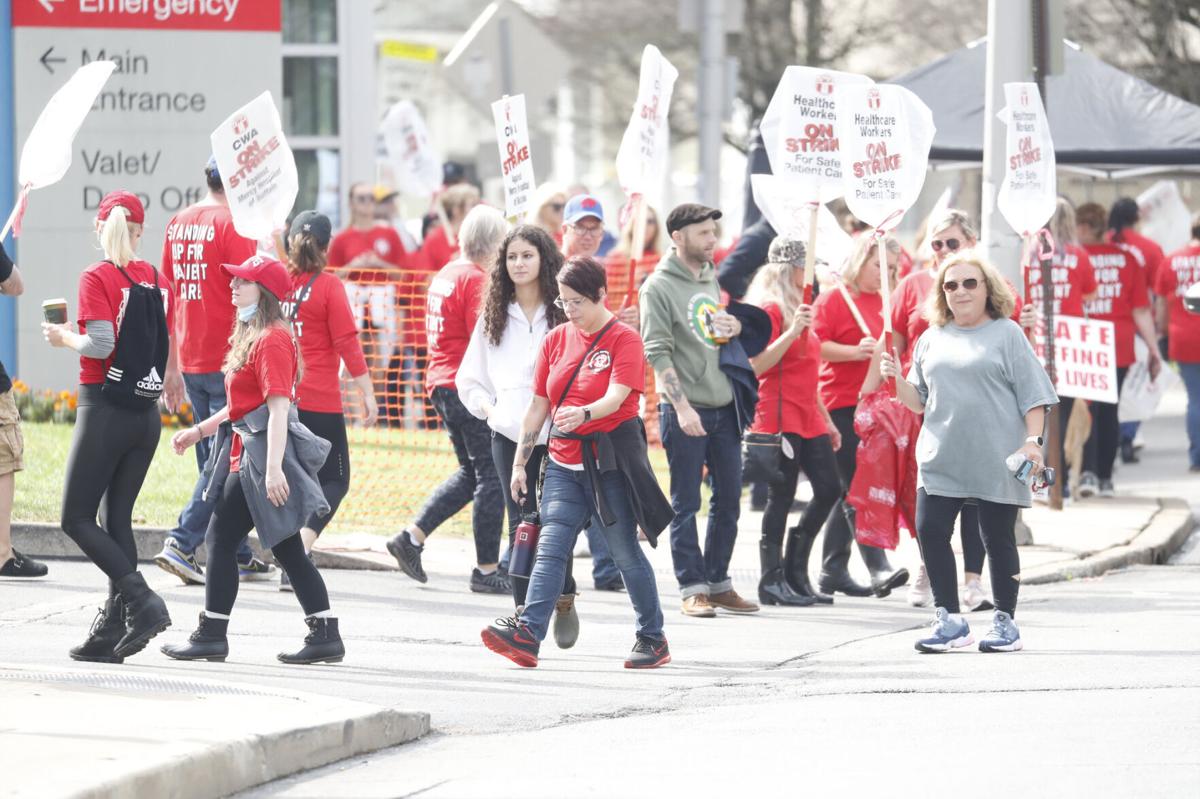
Suddenly, Marmor was caring for as many as 10 patients during a shift, part of a staffing shortage that is the primary reason why she and about 2,000 health care workers at Mercy Hospital decided to strike more than a week ago.
The ongoing worker shortage, especially for nurses, could also provide leverage for the Communications Workers of America Local 1133 as they continue to negotiate with Catholic Health System, hospital employees and labor experts say.
People are also reading…
"I think we definitely do have leverage," said Marmor, a 31-year-old Orchard Park resident. "I think the strike needed to happen so Catholic Health would take us seriously."
The pandemic has pushed workers throughout the economy to do more and stay on the job in uncertain times to meet the heightened demand for labor, bolstering their confidence in deciding to go on strike. At the same time, a labor shortage, which has has forced many companies to boost wages in the battle for workers, means it's more difficult to find new employees to take their place.
Just this week, about 1,400 cereal factory workers at Kellogg Co. started picketing in Michigan, Pennsylvania, Nebraska and Tennessee, the first time the company's U.S. cereal workers have gone on strike since 1972. That followed strikes this summer by hundreds of Frito-Lay workers in Kansas and about 1,000 employees at Nabisco plants in five states.
Closer to home, workers at several Buffalo-area Starbucks locations are trying to organize a union, a closely watched effort in the retail industry.

For Catholic Health, keeping Mercy Hospital open means paying vastly higher wages to replacement workers. For striking workers, each day means more lost wages.
So far this year, there have been 224 labor strikes across the country, according to the Cornell-ILR Labor Action Tracker that started documenting strikes late last year. Of those, 30 are in health care and social assistance, including the Mercy Hospital strike and a nurses' strike at Saint Vincent Hospital in Worcester, Mass., that started in March.
While the Labor Action Tracker doesn't have a full year of data for 2020, the U.S. Bureau of Labor Statistics said there were just eight major work stoppages across the country in 2020, the third-lowest number since 1947. A major work stoppage involves at least 1,000 workers and lasts at least one shift during a work week.
As of the BLS's last update Sept. 8, there have been nine major work stoppages so far this year – Mercy Hospital will add to that tally. In 2019, by comparison, there were 25 major work stoppages, the highest number recorded since 2001.
“They know there’s money out there, and that it could be shared with them, across all industries," said Cathy Creighton, a former labor attorney and the director of the Cornell University Industrial and Labor Relations School's Buffalo office.
While just 10.8% of U.S. workers belonged to unions in 2020, down from as high as 20% in 1983, Creighton pointed to a Gallup poll released last month that found 68% of Americans approve of labor unions – the highest reading measured since 71% in 1965.
Nursing shortage
Catholic Health has maintained it is actively recruiting to fill jobs and has faced some of the same challenges as other companies across the country trying to hire in a tight labor market.
The health system also has regularly pointed out that staffing shortages are not specific to its hospitals. This week, Catholic Health echoed a recent Morning Consult survey of 1,000 U.S. health care workers that found 18% of them had quit their jobs during the pandemic.
“This is a national staffing crisis,” Catholic Health CEO Mark Sullivan said Wednesday. “Health care, overall, is broken.”

Mercy Hospital of Buffalo was caring for less than half as many patients on Wednesday than i…
And the biggest challenge facing hospitals is filling registered nurse positions as well as those directly supporting them, such as certified nurse assistants, licensed practical nurses and medical technicians, according to a Sept. 12 report from the Healthcare Association of New York State. The association's survey, which more than 60 of its members responded to, noted a registered nurse vacancy rate of 25%, while other rates varied by position but averaged 19%.
“Is this a case of the union seizing an opportunity associated with a national shortage of nurses for acute and patient care to leverage a better deal, or is this a case of a hospital system that lacks the money or the supply of nurses to staff the way they know they should?” said Alan Sager, health law, policy and management professor at Boston University.
“The combination of the nursing shortage giving some leverage to nurses combined with the stresses of clinical work in patient units over the last 18 months constitutes an explosive mixture," he said.
In its proposal last week, Catholic Health said it would hire 258 full-time employees, add staffing 10% above the average daily census and spend $20 million, including bonus pay for employees who pick up an additional shift when staffing targets aren’t met.
While the pandemic hurt health care personnel retention, it also put a dent in hospital finances, so Sullivan and the health system also are looking to ensure the future financial viability of Catholic Health in a new contract.
What the CWA is looking for is "very specific" nurse-to-patient ratios as well as staffing ratios for other positions throughout the hospital, CWA area director Debora Hayes said Tuesday.
In an update to members Friday, the union said it received a comprehensive proposal from Catholic Health at 10 p.m. Thursday, noting, "We are still very far apart."
Importantly, however, the update noted that the two sides "have moved closer on staffing."

CWA Area Director Debora Hayes provided an update Tuesday evening on negotiations with Catholic Health System, which resumed early Tuesday morning.
That would be good news for all sides, including Mercy Hospital nurses like Marmor who are anxiously awaiting news on the picket line and hoping to get back to their patients.
But what she and her co-workers went through over the last 18 months is still fresh in her mind. She remembers the personal protective equipment that she would sweat through within the first 30 minutes of her shift, or having to hunt down bleach wipes because there was no one from environmental services available to clean up an accident on the floor.
In April 2020, she even moved out of her parents' house for a few weeks, worried she could get them sick.
As the months went on, Marmor said she would have to constantly fill out short staffing forms.
"I'm hoping that when I go into work, I'm taking care of four to five patients and not 10 patients," she said.
'Banding together'
At the start of the pandemic, Mary Astyk remembers the feeling of the unknown, dealing with a novel virus and everything that came with it.
For her, a registered nurse in the dialysis department at Mercy Hospital, what it ultimately meant was transferring to where she was needed: St. Joseph Campus, which had been turned into a Covid-19-only hospital. What followed were seven-day work weeks that could last 15 hours a day, since, Astyk said, she was one of the only dialysis nurses.
She wondered how long it could go on.
And now she's wondering the same thing, hoping Catholic Health and the union will reach an agreement to bolster staffing.
"We’re striking because we believe so strongly that we need change to happen, and we need to show them that we’re going to band together until this change is put into effect, and we hope they work with us," said Astyk, a 41-year-old West Seneca resident.
If changes aren't made, she believes more people will get burned out, exacerbating the ongoing shortages.
In fact, that's what happened to her. After her stint at St. Joseph Campus, Astyk returned to Mercy Hospital for the second and third waves of the pandemic. Sometimes her three kids wouldn't see their mom for three days in a row.
So last month, she made the switch from dialysis nurse to case management, working with doctors, floor nurses and others to provide safe discharge plans for patients.
It's going well, but she hopes to one day return to being a nurse – something she loved.
But not until changes are made.
"We banded together during the pandemic," Astyk said, noting she felt the same solidarity at Thursday evening's union vigil outside Mercy.
"Looking at everyone who was there, we are strong and we are banding together so that we can do what we do best and that is providing our patients with the best care possible."


